In an era of shifting economic landscapes, outdated financial habits can quietly erode your long-term wealth. This comprehensive guide explores five critical shifts necessary for modern financial stability, as highlighted by TimelyBills. From the high costs of relying on overdrafts to the strategic importance of high-yield savings, we break down actionable steps to safeguard your capital. Readers will learn the mathematical reality of interest rates, the role of automation in maintaining credit health, and the protective necessity of adequate insurance coverage. By moving away from reactive money management and adopting proactive, tech-forward strategies, individuals can better navigate inflation and market volatility. This article serves as a roadmap for anyone looking to modernize their personal finance routine, ensuring their daily habits align with contemporary economic demands and long-term fiscal security.
The transition from traditional banking to a digitally integrated financial ecosystem has changed more than just how we spend money—it has changed the rules of how we should manage it. Maintaining financial health in 2026 requires a departure from “business as usual.” To achieve true fiscal resilience, one must identify and eliminate legacy habits that no longer serve a modern portfolio.
Based on the latest data from leading budget planners, here are the five money habits to leave in the past and the professional strategies to replace them with.
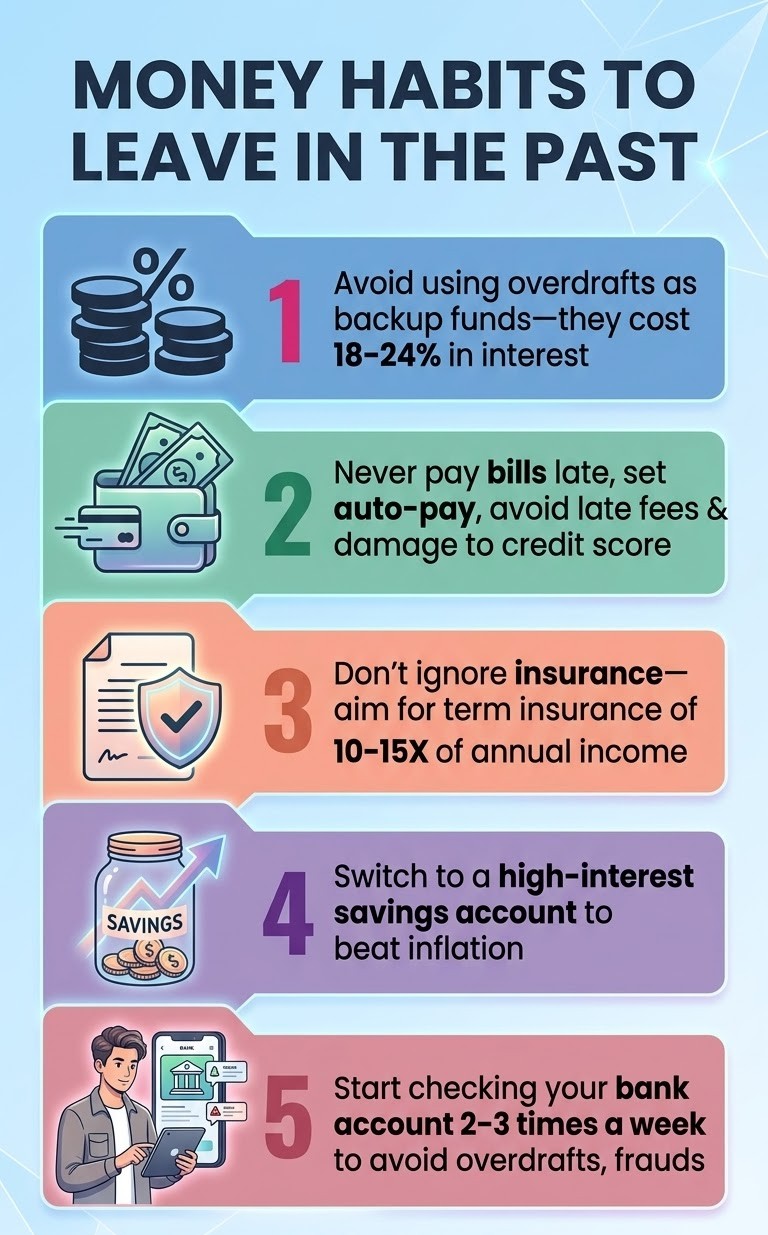
1. Eliminating Overdraft Reliance
Many individuals historically viewed overdraft protection as a safety net. However, using an overdraft as a “backup fund” is one of the most expensive ways to manage liquidity. In current market conditions, overdrafts can cost between 18% and 24% in interest.
When compared to traditional personal loans or credit lines, this interest rate is predatory. To move past this habit, financial experts recommend building a dedicated emergency fund. By treating an overdraft as a high-interest debt rather than a secondary balance, you preserve your cash flow for growth rather than service fees.
2. The Shift to Total Automation
The habit of manual bill payment is a relic of the past that introduces unnecessary risk. Late payments are not merely a nuisance; they trigger immediate fees and cause significant, long-term damage to credit scores.
Modern personal finance revolves around auto-pay systems. Setting up recurring payments ensures that “life” doesn’t get in the way of your creditworthiness. By automating the essentials, you create a baseline of financial reliability that allows you to focus on more complex investment strategies.
3. Modernizing Insurance Standards
Ignoring insurance or maintaining inadequate coverage is a risk that few can afford. The current standard for comprehensive protection involves shifting toward term insurance that accounts for your total economic value.
The benchmark for modern financial planning is aiming for term insurance of 10–15X your annual income. This isn’t just a safety precaution; it is a foundational pillar of an estate. Transitioning from “just enough” coverage to “strategically sufficient” coverage ensures that unforeseen events do not derail decades of wealth accumulation.
4. Beating Inflation with High-Yield Vehicles
Leaving large sums of capital in a standard, low-interest checking or savings account is a habit that effectively loses money over time. As inflation fluctuates, stagnant cash loses its purchasing power.
The modern alternative is the high-interest savings account (HYSA). By switching to accounts that offer competitive APY (Annual Percentage Yield), your dormant cash works to offset the rising cost of living. In a “MySavings” context, the goal is to ensure every dollar is optimized for the highest possible risk-adjusted return.
5. Proactive Account Surveillance
Finally, the “set it and forget it” mentality regarding bank balances must be replaced with active monitoring. Experts now suggest checking bank accounts 2–3 times a week.
This frequent oversight serves two critical purposes:
- Fraud Prevention: In an age of digital transactions, early detection of unauthorized charges is the only way to ensure full recovery of funds.
- Overdraft Avoidance: Consistent check-ins provide a real-time pulse on your spending, allowing for immediate adjustments before balances dip into negative territory.
Financial evolution is a continuous process. By leaving these five outdated habits in the past—overdraft reliance, manual payments, under-insurance, low-yield saving, and passive monitoring—you position yourself for a more secure and prosperous future. Modern finance is about precision, and these shifts provide the accuracy needed to thrive.