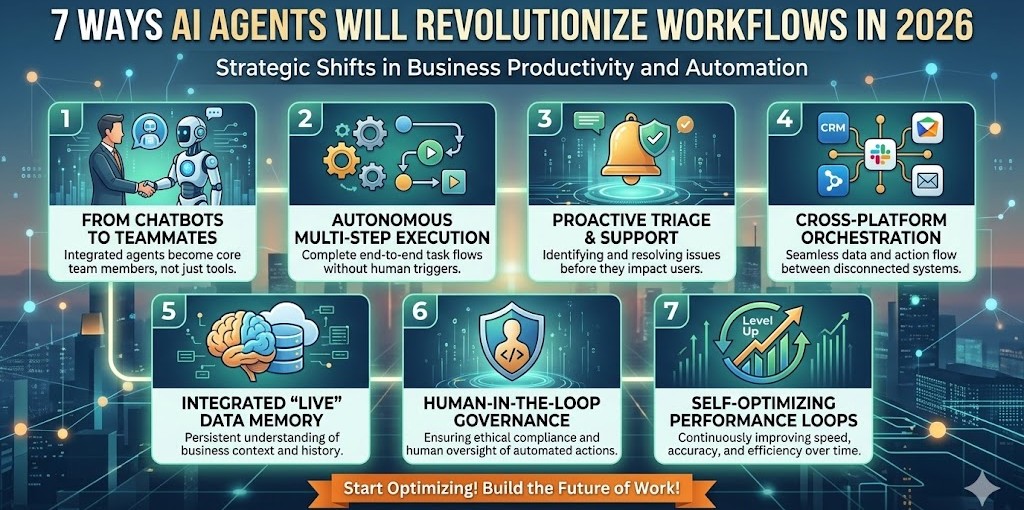
Discover how AI Agents will revolutionize your professional life by 2026. Learn about the 7 ways these digital partners create a seamless, magical workflow.
Imagine waking up to a workday where your most tedious tasks have already been handled before you even pour your first cup of coffee. By the year 2026, the widespread implementation of AI Agents will transform this futuristic dream into a standard reality for professionals across the globe. These sophisticated digital entities are moving far beyond the capabilities of simple chatbots, evolving into proactive partners that understand context, anticipate needs, and execute complex sequences of actions without constant supervision. Instead of spending your energy on the “work about work,” you will find yourself navigating a landscape defined by high-level strategy and creative problem-solving. This shift represents more than just a minor productivity boost; it is a fundamental redesign of the human-software relationship.
Hyper-Personalized Assistance and Intent-Based Scheduling
The most immediate change you will notice in 2026 is the disappearance of the traditional “to-do list” as we know it today. AI Agents will transition from being reactive tools to proactive organizers that understand the nuances of your professional and personal life. These agents will not just look at your calendar; they will understand the intent behind your appointments and the cognitive load required for each task.
The End of the Scheduling Nightmare
In the current landscape, finding a meeting time that suits five different stakeholders can take dozens of emails. In 2026, your agent will communicate directly with the agents of your colleagues to negotiate the best possible time based on everyone’s energy levels and historical productivity patterns. This happens in the background, ensuring that your peak focus hours are protected from unnecessary interruptions.
Prioritization Through Contextual Awareness
Your digital partner will serve as a sophisticated filter for your inbox and notifications. By analyzing the urgency of incoming requests and cross-referencing them with your current project deadlines, the agent can draft responses or even solve minor issues autonomously. This ensures that when you sit down to work, you are presented with only the most critical information that requires human intervention.
– Automatic conflict resolution across multiple time zones.
– Intelligent “do not disturb” modes that activate based on task complexity.
– Proactive reminders that include all relevant files and background research for upcoming calls.
– Real-time adjustment of your daily schedule when unexpected high-priority tasks emerge.
Orchestrating Ecosystems of Integrated AI Agents
By 2026, we will move away from isolated applications toward a cohesive ecosystem where different specialized agents work together. This “multi-agent” approach allows for much more complex workflows than a single general-purpose model could handle. These AI Agents will act as a connective tissue between your CRM, project management tools, and communication platforms.
The Rise of the Agentic Workflow
Instead of you manually exporting data from a spreadsheet to create a report in a slide deck, an orchestrator agent will delegate tasks to specialized sub-agents. One agent might focus on data retrieval, another on trend analysis, and a third on visual design. You simply provide the goal, and the ecosystem handles the execution across various software boundaries.
Interoperability Across Legacy and Modern Systems
One of the magic elements of 2026 workflows is the ability of these agents to interact with older software that lacks modern APIs. Through advanced computer vision and robotic process automation, agents can “see” and “click” through legacy interfaces just like a human would. This removes the friction often found in digital transformation projects, allowing for a seamless flow of data throughout the entire organization.
1. A project manager agent identifies a delay in a software development sprint.
2. It triggers a communication agent to notify stakeholders with a revised timeline.
3. Simultaneously, it tasks a resource agent to look for available contractors to fill the gap.
4. The user is presented with a final recommendation and three pre-vetted options for approval.
Predictive Problem Solving and Risk Mitigation
Wait-and-see management styles will become obsolete as AI Agents provide a layer of predictive intelligence over every project. These systems will be constantly running simulations and analyzing data patterns to identify potential roadblocks before they manifest as actual problems. This proactive stance turns every professional into a proactive strategist rather than a reactive fire-fighter.
Identifying Bottlenecks Before They Occur
By monitoring the velocity of work across a team, an agent can predict when a deadline is at risk. It doesn’t just send an alert; it analyzes the cause. If the bottleneck is a pending approval from a specific executive, the agent can gently nudge that person or suggest an alternative workflow to keep the project moving. This level of foresight is a hallmark of the agentic era.
Advanced Financial and Operational Forecasting
For business owners and managers, agents will provide real-time “what-if” analysis. If you are considering a new marketing spend, your agent can simulate the impact on your cash flow and inventory levels six months down the line. This type of deep-dive analysis, which used to take a team of analysts weeks, will be available in seconds through intuitive natural language queries.
According to research by high-authority firms like Gartner, agentic AI is one of the top strategic technology trends that will redefine the competitive landscape in the coming years. Organizations that embrace these predictive capabilities will significantly outperform those relying on traditional, historical reporting methods.
Redefining Content Creation Through Collaborative Intelligence
The act of creation in 2026 will be a collaborative dance between human intuition and machine execution. AI Agents will no longer just generate “placeholder” text or basic images; they will understand a brand’s unique voice, historical preferences, and long-term goals. This allows for the production of high-quality assets at a speed that was previously unimaginable.
From Blank Page to Polished Draft
The “blank page syndrome” will be a relic of the past. When you start a new project, your agent will have already gathered the necessary research, outlined the core arguments, and gathered relevant case studies from your company’s internal database. You act as the editor-in-chief, refining the narrative and ensuring the emotional resonance of the content while the agent handles the heavy lifting of structure and data integration.
Dynamic Asset Personalization
In marketing and sales, agents will enable mass personalization at scale. Instead of one campaign for a thousand people, agents can generate a thousand variations of a campaign, each tailored to the specific needs, pain points, and reading habits of an individual prospect. This level of personalization makes every interaction feel bespoke and high-touch without increasing the workload on the human team.
– Instant translation and localization of content for global audiences.
– Automatic generation of social media snippets from long-form reports.
– Real-time feedback on content tone and alignment with brand guidelines.
– Automated fact-checking against trusted internal and external sources.
Autonomous Data Analysis and Executive Decision Support
In 2026, the barrier between “data” and “insights” will finally crumble. Most professionals currently struggle with “dashboard fatigue,” where they have access to plenty of charts but little clarity on what actions to take. AI Agents will solve this by acting as a bridge, translating complex data sets into actionable narratives that support executive decision-making.
The Shift from Describing to Prescribing
Traditional analytics tell you what happened. Advanced agents tell you why it happened and what you should do next. If sales are down in a specific region, the agent won’t just show a downward red arrow. It will analyze competitor pricing, local economic shifts, and internal lead response times to suggest three specific interventions, ranked by their likely return on investment.
Democratizing Data Science
You won’t need a degree in data science to perform complex statistical analysis. Through natural language interfaces, any employee can ask their agent to “find the correlation between our customer support response times and our churn rate over the last three years.” The agent performs the regression analysis, creates the visualizations, and explains the findings in plain English.
1. Query: “Why is our project over budget?”
2. Agent Action: Scans invoices, time-tracking software, and vendor contracts.
3. Analysis: Identifies that a specific vendor increased rates by 15% without a formal contract update.
4. Resolution: Drafts an email to the vendor requesting a credit based on the original agreement.
Real-Time Knowledge Synthesis and Corporate Memory
One of the biggest hidden costs in modern business is the loss of institutional knowledge. When an employee leaves, their expertise often goes with them. In 2026, AI Agents will serve as the “brain” of the organization, capturing, indexing, and synthesizing every piece of communication, every decision, and every project outcome into a searchable, living corporate memory.
Finding the Needle in the Digital Haystack
Imagine asking your agent, “Why did we decide against using that specific supplier in 2023?” Instead of digging through old email threads, the agent retrieves the specific meeting transcript, the relevant comparison spreadsheet, and the final summary memo. It provides a concise explanation of the decision-making process, ensuring that the company doesn’t repeat past mistakes.
Onboarding at the Speed of Light
New hires will no longer spend weeks “getting up to speed.” An onboarding agent can provide a personalized curriculum based on the specific role, answering questions about company culture, technical workflows, and project histories in real-time. This reduces the burden on mentors and managers while empowering new employees to contribute more quickly.
– Automatic tagging and categorization of all company documents.
– Real-time transcription and summarization of every internal meeting.
– Intelligent cross-referencing of similar projects to encourage internal collaboration.
– Proactive identification of subject matter experts within the organization.
Transitioning to an Agent-First Work Culture
As AI Agents become deeply embedded in our daily lives, the skills required for professional success will shift. The value of a worker will no longer be measured by their ability to perform repetitive tasks or manage complex software interfaces. Instead, the focus will move toward “agent orchestration”—the ability to direct, audit, and refine the outputs of digital partners.
The Human-in-the-Loop Philosophy
While agents handle the execution, humans remain the ultimate decision-makers. The “magic” of the 2026 workflow is not that the human is replaced, but that the human is elevated. You will spend more time on high-stakes negotiations, ethical considerations, and strategic pivots that require a level of empathy and nuanced judgment that machines cannot replicate.
Preparing for the Transformation
To thrive in this new environment, professionals must develop a “growth mindset” regarding technology. This involves learning how to give clear instructions to agents, understanding the limitations of AI models, and maintaining a critical eye on the data they provide. By 2026, “prompting” will have evolved into “orchestration,” where you manage a fleet of digital assistants to achieve your goals.
Developing Ethical Frameworks
As agents take on more autonomy, organizations will need to establish clear ethical guidelines. This includes transparency about when an agent is communicating with a client and ensuring that the data used by agents is free from bias. Establishing these frameworks early will be a key differentiator for successful companies in the late 2020s.
Fostering Creative Problem Solving
With the “how” of work largely automated, the “why” and “what” become more important. Training programs will shift toward fostering creativity, lateral thinking, and emotional intelligence. These are the traits that will allow humans to add unique value in an increasingly automated world.
The transition to a workflow powered by AI Agents represents one of the most significant shifts in the history of work. By 2026, these digital partners will have eliminated the friction of scheduling, integrated our fragmented software ecosystems, and provided us with the predictive insights needed to stay ahead of the curve. This evolution is not about doing more work in less time; it is about changing the nature of work itself. We are moving toward an era of “magical” productivity where your tools finally understand you, rather than you having to understand your tools.
As we look toward this future, the most important step you can take today is to begin experimenting with the agentic tools already entering the market. By building your “orchestration” muscles now, you will be perfectly positioned to lead in the automated landscape of tomorrow. The magic of 2026 is already being built, and it is time to start imagining how you will spend the time it gives back to you.
For more insights or collaboration opportunities, visit www.agentcircle.ai.