Debt can feel overwhelming, but the right repayment strategy can transform financial stress into a structured path toward freedom. This comprehensive guide breaks down two of the most effective debt elimination methods: the Debt Avalanche and the Debt Snowball. You will discover how the Avalanche method focuses on minimizing total interest by targeting high-rate debts first, while the Snowball method builds psychological momentum through quick wins by clearing smaller balances. The article also explores behavioral finance insights, explaining why emotional motivation often outweighs pure mathematical logic in real-world decision-making. Additionally, you’ll learn a step-by-step action plan to audit your debts, choose the right strategy, and build a sustainable repayment system. Whether you prefer logic-driven optimization or motivation-based progress, this guide helps you design a personalized debt repayment blueprint that accelerates your journey toward financial stability and long-term money freedom.
⚖️ Debt Avalanche vs Debt Snowball: The Core Comparison
When it comes to eliminating debt efficiently, two dominant repayment strategies stand out: the Debt Avalanche method and the Debt Snowball method. Both aim to help individuals become debt-free, but they approach the problem from completely different perspectives.
📉 Debt Avalanche Method (Mathematical Optimization)
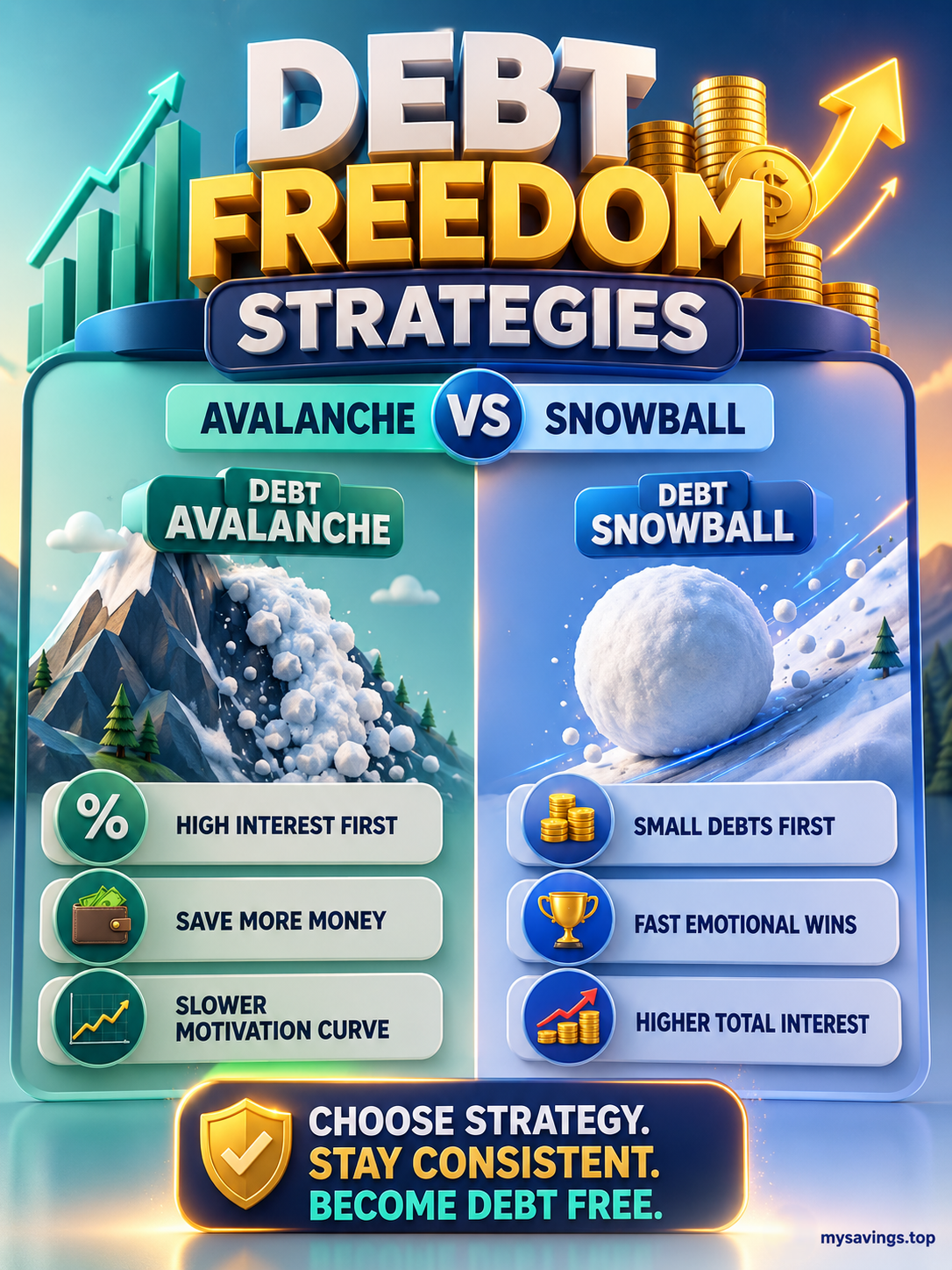
The Debt Avalanche method prioritizes paying off debts with the highest interest rates first while making minimum payments on all other debts.
This method is based on a simple financial principle:
High-interest debt grows faster and becomes more expensive over time.
Key Advantages:
- Minimizes total interest paid
- Reduces long-term repayment cost
- Mathematically most efficient strategy
Key Challenge:
- Progress may feel slow at the beginning
- Requires strong discipline and patience
🟢 Debt Snowball Method (Behavioral Momentum)
The Debt Snowball method focuses on paying off the smallest debts first, regardless of interest rate.
Once a small debt is cleared, the freed-up payment is rolled into the next smallest debt, creating a “snowball effect.”
Key Advantages:
- Fast emotional wins boost motivation
- Builds strong repayment momentum
- Easier to stay consistent
Key Challenge:
- May cost more in total interest
- Not mathematically optimal
📊 Side-by-Side Comparison
| Feature | Debt Avalanche | Debt Snowball |
|---|---|---|
| Focus | Highest interest rate | Smallest balance |
| Efficiency | High | Moderate |
| Motivation | Slower start | Fast wins |
| Total cost | Lower interest paid | Higher interest paid |
| Best for | Logical planners | Motivation-driven users |
🧠 The Psychology Behind Debt Repayment
Debt repayment is not only a financial challenge—it is a behavioral challenge. Many individuals fail not because of poor math, but because of inconsistent behavior.
🎯 Why Motivation Often Beats Mathematics
Even if the Avalanche method saves more money, it requires delayed gratification. Human behavior, however, naturally favors immediate rewards. The Snowball method leverages this psychological reality by providing quick wins.
⚠️ The Danger of Over-Planning
A common mistake is building a perfect repayment plan but failing to execute it. Over-analysis often leads to procrastination, especially when results are not immediately visible.
🧩 Understanding Your Financial Personality
To choose the right method, consider:
- Do you need visible progress to stay motivated?
- Or are you comfortable focusing on long-term efficiency?
- Do you struggle with consistency or patience?
Your answer determines whether you should prioritize psychological momentum or mathematical optimization.
🛠️ Step-by-Step Guide: Building Your Debt Repayment Plan
A structured approach can transform confusion into clarity. Below is a practical roadmap to build your debt repayment system this month.
📊 Step 1: Audit All Debts
Start by listing all outstanding debts:
- Credit cards
- Personal loans
- Vehicle loans
- Student loans (if applicable)
For each debt, record:
- Total balance
- Minimum monthly payment
- Interest rate
This creates a full financial snapshot and eliminates uncertainty.
⚖️ Step 2: Choose Your Strategy
Now select your repayment method:
Choose Debt Avalanche if:
- You want to minimize total interest
- You are disciplined and patient
- You prefer data-driven decisions
Choose Debt Snowball if:
- You need motivation and quick wins
- You struggle with consistency
- You want visible progress early
💳 Step 3: Build a Monthly Payment System
Set up a fixed monthly repayment structure:
- Pay minimum amounts on all debts
- Allocate extra funds to priority debt
- Automate payments where possible
Automation reduces emotional decision-making and ensures consistency.
📅 Step 4: Create a Budget Workflow
A strong repayment plan requires a reliable budget:
- Track income vs expenses
- Cut unnecessary spending
- Redirect savings toward debt repayment
Even small adjustments create long-term impact.
📈 Step 5: Use a Debt Tracker System
Tracking progress is essential for motivation.
You can use:
- Spreadsheet trackers
- Printable debt logs
- Mobile budgeting apps
The key principle is consistency over perfection. Visibility of progress reinforces discipline.
🔁 Step 6: Reinforce Monthly Review Cycles
At the end of every month:
- Review remaining balances
- Adjust strategy if needed
- Celebrate milestones (small or large)
This creates a feedback loop that strengthens financial discipline.
🔄 Choosing the Right Method for Maximum Success
There is no universal “best” strategy. The correct choice depends on behavioral tendencies.
- If you are analytical → Avalanche performs better long-term
- If you are emotionally driven → Snowball ensures consistency
- If you are mixed → Hybrid approach can combine both strategies
A hybrid model may look like:
- Start with Snowball for motivation
- Switch to Avalanche for long-term savings
🏁 Final Thoughts
Debt elimination is not just about numbers—it is about sustainable behavior. The most effective strategy is the one you can consistently follow. Whether you choose the precision of the Avalanche method or the momentum of the Snowball method, success depends on discipline, structure, and tracking.
Financial freedom is achieved not through perfection, but through consistent action over time.