Best Ways to Invest $1,000 for the Best Returns in 2026
Investing $1,000 in 2026 can absolutely move the needle if you focus on the right mix of growth, diversification, fees, and time horizon. The “best returns” usually come from taking appropriate risk (not reckless risk), staying invested, and avoiding high-cost products.
Below are the best ways to invest 1000 dollars for strong potential returns in 2026, with practical steps, examples, and what to watch out for.
Quick Take: What “Best Returns” Really Means in 2026
No one can guarantee the highest return in a single year. But you can maximize your odds by choosing investments that historically deliver strong long-term performance and are positioned well for 2026 trends while keeping costs low.
Key factors that influence your returns:
- Time horizon: 6–12 months vs. 3–10 years changes everything
- Risk tolerance: higher potential return = higher volatility
- Fees & taxes: small costs compound into big losses over time
- Diversification: reduces the chance of a single mistake wiping you out
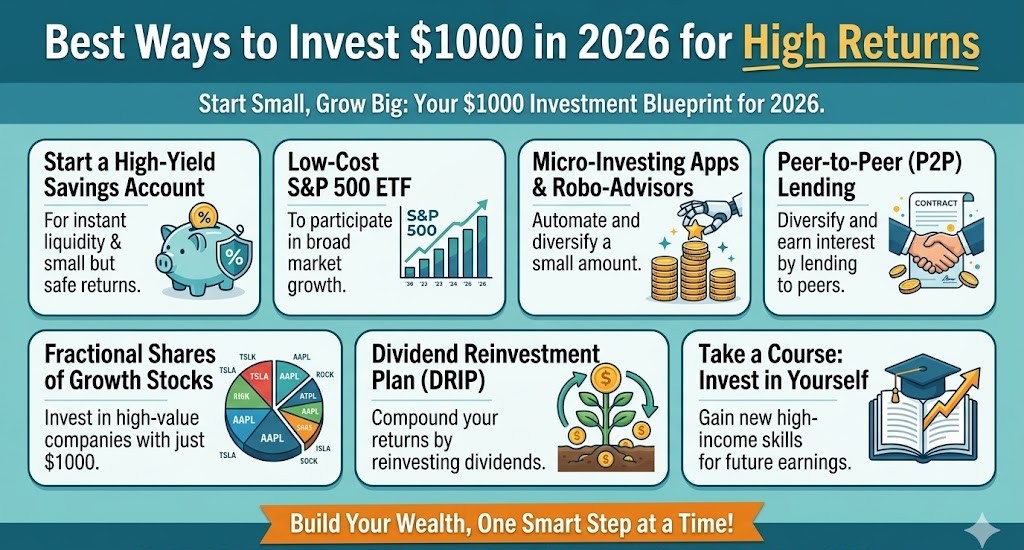
1) Low-Cost Index Funds (Best All-Around Choice for Most People)
If you want the best balance of return potential + simplicity, index funds and ETFs are hard to beat.
Why it can deliver strong returns
- Broad exposure to the market (hundreds or thousands of companies)
- Extremely low fees compared to actively managed funds
- Historically strong long-term performance
Best index fund options for $1,000 in 2026
- S&P 500 ETF (large U.S. companies)
- Total Stock Market ETF (broader U.S. exposure)
- Global/International ETF (diversifies beyond the U.S.)
Example allocation (simple):
- 80% total stock market ETF
- 20% international ETF
Best for: Beginners, long-term investors, retirement investing
Main risk: Market drops in the short term returns aren’t guaranteed year-to-year
2) AI & Tech ETFs (Higher Upside, Higher Volatility)
AI-related growth trends are expected to remain major themes through 2026. Rather than picking individual winners, many investors prefer AI or tech-focused ETFs for diversification.
Why it can perform well in 2026
- Continued enterprise AI adoption
- Productivity gains and infrastructure growth (chips, cloud, software)
- Potential tailwinds from innovation cycles
Best for: Investors comfortable with volatility and 3–5+ year horizon
Main risk: Overvaluation, sector drawdowns, hype cycles
Tip: Keep a “thematic” ETF as a slice of your portfolio (e.g., 10–30%), not the whole thing.
3) Dividend Growth ETFs (Solid Returns + Cash Flow Potential)
Dividend investing isn’t just about income it can also be a strong total-return strategy, especially when focusing on dividend growth (companies that consistently raise dividends).
Why it’s a good 2026 strategy
- Can be more resilient during choppy markets
- Dividends can be reinvested to compound faster
- Often tilted toward profitable, established businesses
Best for: Investors who want stability + growth
Main risk: Dividend funds can lag high-growth markets during bull runs
4) High-Yield Savings Accounts or Money Market Funds (Best “No-Regret” Option)
If your time horizon is short (like 6–18 months), the “best return” may actually be not losing money. A high-yield savings account (HYSA) or money market fund can be ideal for parking $1,000 while still earning interest.
Why it works in 2026
- Low risk and high liquidity
- Great for emergency funds or near-term goals
- Helps you avoid selling investments at a bad time
Best for: Emergency fund, short-term goals, risk-averse investors
Main risk: Returns may not beat inflation over time
5) U.S. Treasury Bills (T-Bills) (Low Risk, Often Competitive Yields)
T-bills are short-term government securities and are among the lowest-risk investments available.
Why T-bills can be attractive in 2026
- Backed by the U.S. government
- Predictable returns if held to maturity
- Often competitive vs. bank savings rates
Best for: Capital preservation with a bit more structure than savings
Main risk: Opportunity cost if stocks surge
6) Roth IRA Contribution (Best “Return on Taxes” You Can Get)
If you have earned income and qualify, putting $1,000 into a Roth IRA can be one of the smartest moves because the gains can grow tax-free.
Why it’s powerful
- Tax-free growth and withdrawals in retirement (rules apply)
- You can invest in ETFs inside the Roth IRA
- Great way to build long-term wealth with small amounts
Best for: Retirement investing
Main risk: Same market risks as your investments, but with major tax advantages
7) Invest in Yourself (Often the Highest ROI)
This isn’t hype skills can generate returns far beyond what markets can do with $1,000.
High-ROI ways to invest $1,000 in 2026
- Certifications in data analytics, cybersecurity, cloud, AI tools, project management
- Portfolio projects + a personal website
- Industry-specific training that leads to a raise or new role
Best for: Career growth, entrepreneurs, students
Main risk: Requires time and execution; ROI isn’t automatic
8) Micro-Investing + Automated DCA (Best Habit Builder)
If you’re nervous about investing all at once, use dollar-cost averaging (DCA): invest smaller amounts over time.
Why it helps in 2026
- Reduces the stress of market timing
- Builds consistent investing habits
- Works well with ETFs and index funds
Example DCA plan:
- Invest $250/week for 4 weeks into a broad market ETF
Best for: New investors, anyone worried about volatility
Main risk: If markets rise quickly, lump-sum investing may outperform
9) Individual Stocks (Only If You Know What You’re Doing)
Picking individual stocks can outperform but it can also underperform badly. With $1,000, concentration risk is real.
When it makes sense
- You already have diversified index funds
- You’re willing to research financials and long-term business fundamentals
- You can hold through volatility
Best practice: Keep individual stocks to 10–20% of your total portfolio until you gain experience.
10) Crypto (High Risk, High Potential Not for “Best Guaranteed Returns”)
Crypto can produce huge gains, but it’s speculative and volatile. If you invest $1,000 here, treat it like a high-risk bet, not a core plan.
Smarter way to approach crypto
- Keep it small (e.g., 1–5% of your portfolio)
- Use reputable exchanges and secure storage practices
- Avoid leverage and hype tokens
Best for: High risk tolerance, long time horizon
Main risk: Large drawdowns, regulatory uncertainty, scams
Best $1,000 Investment Portfolios for 2026 (Pick One)
Option A: Balanced Growth (Great default)
- 70% Total stock market ETF
- 20% International ETF
- 10% Bond ETF or money market fund
Option B: Aggressive Growth (Higher potential return)
- 70% Total stock market ETF
- 20% AI/tech ETF
- 10% International ETF
Option C: Low Risk / Short-Term Goal
- 50% HYSA or money market fund
- 50% T-bills (laddered over 4–12 weeks)
How to Choose the Best Way to Invest $1,000 in 2026
Ask yourself:
- When do I need this money?
- < 1 year: HYSA/T-bills
- 1–5 years: mix of conservative + equities
- 5+ years: mostly equities/index funds
- Can I handle a 20–40% drop temporarily?
- Do I have high-interest debt?
Paying off 18–30% APR debt can beat most investments. - Do I have an emergency fund?
If not, build that first.
Common Mistakes to Avoid in 2026
- Chasing “hot” stocks or viral trends
- Paying high fees (expense ratios, trading fees, advisor fees)
- Panic-selling during dips
- Investing money you’ll need soon
- Ignoring taxes (use Roth IRA/401(k) where possible)
FAQs: Investing $1,000 for Best Returns in 2026
What is the safest way to invest $1,000 in 2026?
A high-yield savings account, money market fund, or U.S. Treasury bills are among the safest options.
What investment has the highest return potential?
Historically, stocks—especially broad index funds offer the strongest long-term return potential, but they can be volatile in the short run.
Should I invest $1,000 all at once or over time?
If you can tolerate volatility, lump-sum investing often wins mathematically. If you want less stress, dollar-cost averaging is a solid approach.
Can I turn $1,000 into $10,000 quickly?
It’s possible only with very high risk (and a high chance of loss). A more realistic plan is consistent investing plus time.
Final Thoughts: The Best Way to Invest $1,000 in 2026
For most people, the best way to invest 1000 dollars for strong returns in 2026 is a low-cost index fund or ETF, ideally inside a Roth IRA if eligible. If you need the money soon, choose T-bills or a high-yield savings account. If you want higher upside, add a small allocation to AI/tech ETFs but keep diversification as your foundation.
If you want, tell me:
- your goal (retirement, emergency fund, buy a car, etc.)
- your time horizon
- your risk tolerance (low/medium/high)
…and I’ll suggest a tailored $1,000 portfolio for 2026.