The Myth of “More Money Fixes Everything”:
Many people chase higher salaries, believing it’ll solve financial woes. But if habits don’t change, nothing does. A raise often leads to lifestyle inflation—bigger expenses matching bigger paychecks. Data from a 2023 Northwestern Mutual study shows 43% of Americans live paycheck to paycheck, even those earning over $100K. Key point: Income amplifies habits; poor ones lead to debt, good ones to freedom.
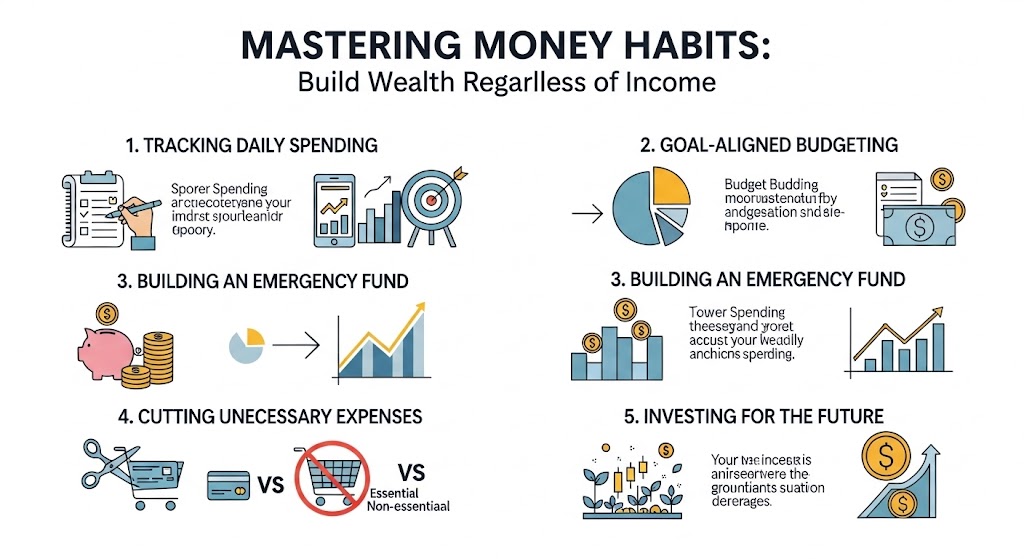
Habit 1: Income amplifies
- Why it matters: Awareness is key—most don’t overspend; they under-track. A 2024 Mint survey found people underestimate spending by 20-30%.
- How to start: Use apps like Mint or Excel. Log daily for 30 days: categorize into needs (rent, groceries) vs. wants (dining out).
- Key data: Tracking can cut unnecessary spending by 15%, per a Journal of Consumer Research study.
- Impact: Reveals leaks, like $150/month on unused subscriptions, freeing cash for goals.
Habit 2: Create a Goal-Aligned Budget
- Core idea: Budgeting isn’t restriction—it’s prioritization. Fund what matters first (e.g., debt payoff over gadgets).
- Steps: List income/expenses; use 50/30/20 rule (50% needs, 30% wants, 20% savings). Tools: YNAB or Google Sheets.
- Key stats: Budgeters save 2x more, according to a 2022 Fidelity report—average saver builds $10K+ emergency fund faster.
- Pro tip: Review monthly; adjust for life changes like a new job.
Habit 3: Build an Emergency Fund
- Essentials: Life’s surprises (e.g., $500 car repair) shouldn’t derail you. Aim for 3-6 months’ expenses.
- Build strategy: Start with $1,000; automate $50-100/month transfers to high-yield savings (4-5% APY via Ally or Capital One).
- Data insight: 56% of Americans can’t cover a $1,000 emergency, per 2024 Bankrate survey—leading to high-interest debt.
- Benefit: Provides peace; reduces stress, with studies linking buffers to better mental health.
Habit 4: Cut Unnecessary Expenses
- Guiding rule: If you wouldn’t buy it twice, skip it once. Focus on value, not impulse.
- Tactics: Audit bills; cancel redundants (e.g., multiple streaming services). Meal prep to save $200/month on food.
- Supporting data: Average household wastes $1,500/year on unused items, says a 2023 Waste Watchers report.
- Long-term win: Redirect savings—turn $100/month cuts into investments growing via compounding.
Habit 5: Invest in Your Future
- Power of compounding: Start early; $100/month at 7% return grows to $200K in 40 years (per Vanguard calculator).
- Beginner steps: Open Roth IRA or 401(k); invest in low-fee index funds (e.g., S&P 500 via Vanguard).
- Key facts: Delaying 10 years halves potential wealth, per a 2024 Morningstar analysis.
- Advice: Read “The Simple Path to Wealth”; consult free resources like Khan Academy.
Final Takeaway: Start Today for Lasting Peace: Don’t wait for “more money”—habits scale with income. Implementing these can boost net worth by 20-30% in 5 years, based on Ramsey Solutions data. Track progress quarterly; small wins compound into financial independence. What’s your first step?