Understanding the mechanics of compound interest is the cornerstone of successful financial planning. This article explores the “Rule of 72,” a simplified yet powerful mental shortcut used by investors globally to estimate how long it takes for an investment to double in value. By analyzing the relationship between fixed annual rates of return and time, the Rule of 72 provides an immediate snapshot of potential portfolio growth without the need for complex logarithmic equations. We delve into the practical applications of this rule across various interest rates—ranging from conservative 6% returns to more aggressive 12% targets. Beyond the math, the article outlines critical investment pillars, including the impact of early entry into the market and the necessity of minimizing withdrawals to maintain compounding momentum. Whether evaluating a savings account or a high-yield investment vehicle, mastering this rule empowers individuals to make data-driven decisions for long-term fiscal stability.
The quest for financial literacy often begins with a single, fundamental question: “How long will it take for my money to grow?” While modern financial software can provide precise projections down to the cent, there is an elegant mathematical shortcut that has served as a benchmark for decades. Known as the Rule of 72, this formula is an indispensable tool for anyone looking to understand the velocity of their wealth accumulation.
What is the Rule of 72?
The Rule of 72 is a simplified formula used to estimate the number of years required to double the invested capital at a given annual fixed interest rate. It serves as a mental proxy for the power of compound interest. Unlike simple interest, where earnings are calculated only on the principal, compound interest calculates returns on both the initial principal and the accumulated interest from previous periods.
The formula is strikingly straightforward:
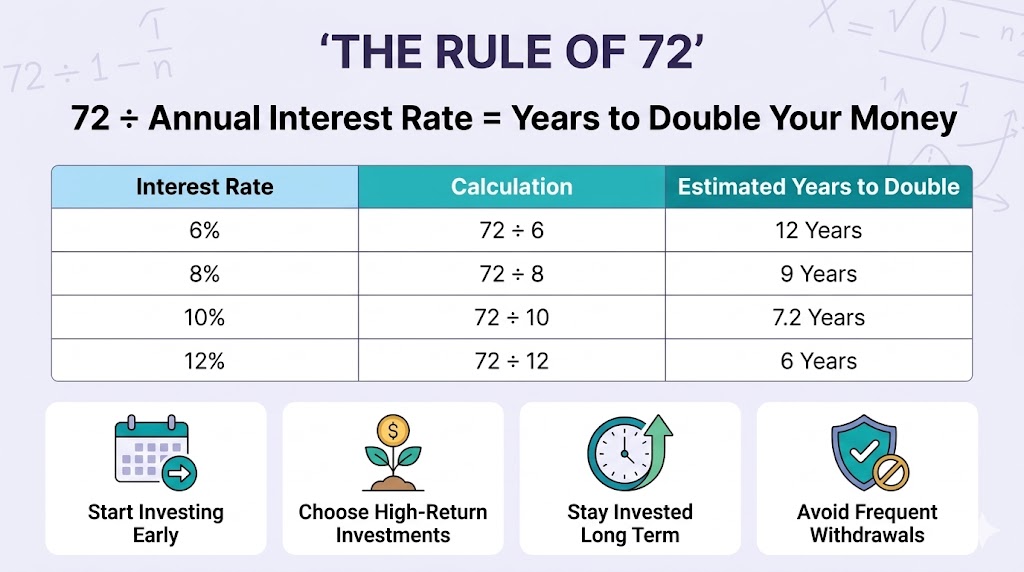
Years to Double = 72 / Annual Interest Rate
The Math in Motion: Comparative Growth Scenarios
To visualize the impact of varying interest rates, consider how different percentages drastically alter the timeline for wealth doubling. Using the Rule of 72, the following benchmarks emerge:
| Interest Rate | Calculation | Years to Double |
|---|---|---|
| 6% | 72 ÷ 6 | 12 Years |
| 8% | 72 ÷ 8 | 9 Years |
| 10% | 72 ÷ 10 | 7.2 Years |
| 12% | 72 ÷ 12 | 6 Years |
As demonstrated, a 6% increase in the interest rate (from 6% to 12%) does not just add a little more value—it halves the time required to double the investment. This highlights the “time value of money” and the critical importance of seeking competitive yields.
Practical Example: The $10,000 Milestone
Consider a scenario where an individual invests $10,000 into an asset offering a steady 8% annual return. By applying the Rule of 72 (72 ÷ 8), the investor can estimate that their capital will grow to $20,000 in approximately 9 years. If that same $20,000 is left untouched for another 9 years, it doubles again to $40,000. This exponential trajectory is why early-stage investing is so frequently emphasized by financial analysts.
Core Pillars of Investment Success
While the Rule of 72 provides the “when,” achieving these results requires adherence to several fundamental investment disciplines:
1. The Advantage of Early Entry
Time is the most significant variable in the compounding equation. Starting to invest in one’s early twenties versus thirties can result in significantly more “doubling cycles” over a lifetime. Every year of delay is a lost opportunity for the initial principal to begin its exponential climb.
2. Selecting High-Return Vehicles
Risk and return are inherently linked. While low-risk accounts offer security, they often yield lower interest rates that can lead to doubling periods exceeding 20 or 30 years. To accelerate growth, investors often look toward diversified portfolios, including equities or index funds, which historically aim for higher average returns.
3. The Necessity of Long-Term Commitment
Compounding is a back-loaded process. The most significant gains occur in the later years of an investment’s lifespan. Maintaining a “Stay Invested” mindset ensures that the cycle of interest-on-interest remains uninterrupted, allowing the Rule of 72 to reach its full potential.
4. Mitigating Withdrawals and Leakage
Frequent withdrawals are the primary enemy of wealth doubling. Removing funds from an investment account resets the principal and halts the compounding process. To maximize the Rule of 72, capital must remain “locked” within the growth vehicle to ensure every dollar is working toward the next doubling milestone.
The Rule of 72 is more than just a math trick; it is a window into the future of a financial portfolio. By understanding that time and interest rates are the primary levers of wealth, investors can better navigate their choices between different financial products. Consistency, patience, and a clear understanding of these mathematical realities are the true drivers of long-term economic success.