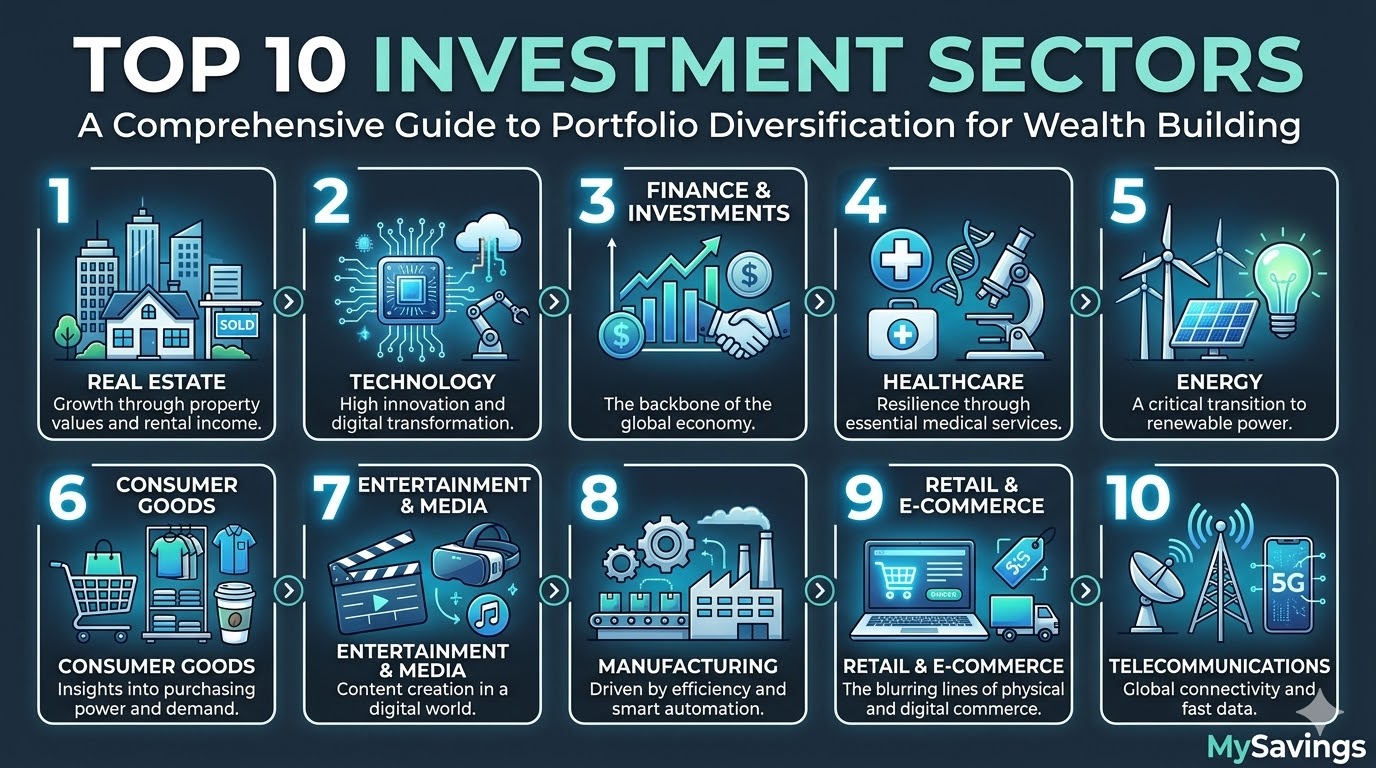
Identifying the right sectors for capital allocation is a cornerstone of long-term financial independence. This comprehensive guide explores the ten pivotal industries currently shaping the global economy, from the tangible stability of Real Estate to the rapid innovation cycles of Technology and Telecommunications. By understanding the fundamental drivers behind Finance, Healthcare, and Energy, investors can better navigate market volatility and inflationary pressures. We also examine the evolving landscapes of Consumer Goods, Entertainment, and Manufacturing, alongside the digital transformation of Retail and E-commerce. This article provides an objective analysis of how these sectors interact with macroeconomic trends, offering a roadmap for those looking to build a resilient, diversified portfolio. Whether you are focusing on value-driven investments in traditional industries or seeking growth in high-tech frontiers, this breakdown serves as a professional resource for aligning your savings strategy with global market momentum and sustainable wealth-building principles.
In the pursuit of financial stability and wealth accumulation, the most critical decision an investor makes is not just when to invest, but where. The global economy is a complex web of interconnected industries, each reacting differently to interest rate shifts, technological breakthroughs, and consumer behavior. For the modern investor, a “set it and forget it” approach is no longer sufficient. To optimize a personal savings and investment strategy, one must analyze the sectors that serve as the engines of global GDP.
1. Real Estate: The Foundation of Tangible Wealth
Real Estate remains a primary vehicle for wealth preservation. Its appeal lies in its dual-income potential: capital appreciation over time and consistent cash flow through rental yields. Unlike digital assets, real estate offers a physical hedge against inflation. As the cost of living rises, property values and rents typically follow suit. Within this sector, diversification can occur through residential, commercial, or industrial properties, as well as Real Estate Investment Trusts (REITs), which allow for liquidity in an otherwise illiquid market.
2. Technology: Driving Exponential Growth
The technology sector is the undisputed leader in growth potential. Driven by advancements in Artificial Intelligence (AI), cloud computing, and software-as-a-service (SaaS), this sector frequently outperforms traditional benchmarks. Investment in technology is an investment in efficiency. Companies in this space often boast high margins and scalability. However, the tech sector is also prone to higher volatility, making it a “high-risk, high-reward” component of a balanced portfolio.
3. Finance and Investments: The Economic Catalyst
The financial sector is the backbone of the global markets. This includes banking, insurance, and asset management firms. Investing in finance is essentially a bet on the health of the broader economy. When businesses grow, they need loans; when individuals build wealth, they need investment services. This sector often benefits from rising interest rates, which can improve the net interest margins of traditional banking institutions.
4. Healthcare: Stability Through Necessity
Healthcare is often categorized as a defensive sector. Regardless of the economic climate, the demand for medical services, pharmaceuticals, and medical devices remains constant. With an aging global population and continuous innovation in biotechnology, this sector offers a unique blend of stability and long-term growth. It is less sensitive to economic cycles, providing a safety net for portfolios during recessionary periods.
5. Energy: Powering Global Infrastructure
The energy sector is currently undergoing a massive transition. While traditional oil and gas remain vital for current global infrastructure, the shift toward renewable energy (solar, wind, and hydroelectric) presents new opportunities. Energy stocks often serve as a hedge against geopolitical instability. As emerging markets industrialize, the global demand for reliable power continues to surge, ensuring this sector’s relevance for decades to come.
6. Consumer Goods: The Pulse of Daily Life
Divided into “staples” (essentials like food and hygiene) and “discretionary” (luxury items and electronics), consumer goods provide insight into the public’s purchasing power. Consumer staples offer low volatility and consistent dividends, while discretionary goods offer higher growth during economic expansions. A balanced investment approach often includes both to capture steady returns and cyclical upswings.
7. Entertainment and Media: The Digital Content Revolution
The way the world consumes content has shifted from linear broadcasting to on-demand streaming and interactive gaming. This sector is characterized by high consumer engagement and recurring subscription models. As high-speed internet becomes a global standard, the reach of media companies has expanded into every corner of the globe, creating a massive marketplace for digital advertising and premium content.
8. Manufacturing: The Engine of Production
Manufacturing is the process of turning raw materials into finished goods. This sector is currently being revolutionized by “Industry 4.0,” which incorporates automation and robotics into production lines. Strategic investment in manufacturing focuses on companies that provide the essential components for global trade, from automotive parts to industrial machinery. It is a sector deeply tied to supply chain efficiency and global trade agreements.
9. Retail and E-commerce: The Future of Commerce
The boundary between physical and digital retail has blurred. E-commerce continues to take market share from traditional brick-and-mortar stores, driven by the convenience of mobile shopping and logistics advancements. However, “omnichannel” retail—where brands maintain both a digital and physical presence—is proving to be the most resilient model. Investing in this sector requires an eye for companies that master data analytics and last-mile delivery.
10. Telecommunications: The Connectivity Layer
Telecommunications provides the infrastructure that makes the modern digital world possible. With the rollout of 5G and the increasing necessity of high-speed data for both work and leisure, telecom companies have become utility-like in their importance. They often offer stable dividends, as their services are considered essential for both individuals and businesses in an increasingly connected global society.
Conclusion: Building a Diversified Strategy
True financial growth is rarely the result of a single “lucky” investment. Instead, it is the product of strategic diversification across these ten key sectors. By spreading capital across industries with different risk profiles and growth drivers—such as pairing the stability of Healthcare with the dynamism of Technology—investors can protect their savings from localized downturns while capturing the benefits of global progress.