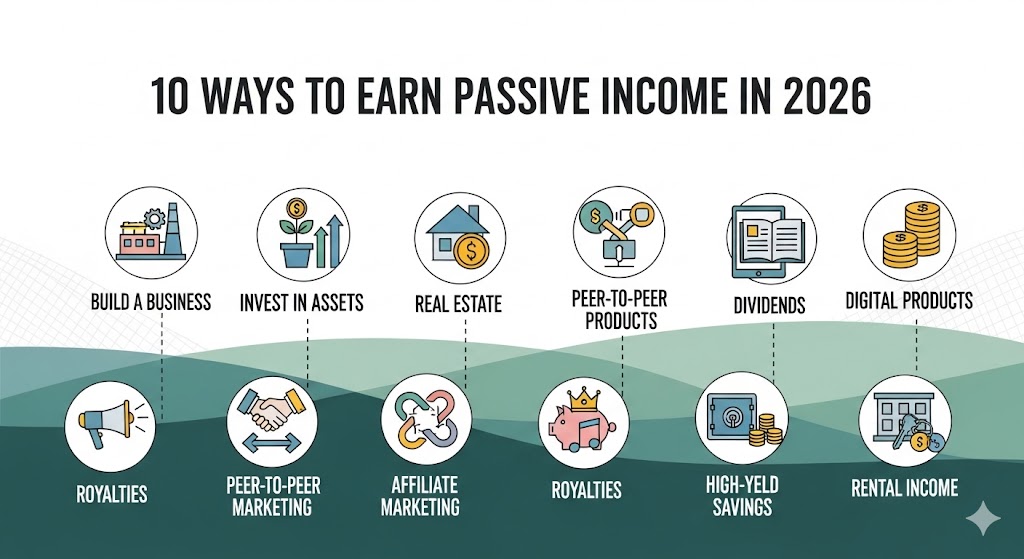
Generating passive income usually requires an upfront investment of either time (building a business) or money (investing in assets). In 2025, the rise of AI and automation has made several digital streams more accessible, while traditional methods like real estate remain reliable staples.
1. High-Yield Savings & CDs
If you have cash sitting in a standard bank account, you’re losing money to inflation. High-yield savings accounts (HYSAs) and Certificates of Deposit (CDs) currently offer around 4% to 5% APY. This is the most “passive” option as it requires zero effort beyond opening the account.
2. Dividend Stocks & Index Funds
By investing in companies that pay out a portion of their profits to shareholders (dividends), you create a recurring cash flow.
- Pro Tip: Use a “Dividend Reinvestment Plan” (DRIP) to automatically use your payouts to buy more shares, compounding your wealth over time.
3. Real Estate Investment Trusts (REITs)
If you want to invest in real estate without the headache of being a landlord, REITs are the answer. They are companies that own and manage portfolios of commercial or residential properties. You buy shares like a stock and receive a share of the rental income.
4. Create and Sell Digital Products
This is a “build once, sell forever” model. With tools like Canva or AI assistants, you can create:
- Templates: Budget trackers, Notion dashboards, or social media kits.
- Printables: Workbooks, planners, or wall art.
- Where to sell: Etsy, Gumroad, or your own website.
5. Affiliate Marketing
You earn a commission by recommending products you love. If someone clicks your link and buys, you get a cut.
- Strategy: Focus on a specific niche (e.g., tech reviews, sustainable living) on a blog, YouTube channel, or social media page to build an audience that trusts your recommendations.
6. Online Courses & Memberships
If you have a skill—whether it’s coding, sourdough baking, or Excel—you can record a course and host it on platforms like Udemy, Skillshare, or Teachable. Once the content is live, it can generate sales for years.
7. Rent Out “Digital Real Estate”
This involves building or buying niche websites that generate ad revenue or lead-generation income. You can also “flip” domain names or buy existing small content sites on marketplaces like Flippa or Empire Flippers.
8. Print-on-Demand (POD)
Design t-shirts, mugs, or posters and upload them to sites like Printful or Redbubble. They handle the printing, shipping, and customer service. You only focus on the design and marketing, taking a royalty on every sale.
9. Peer-to-Peer (P2P) Lending
Platforms like LendingClub or Prosper allow you to act as the bank. You lend small amounts of money to individuals or small businesses in exchange for interest payments. It carries more risk than a savings account but offers higher potential returns.
10. Automated Vending or ATMs
This requires physical capital but is highly scalable. Buying a vending machine or an ATM and placing it in a high-traffic area (like a gym or office building) provides a steady stream of cash with only weekly or bi-weekly maintenance required.
Comparison at a Glance
| Method | Initial Investment | Risk Level | Passive Effort |
| HYSAs | Money (Low) | Very Low | None |
| Dividend Stocks | Money (Varies) | Medium | Low |
| Digital Products | Time (High) | Low | Low |
| Rental Property | Money (High) | Medium | Medium |
| Affiliate Marketing | Time (High) | Low | Medium |