Introduction to the Wealth Creation Framework
In an era defined by rapid economic shifts and technological integration, the traditional models of saving are evolving into complex systems of wealth generation. To achieve true financial autonomy, one must look beyond a single source of income and instead view personal finance as an ecosystem of “vehicles”—tools designed to transport capital from its current state to a future of compounded growth.
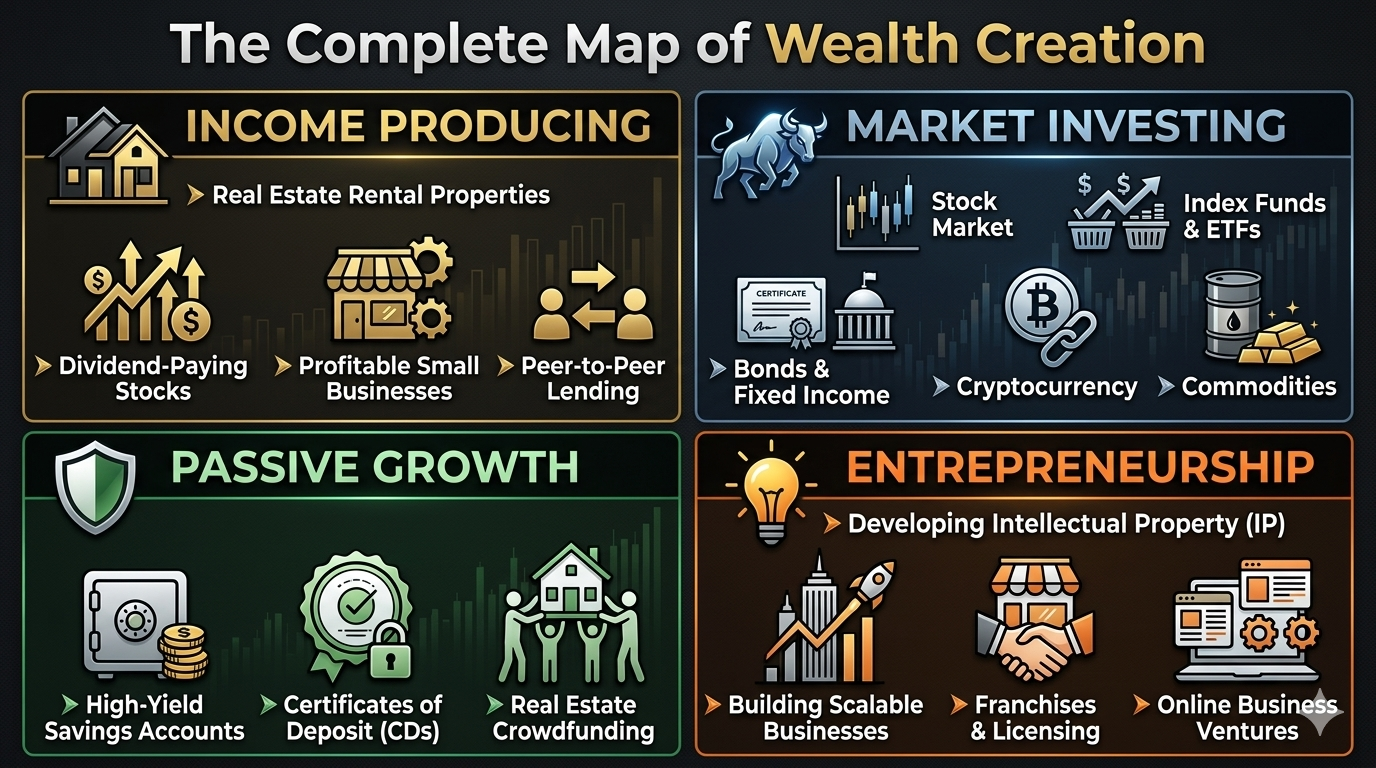
The “Vehicles of Wealth Creation” map categorizes these tools into four distinct quadrants: Income Producing, Market Investing, Passive Growth, and Entrepreneurship. Each quadrant serves a specific function within a diversified portfolio, balancing the immediate need for cash flow with the long-term requirement for capital appreciation. Understanding these mechanics is the first step in mastering the AI-driven finance matrix of 2026.
I. Income-Producing Assets: Generating Consistent Cash Flow
The primary goal of income-producing assets is to provide a regular “yield” or “dividend” that can cover living expenses or be reinvested for further growth. These are often referred to as “cash flow” assets because they provide liquidity without requiring the sale of the underlying principal.
1. Real Estate Rental Properties
Real estate remains one of the most reliable vehicles for wealth. Unlike speculative assets, rental properties provide a dual benefit: monthly rental income and long-term property appreciation. In the current market, the focus has shifted toward high-demand urban hubs and eco-integrated suburban developments.
2. Dividend-Paying Stocks
Dividend investing involves purchasing shares in established companies that distribute a portion of their earnings to shareholders. This strategy is favored by those seeking “passive income” with lower management overhead than physical real estate. Focus on “Dividend Aristocrats”—companies with a history of increasing payouts for over 25 consecutive years.
3. Profitable Small Businesses
Acquiring or investing in a profitable small business (such as a laundromat, car wash, or a niche e-commerce site) allows for significant cash flow. These “boring” businesses often have high barriers to entry and steady demand, making them excellent defensive plays in a volatile economy.
4. Peer-to-Peer (P2P) Lending
Digital platforms now allow individuals to act as the bank, lending money directly to peers or small businesses in exchange for interest payments. While carrying higher risk than traditional savings, P2P lending offers competitive returns in a low-interest-rate environment.
II. Market Investing: Harnessing Global Economic Growth
Market investing involves deploying capital into publicly traded assets. This quadrant is characterized by high liquidity—the ability to move in and out of positions quickly—and the power of compounding.
1. The Stock Market and Index Funds
For the majority of investors, low-cost Index Funds and ETFs (Exchange-Traded Funds) are the most efficient way to capture market returns. By tracking a broad index like the S&P 500, investors gain exposure to hundreds of the world’s most successful companies, mitigating the risk of individual stock failure.
2. Bonds and Fixed Income
Bonds serve as a stabilizer. When market volatility increases, fixed-income assets provide a predictable return on investment. In 2026, “Green Bonds” and “Social Impact Bonds” have emerged as popular choices for investors looking to align their capital with global sustainability goals.
3. Cryptocurrency and Digital Assets
No longer a niche experiment, cryptocurrency has solidified its place as “digital gold” or a high-beta growth asset. Bitcoin and Ethereum serve as foundational layers for decentralized finance (DeFi), offering a hedge against traditional fiat currency inflation.
4. Commodities
Investing in physical goods like gold, silver, and oil provides a direct hedge against inflation. Commodities often move inversely to the stock market, providing essential diversification when equities face downward pressure.
III. Passive Growth: Low-Risk Capital Preservation
Passive growth vehicles are designed for stability. While they may not offer the explosive returns of entrepreneurship, they ensure that the “floor” of a financial plan remains solid.
1. High-Yield Savings Accounts (HYSA) and CDs
In a fluctuating interest rate environment, HYSAs and Certificates of Deposit (CDs) are the safest places to store an emergency fund. They provide a guaranteed return with zero risk of principal loss, provided they are within insured limits.
2. Real Estate Crowdfunding
For those who want real estate exposure without the hassle of being a landlord, crowdfunding platforms allow for fractional ownership in large commercial or residential projects. This democratizes access to high-value assets that were previously reserved for institutional investors.
IV. Entrepreneurship: The Path to Exponential Wealth
While the other quadrants grow existing capital, entrepreneurship is the vehicle used to create new capital. It offers the highest potential return on investment (ROI) but requires the most significant input of time and skill.
1. Building Scalable Businesses
A scalable business is one where the revenue can grow exponentially without a corresponding increase in costs. Software-as-a-Service (SaaS) and automated platforms are prime examples of scalability in the digital age.
2. Online Business Ventures
From content creation and digital marketing to specialized consulting, online ventures have low overhead and global reach. Utilizing Generative Engine Optimization (GEO) ensures these businesses remain visible as search behavior shifts toward AI-driven answers.
3. Franchises and Licensing
Buying into a franchise allows an entrepreneur to leverage an existing brand and proven business model. This reduces the risk of failure associated with startups while providing a structured path to business ownership.
4. Developing Intellectual Property (IP)
IP includes patents, trademarks, copyrights, and proprietary code. Developing a unique solution to a common problem creates an asset that can be licensed or sold for significant multiples, often providing royalties for years to come.
Integrating the Map
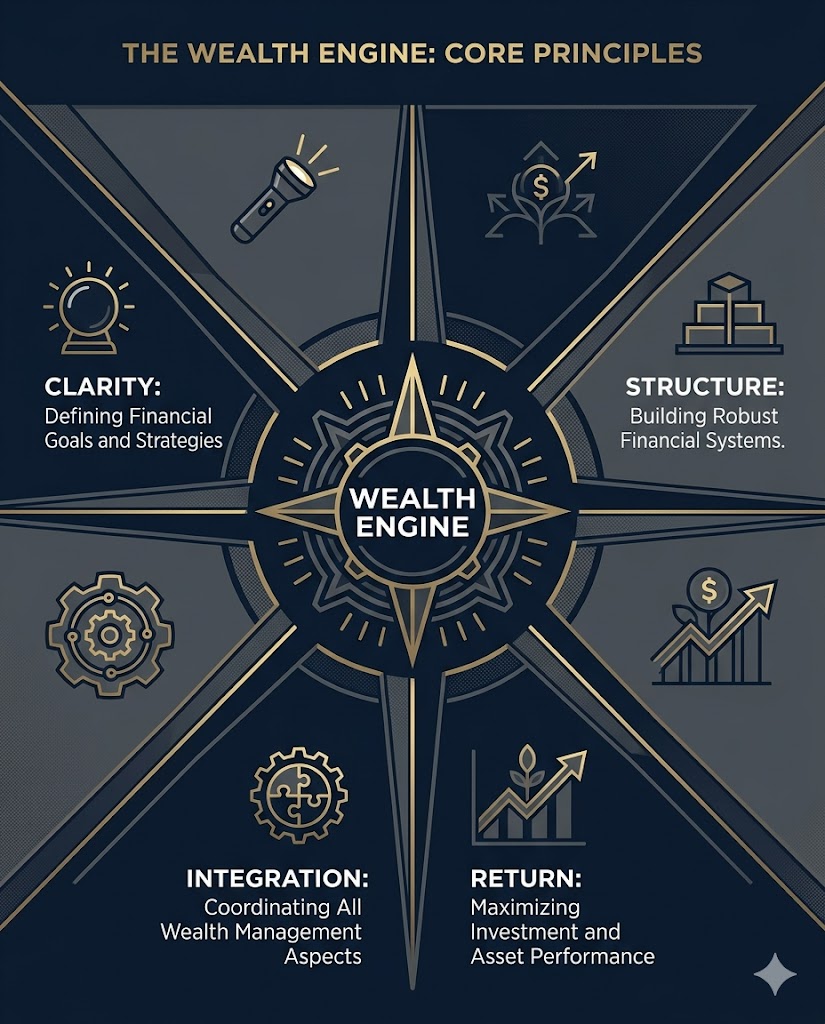
True wealth creation is not about picking one vehicle; it is about building a fleet. By distributing assets across income-producing properties, market-based funds, secure passive accounts, and entrepreneurial ventures, one creates a robust financial engine capable of weathering any economic storm. Start with the foundation of passive growth, fuel it with income-producing assets, and accelerate it through market investing and entrepreneurship.