
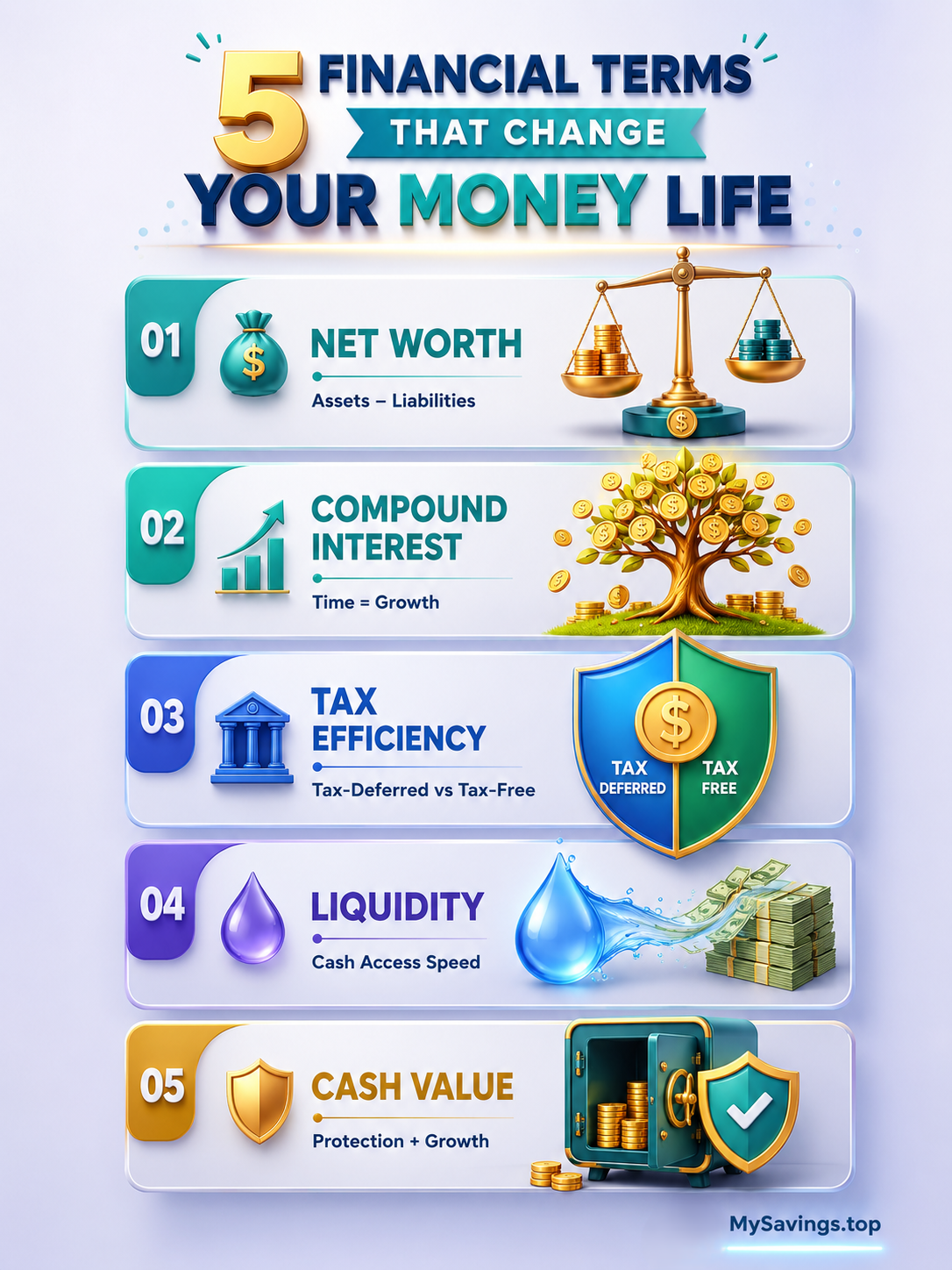
💰 Understanding money goes far beyond earning a salary—it’s about knowing how wealth truly grows, is protected, and is accessed over time. 📈 This guide breaks down five essential financial concepts that are rarely taught in school but are crucial for building long-term financial stability. From understanding your true financial position through net worth, to unlocking the power of compound growth, and learning how taxes affect your investments, each concept provides practical financial clarity. 💡 It also explains liquidity, helping you understand how quickly your assets can be converted into cash during emergencies, and introduces cash value life insurance as a flexible financial tool. 🛡️ Whether you’re planning savings, investments, or long-term wealth strategies, these insights help you make smarter financial decisions and avoid common money mistakes. This article simplifies complex financial ideas into clear, actionable knowledge for better money management and future financial confidence. 🚀
💼 Why Financial Literacy Matters More Than Ever
Financial success is not determined only by how much money is earned, but by how effectively it is understood, managed, and grown. Many individuals enter adulthood with strong academic knowledge but limited exposure to real-world financial concepts. As a result, key principles that drive wealth creation and financial security often remain unfamiliar.
This article explores five essential financial terms that shape long-term financial outcomes. These concepts influence savings behavior, investment decisions, tax planning, and overall financial stability. Understanding them provides a strong foundation for building sustainable wealth and improving financial decision-making in everyday life.
📊 1. Net Worth – The True Measure of Financial Health
Net worth is one of the most important indicators of financial well-being. Unlike income, which reflects earnings, net worth reflects actual wealth accumulated over time.
💡 Core Idea
Net worth represents what remains after subtracting debts from total assets.
🧮 Formula
Assets − Liabilities = Net Worth
📌 Why It Matters
Net worth provides a realistic picture of financial stability. A high income does not always mean strong financial health if liabilities are equally high. Tracking net worth helps identify whether financial decisions are leading toward wealth accumulation or debt dependency.
📈 Key Insight
- Assets include cash, investments, property, and valuables
- Liabilities include loans, credit card debt, and other obligations
Monitoring net worth over time helps in evaluating financial progress and adjusting spending or saving habits accordingly.
📈 2. Compound Interest – The Engine of Wealth Growth
Compound interest is often described as one of the most powerful financial principles because it allows money to grow exponentially over time.
💡 Core Idea
It is the process of earning returns not only on the original investment but also on previously earned returns.
🧮 Concept Representation
Money + Time = More Money
⏳ Why It Matters
Time plays a crucial role in compounding. The earlier investments begin, the greater the long-term growth potential. Even small contributions can grow significantly when given enough time.
📌 Key Insight
- Short-term growth appears slow
- Long-term growth accelerates significantly
- Consistency matters more than large one-time investments
Compounding rewards patience, discipline, and long-term thinking, making it essential for retirement planning and wealth building.
🏦 3. Tax-Deferred vs Tax-Free – Understanding Investment Efficiency
Tax structure plays a major role in determining actual investment returns. Not all investment accounts are taxed in the same way, and understanding this difference can significantly impact long-term wealth.
💡 Core Idea
Some investments allow taxes to be postponed, while others may eliminate taxes entirely under certain conditions.
📌 Tax-Deferred
Taxes are paid later, usually during withdrawal. This allows investments to grow without immediate tax deductions, increasing short-term growth potential.
📌 Tax-Free
Qualified withdrawals are not taxed, depending on account structure and regulations. This can maximize long-term returns.
📊 Why It Matters
Choosing between tax-deferred and tax-free options affects:
- Retirement planning efficiency
- Investment growth speed
- Long-term financial outcomes
Strategic use of tax-efficient accounts helps preserve more wealth over time.
💧 4. Liquidity – How Quickly Money Becomes Accessible
Liquidity refers to how easily assets can be converted into cash without loss of value or penalties. It plays a critical role in financial security and emergency preparedness.
💡 Core Idea
Liquidity determines how fast financial resources can be accessed when needed.
📊 Liquidity Hierarchy
Cash → Savings → Investments → Real Estate
⚠️ Why It Matters
Even individuals with significant wealth may face financial stress if their assets are not easily accessible. For example, real estate may hold high value but cannot be quickly converted into cash during emergencies.
📌 Key Insight
- High liquidity = faster access to money
- Low liquidity = delayed access or penalties
- Balance is essential for financial stability
A well-structured financial plan maintains both growth-oriented and liquid assets.
🛡️ 5. Cash Value – A Living Financial Asset
Cash value is a feature found in permanent life insurance policies that builds accessible savings over time while maintaining insurance protection.
💡 Core Idea
It represents a growing financial reserve within a life insurance policy that can be accessed during one’s lifetime.
🧮 Concept Formula
Growth + Access + Protection
📌 Why It Matters
Cash value offers financial flexibility by allowing policyholders to:
- Borrow against accumulated value
- Access funds during emergencies
- Support long-term financial planning
It combines protection with savings accumulation, creating a dual-purpose financial tool.
📊 Key Insight
Unlike traditional insurance products that only provide benefits after death, cash value policies provide usable financial resources during life.
🧭 Building Strong Financial Awareness
Understanding these five financial concepts transforms the way money is viewed and managed. Net worth provides clarity on financial standing, compound interest drives long-term growth, tax structures improve efficiency, liquidity ensures accessibility, and cash value offers flexible financial support.
Together, these principles form a strong foundation for financial literacy. Applying them consistently can lead to improved savings habits, smarter investment choices, and stronger long-term financial security.