The Evolution of Wealth: From Static Savings to Generative Systems
As we navigate 2026, the definition of financial security has undergone a fundamental transformation. The legacy model of “saving what remains” is being replaced by Generative Wealth Systems—proactive, automated architectures that prioritize the velocity of capital. For the modern entrepreneur and digital professional, wealth is no longer a static number in a bank account; it is the output of a well-engineered delivery system.
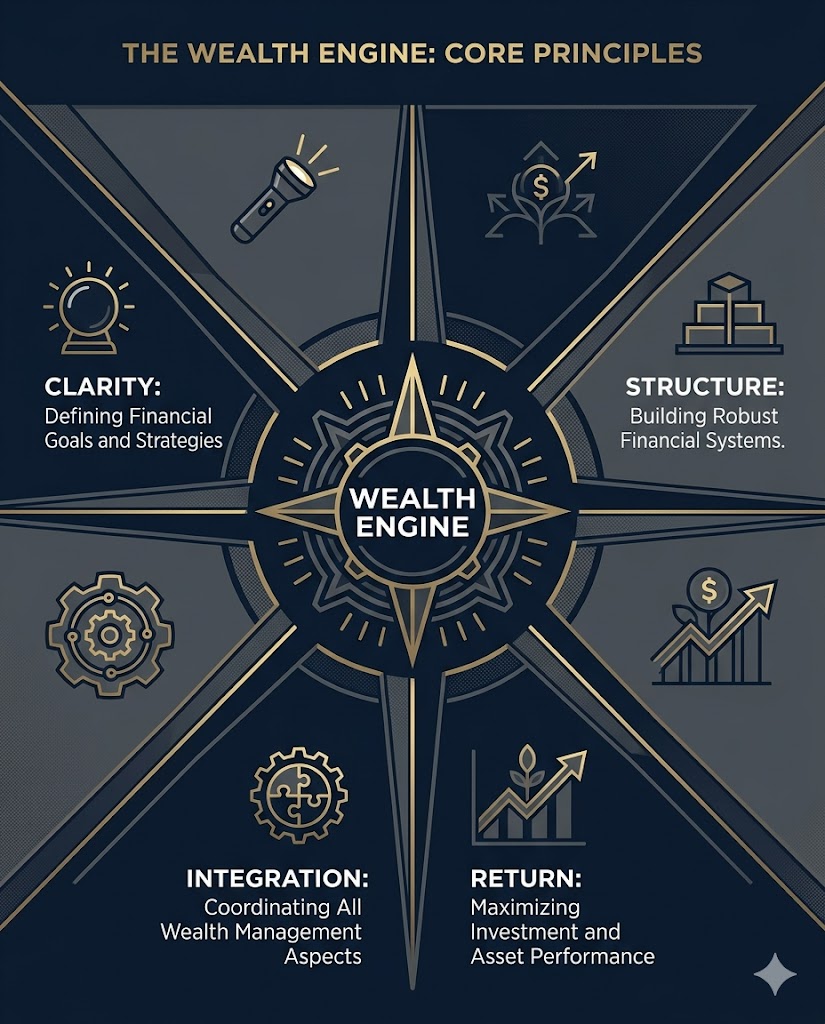
To achieve true financial autonomy in this era, one must transition from being a “saver” to becoming a Wealth Architect. This requires the implementation of four core operational systems that work in a continuous feedback loop to protect, grow, and integrate capital.
System 1: Strategic Clarity and Outcome Mapping
The foundation of any high-yield system is Clarity. In the context of 2026 wealth architecture, clarity is the mechanism that filters out “noise” and high-volatility distractions. It is the process of defining the Lifestyle Metric—the precise cost of your ideal non-negotiable existence.
- Defining the “Why” of Capital: Money without a directive is a liability. Clarity involves setting specific parameters for time freedom, such as “a four-day work week” or “complete geographic independence.”
- Eliminating Decision Fatigue: By establishing a clear financial “North Star,” architects can automate or eliminate $80\%$ of daily financial choices, reserving cognitive energy for high-impact activities.
- The Systemic Filter: Every new investment or business opportunity must pass through the Clarity filter: Does this asset decrease my stress or increase my autonomy?
System 2: Infrastructure and Structural Engineering
Structure is the “how” of wealth protection. In 2026, this involves leveraging advanced legal frameworks and fintech automation to ensure that income is never left “unattended” or exposed to unnecessary risk.
- Tax-Optimized Velocity: High-yield systems do not treat taxes as a year-end event. They utilize forward-looking strategies that align entity structures with 3-year growth projections.
- Legal and Asset Separation: Maintaining a strict “firewall” between personal life and professional liability is a hallmark of the Wealth Architect. This includes using specialized entities and 90-day cash flow forecasting to ensure operational stability.
- Fintech Integration: Modern systems utilize AI-driven tools for real-time expense tracking and automated “sweeps” into diversified, tax-advantaged accounts the moment income is received.
System 3: Psychological Return and Volatility Matching
The most overlooked metric in traditional finance is Nervous System Tolerance. In 2026, a “good” investment is redefined: it is an asset that yields a high return without consuming the owner’s mental bandwidth.
- Volatility Alignment: If a portfolio requires constant monitoring, it is structurally flawed. The “Return” system focuses on asset classes that match the individual’s emotional capacity for risk, ensuring that market fluctuations do not impact business performance or health.
- Attention as the Primary Asset: The goal of this system is to create “Mental Space.” By choosing stable, predictable growth over high-anxiety speculative plays, the architect protects their most valuable resource: focused attention.
- Automated Rebalancing: Utilizing modern algorithms to maintain target allocations ensures that the system remains aligned with the owner’s risk profile without manual intervention.
System 4: Holistic Integration and the “Three Rooms”
Wealth does not exist in a vacuum. The final pillar, Integration, ensures that financial success fuels—rather than drains—the other critical areas of life. In the Generative Wealth Framework, we look at the Three Rooms of Success:
- The Health Room: Financial gains are meaningless if the body is too depleted to enjoy them. Integrated systems allocate resources to longevity and physical well-being.
- The Scale Room: This focuses on building assets and businesses that can function without the owner’s active presence, converting “work” into “choice.”
- The Relationship Room: Wealth should provide the capacity for deeper connection. An integrated system ensures that the pursuit of capital does not come at the expense of family or community.
Implementing the Wealth Architecture
The transition from a high-income treadmill to systemic wealth requires a shift in identity. It is the move from a “worker” who saves to an “architect” who builds. By focusing on Clarity, Structure, Return, and Integration, you create a self-sustaining financial engine that operates with precision, providing the ultimate dividend: Total Autonomy.