⏳💡 Most people spend years trying to earn more money, yet overlook the one resource they can never recover time. Every day, distractions, toxic relationships, unnecessary commitments, and unproductive habits quietly consume valuable hours that could be invested in meaningful growth, financial success, and personal fulfillment. 🚀✨
This article explores why time is your most valuable asset and how finding your purpose transforms the way you spend it. Learn to identify attention thieves, energy vampires, and time traps that silently drain progress and prevent long-term success. 🎯⚡
Discover the powerful 3P Rule Purpose, Peace, and Profit a practical framework for making better decisions, protecting your focus, and aligning your actions with what truly matters. 📈🌱
If you want greater productivity, improved financial outcomes, and a more intentional life, mastering your time may be the most important investment you’ll ever make. ⏰💰
Why Is Time More Valuable Than Money? A Simple Guide
Time Matters More Than Making More Money
Money can be earned, invested, saved, and multiplied. Time cannot.
Every person receives the same 24 hours each day, regardless of income, status, or background. While financial losses can often be recovered, lost time is gone forever. This simple reality makes time the most valuable asset anyone owns.
Yet many people spend years focusing on increasing income while paying little attention to how they spend their days. The result is often frustration, burnout, and a feeling of being busy without making meaningful progress.
The key to changing this pattern starts with understanding purpose and learning how to protect your time from the many forces competing for it.
🎯 Why Purpose Changes Everything
Purpose acts as a compass for decision-making.
Without a clear purpose, it becomes easy to drift through life reacting to opportunities, distractions, and demands from others. Every request feels urgent. Every opportunity appears important. Every notification demands attention.
When purpose becomes clear, priorities become clear as well.
✨ Time stops feeling like a limited resource that constantly slips away.
✨ Decisions become easier because priorities are defined.
✨ Energy is directed toward meaningful goals.
✨ Productivity improves because focus increases.
✨ Long-term progress becomes more achievable.
Purpose provides direction, and direction creates momentum.
Instead of asking, “What should I do next?” people begin asking, “Does this move me closer to what matters most?”
That shift changes everything.
🧠 The Real Cost of Distraction
Modern life is filled with distractions designed to capture attention.
Many distractions seem harmless in isolation. A few minutes scrolling through social media, responding to unnecessary messages, or attending an unproductive meeting may not seem significant.
However, small distractions accumulate over time.
A few wasted minutes each day can eventually become hundreds of lost hours every year.
More importantly, distractions interrupt focus.
Research consistently shows that regaining concentration after an interruption can take significant time. The true cost is not just the interruption itself but the loss of momentum that follows.
Protecting attention has become one of the most important productivity skills in the modern world.
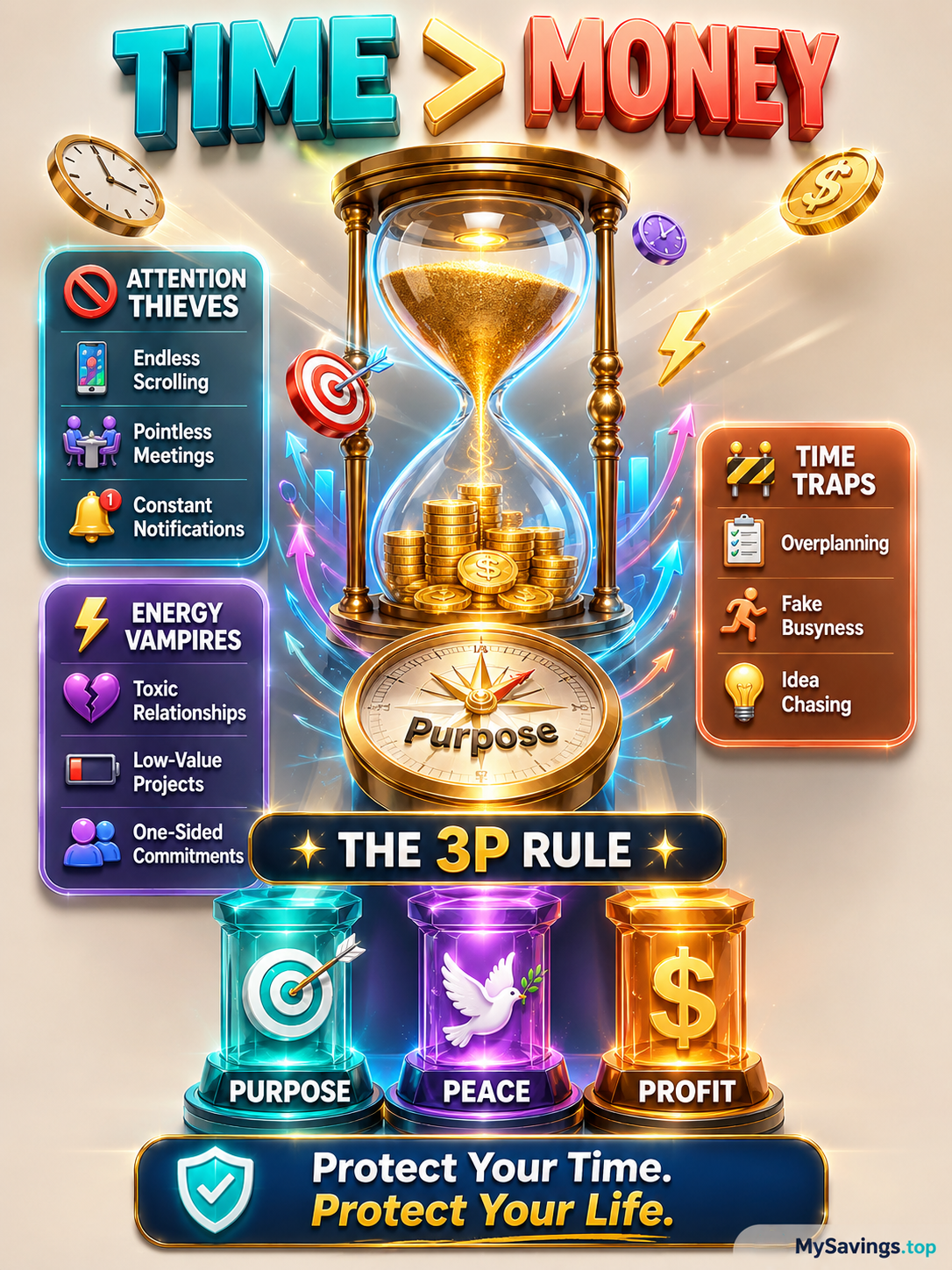
📱 Attention Thieves That Steal Your Future
Attention is one of the most valuable resources you possess.
Where attention goes, time follows.
Unfortunately, many people unknowingly give away their attention to activities that provide little value.
🔹 Pointless Meetings
Not every meeting deserves your presence.
Many discussions can be replaced with a brief email, message, or shared document. Excessive meetings often create the illusion of productivity while reducing time available for meaningful work.
🔹 Endless Scrolling
Social media platforms are designed to keep users engaged for as long as possible.
While they can provide entertainment and useful information, excessive scrolling often consumes time that could be invested in learning, building skills, strengthening relationships, or pursuing meaningful goals.
🔹 Constant Notifications
Notifications create a cycle of interruption.
Each alert encourages task-switching, reducing focus and increasing mental fatigue. Turning off non-essential notifications can dramatically improve concentration and productivity.
⚡ Energy Vampires That Drain Progress
Time alone does not determine success.
Energy matters just as much.
People can spend hours working but achieve little if their mental and emotional energy is constantly depleted.
Identifying energy-draining influences is essential for long-term growth.
🔹 Toxic Relationships
Negative relationships often consume far more than time.
They drain emotional energy, reduce confidence, and create unnecessary stress. Over time, these relationships can limit both personal and professional growth.
Healthy relationships should provide support, encouragement, and mutual respect.
🔹 Unbalanced Commitments
Not every opportunity deserves a commitment.
Some projects demand substantial effort while offering little return. Others create stress without contributing to meaningful goals.
Evaluating commitments carefully helps preserve both time and energy.
🔹 One-Sided Relationships
Relationships built entirely on giving without receiving can become exhausting.
Healthy connections involve mutual support, appreciation, and respect.
Protecting energy sometimes requires setting boundaries and learning when to step away.
🚧 Common Time Traps That Keep People Stuck
Not all wasted time looks unproductive.
Some of the most dangerous time traps disguise themselves as productive activities.
🔹 Planning Without Action
Planning is important.
However, excessive planning often becomes a form of procrastination.
Success comes from execution, not endless preparation.
The perfect plan rarely exists. Progress usually comes from taking action, learning from results, and making adjustments along the way.
🔹 Being Busy Instead of Effective
Many people confuse activity with achievement.
A packed schedule does not automatically mean meaningful progress.
The goal should be effectiveness, not simply busyness.
Every task should contribute to a larger objective.
🔹 Chasing Every New Idea
New opportunities can be exciting.
However, constantly jumping from one idea to another prevents mastery and long-term results.
Consistency often produces better outcomes than constant change.
Focused effort applied over time creates momentum that scattered effort never can.
🔑 The Powerful 3P Rule for Better Decisions
One of the simplest ways to protect time is to apply a decision-making framework before committing to anything new.
This framework is called the 3P Rule.
Before saying yes, ask three questions.
🎯 Does It Align With My Purpose?
Every commitment should support your larger goals.
If an activity does not move you closer to what matters most, it may not deserve your time.
Purpose helps filter opportunities and eliminate unnecessary distractions.
☮️ Will It Bring Me Peace?
Success without peace often leads to stress and burnout.
Consider whether a commitment supports your well-being, mental clarity, and overall quality of life.
Protecting peace is an important part of protecting long-term productivity.
💰 Will It Generate Profit?
Profit does not always mean immediate financial gain.
It can include knowledge, skills, relationships, experience, opportunities, or future income potential.
Every commitment should create value in some meaningful way.
If the answer to all three questions is no, it may be time to walk away.
🌟 Every Yes Has a Hidden Cost
One of the most important productivity principles is understanding opportunity cost.
Every “yes” automatically creates a “no.”
✨ Saying yes to unnecessary meetings means saying no to focused work.
✨ Saying yes to distractions means saying no to progress.
✨ Saying yes to draining relationships means saying no to healthier connections.
✨ Saying yes to low-value tasks means saying no to higher-impact opportunities.
Time is limited.
Choosing carefully becomes essential.
🚀 How to Start Protecting Your Time Today
Protecting time does not require dramatic changes.
Small improvements can create significant long-term results.
🌱 Identify activities that provide little value.
🌱 Reduce unnecessary meetings and commitments.
🌱 Limit distractions and digital interruptions.
🌱 Establish clear personal boundaries.
🌱 Focus on high-impact tasks.
🌱 Review commitments regularly.
🌱 Prioritize meaningful goals over temporary distractions.
🌱 Use the 3P Rule before accepting new responsibilities.
Consistency in these habits can transform productivity, focus, and overall life satisfaction.
💎 Final Thoughts
Money can be replaced.
Time cannot.
Every day presents a choice about how that time will be spent. Some activities move life forward, while others quietly steal progress, energy, and opportunity.
The most successful people are not necessarily those who have the most resources. Often, they are the ones who protect their time with the greatest discipline.
Purpose provides direction.
Focus creates momentum.
Wise decisions protect both.
Treat time as your most valuable asset because it is.
Your life is built from the hours, days, and years you choose to invest.
Spend them intentionally.