1980 vs. 2026: Why Building a Comfortable Family Life Feels Harder Than Ever
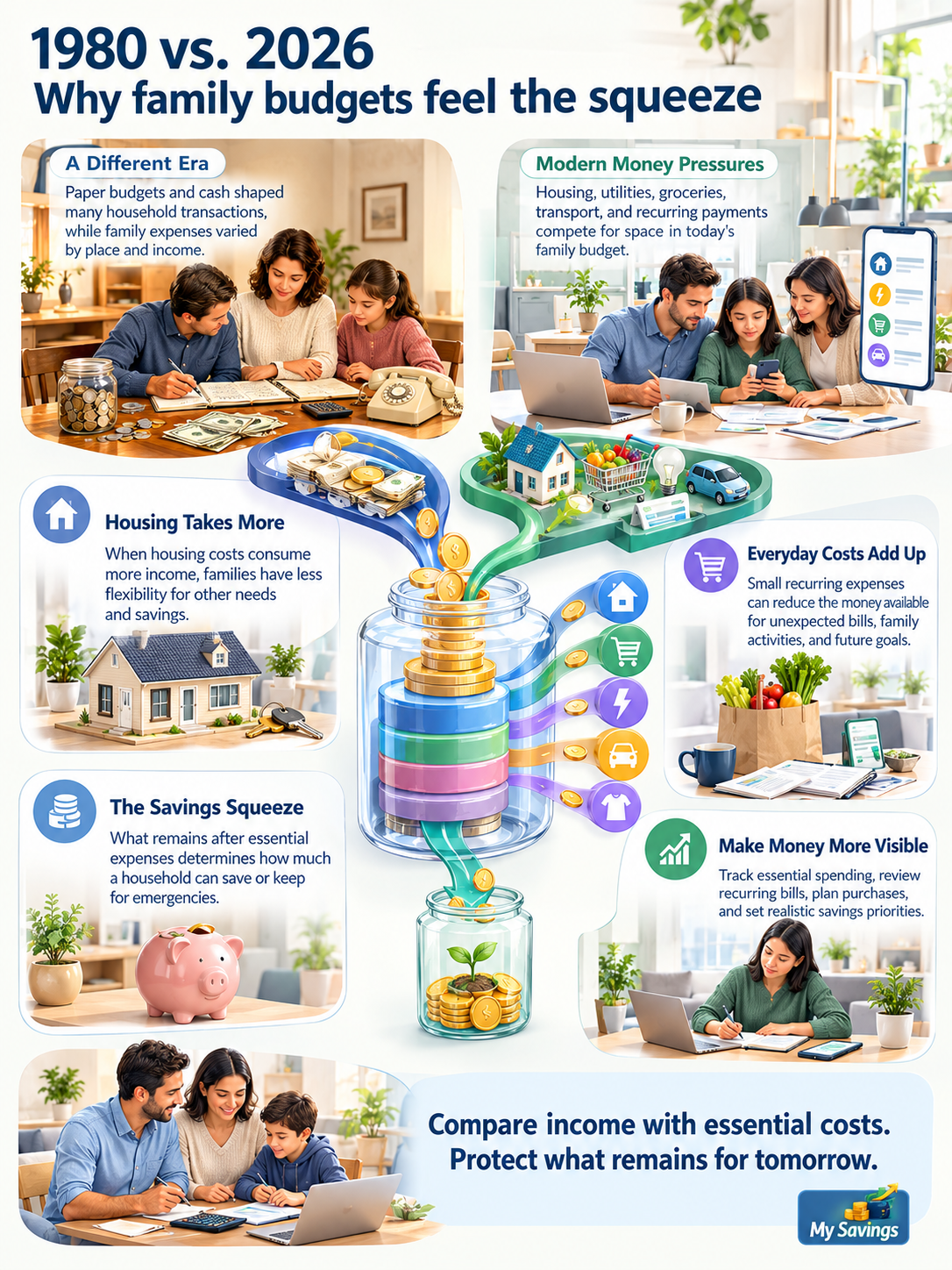
A home, reliable transport, childcare and enough money left over to save have long been part of the picture of a comfortable family life. Yet for many households, balancing these essentials feels increasingly difficult. The difference is not just about what things cost, but how much of a family’s income remains after the bills are paid.
Imagine a family trying to build a secure future. They need a place to live, food on the table, transport for work and a way to care for their children. They also want to save for emergencies and enjoy a little breathing room between paydays.
Now imagine comparing that picture with the experience of a family living decades earlier. The costs, employment arrangements and expectations may look different. A comparison between 1980 and 2026 invites a difficult question: has earning a living become more demanding than building a life with that income?
A popular then-and-now infographic explores this concern through five areas: workers, housing, housing costs, cars and childcare. Its message is provocative, but its underlying question is worth examining carefully, especially for anyone trying to manage a household budget today.
A bigger household income does not automatically create a more affordable life.
One Income or Two: What Has Changed?
The infographic contrasts a household supported by one worker in 1980 with a modern household in which two people may need to earn an income to cover essential expenses.
This comparison captures a familiar financial concern: when housing, transport, childcare and other necessities consume a larger share of available earnings, a second income may help a family meet its obligations without necessarily creating more disposable money.
However, household arrangements differ. Two incomes can provide greater financial flexibility, while a single-income household may face different costs and responsibilities. The number of earners alone does not establish whether a family is financially comfortable.
One primary income
The infographic presents a household in which one worker could support the family’s expected standard of living.
Two incomes under pressure
The infographic describes families relying on two earners while still struggling to cover the costs associated with everyday life.
From a Three-Bedroom House to the Search for a Smaller Home
Housing sits at the centre of the infographic’s argument. It contrasts a three-bedroom house in 1980 with the difficulty of securing even a two-bedroom home in 2026.
The underlying issue is the relationship between the price of a home and the income available to buy it. A house can become harder to afford even when a household earns more money, if the purchase price rises faster than its ability to save for a deposit and manage mortgage repayments.
The infographic’s picture of a more attainable family home.
The infographic’s picture of a more difficult housing market.
These descriptions are illustrative rather than universal. Home prices and affordability vary by location, household income, property type and financing conditions. Still, the comparison highlights why housing deserves a central place in any long-term financial plan.
Why the Relationship Between Home Prices and Earnings Matters
The infographic claims that housing costs have shifted from around three to four times annual income in 1980 to eight to ten times annual income in 2026.
If such a comparison applies to a particular housing market, it illustrates a substantial affordability challenge. A higher price-to-income ratio generally means a household needs more years of income to match a property’s purchase price, before accounting for taxes, living expenses, interest and other costs.
The ratios above are figures presented by the infographic, not independently verified statistics for every country or housing market. They should not be treated as universal measurements without a defined location, data source and comparison method.
For personal financial planning, the practical question is more immediate: how much of your monthly income can you reasonably commit to housing while still covering essential expenses, saving for emergencies and preparing for future needs?
Owning a Car Versus Paying for Two Vehicles
Another contrast in the infographic is the move from owning one car outright to relying on financing for two vehicles.
A vehicle payment can become a significant recurring commitment. When a household finances multiple vehicles, the budget must accommodate the repayments alongside fuel, insurance, maintenance and other transport-related expenses.
Financing is not automatically a poor decision, and owning a car outright does not make transportation free. The key distinction is whether the total cost of the chosen transport arrangement fits the household’s needs and income.
A vehicle should support your financial life, not quietly consume the money needed to build it.
Review the full cost of transport rather than focusing on the monthly instalment alone.
The Cost of Caring for Children
The infographic contrasts childcare described as free in 1980 with expensive professional childcare in 2026. Its earlier example may reflect stay-at-home parenting or support from relatives and the wider community rather than an absence of costs associated with raising children.
Modern childcare arrangements can introduce a substantial expense for working parents. At the same time, unpaid care has its own financial implications, including the possibility that one parent reduces paid working hours or steps away from employment.
A fair comparison therefore needs to consider both direct payments and the income, time and employment choices involved in caring for children. The experiences of families differ, and no single arrangement describes every household.
“One income bought a life. Now two barely buy survival.”
This is the infographic’s central message: a household may earn more in total and still feel financially stretched when essential costs take up much of its income.
The closing claim, “That’s not inflation. That’s a different game,” expresses an argument about structural changes in affordability, not a demonstrated conclusion that inflation is irrelevant. Rising prices, income growth, housing markets, household choices and access to support can all influence the financial picture.
Five Ways to Protect Your Household Finances
You cannot control every change in the economy, and budgeting alone cannot solve a housing affordability crisis. But understanding your own finances can help you make clearer decisions about the money you have.
Know where your money goes
Track your take-home income, household bills, food, transport, childcare and debt repayments. A clear picture of your spending helps identify where your money is being committed each month.
Prioritise essential expenses
Separate essential costs from flexible spending. Focus first on housing, food, utilities, necessary transport and other obligations that keep your household running.
Build an emergency reserve
Set aside an amount that suits your circumstances, even if you need to begin with small, regular contributions. A reserve can help you handle unexpected bills without immediately relying on borrowing.
Look beyond monthly payments
Before committing to a home, car or other major expense, consider the overall cost, ongoing bills and how the commitment affects your ability to save.
Give your savings a purpose
Define what you are saving for, whether it is an emergency reserve, a home deposit, education or future family needs. Clear goals can help you decide how much to set aside and which expenses to reconsider.
Key Ideas to Take Away
- The infographic highlights concerns about the relationship between household income and the cost of essential needs.
- Housing affordability depends on property prices relative to income, not simply on whether earnings have increased.
- Transport and childcare commitments can affect how much money remains available for other priorities.
- Comparisons between 1980 and 2026 need local context and reliable data before their numerical claims can be generalised.
- A realistic budget, an emergency reserve and thoughtful borrowing decisions can support greater financial resilience.
Financial Security Is About More Than Earning a Paycheque
The comparison between 1980 and 2026 raises a question that matters to anyone managing a household: after paying for the essentials, is there enough left to prepare for tomorrow?
The answer will differ across countries, generations and families. The infographic expresses a real concern about affordability, but its broad comparisons should be treated as a starting point for discussion rather than a complete account of economic history.
For readers of My Savings, the practical lesson is to understand the pressures affecting your household, make deliberate financial choices and build savings around your own needs and priorities. You may not be able to change the cost of everything, but you can work towards making your financial decisions more informed.
Your income supports today. Your savings help you prepare for tomorrow.