💡 Planning to buy a home but unsure how much you can truly afford? This comprehensive guide breaks down the powerful 28/36 rule—a trusted method used to calculate a safe and realistic home budget. 🏡 Learn how to determine your ideal monthly housing costs, estimate your loan eligibility, and convert your budget into a practical home price range.
📊 With clear formulas, real-world examples, and expert insights, this article helps simplify complex financial decisions. Discover how factors like interest rates, existing debt, and down payments can significantly impact your affordability.
🔑 Whether you’re a first-time buyer or planning your next investment, this guide equips you with actionable strategies to avoid financial stress and make informed decisions. Start your journey toward confident homeownership today with smarter budgeting techniques and realistic expectations. 🚀
🏡Why Smart Budgeting Matters in Home Buying
Buying a home is one of the most significant financial decisions an individual can make. However, many buyers rely on rough guesses or lender estimates without fully understanding what they can comfortably afford. This often leads to financial strain, unexpected expenses, or long-term debt challenges.
A structured approach to budgeting eliminates uncertainty and provides a clear roadmap. One of the most effective and widely used frameworks is the 28/36 rule, which acts as a financial guardrail to ensure sustainable homeownership.
This guide explains how to use this rule, calculate your ideal housing budget, estimate your loan size, and understand the hidden factors that influence affordability.
📊 Understanding the 28/36 Rule
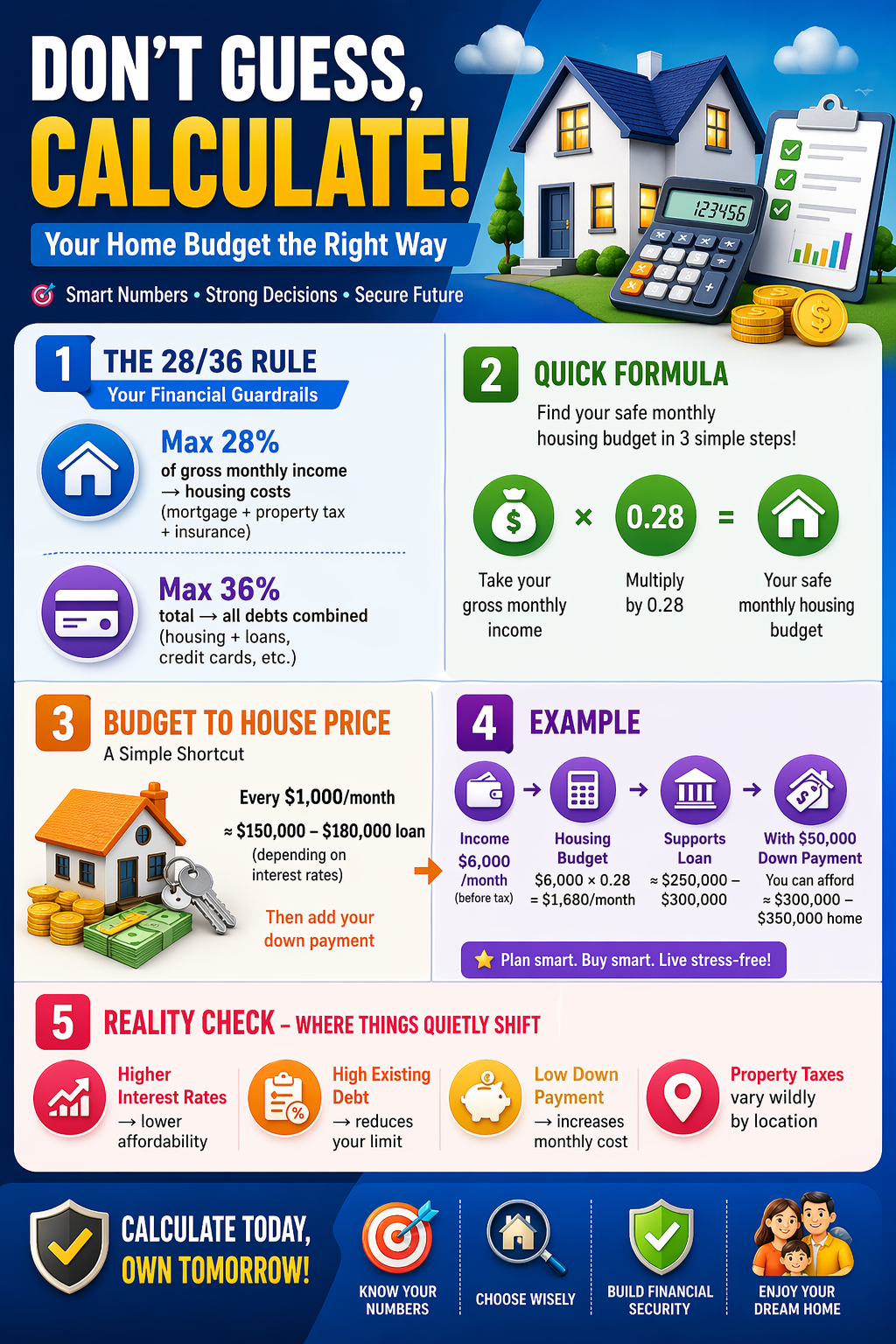
The 28/36 rule is a simple yet powerful guideline used in personal finance and mortgage lending. It defines safe limits for housing expenses and total debt obligations based on gross monthly income.
✅ The Two Key Components
- 28% Rule (Housing Costs):
No more than 28% of your gross monthly income should go toward housing expenses.
This includes:- Mortgage payments
- Property taxes
- Home insurance
- 36% Rule (Total Debt):
Your total monthly debt payments should not exceed 36% of your gross income.
This includes:- Housing costs
- Personal loans
- Credit card payments
- Car loans
This dual limit ensures that housing remains affordable while leaving room for other financial responsibilities.
🧮 How to Calculate Your Home Budget
Applying the 28% rule is straightforward and provides a reliable starting point for planning.
💡 Step-by-Step Formula
- Determine your gross monthly income (before taxes).
- Multiply it by 0.28.
- The result is your maximum safe monthly housing budget.
📌 Example Calculation
If your monthly income is $6,000:
- Housing Budget = $6,000 × 0.28
- Housing Budget = $1,680 per month
This amount represents what you can safely allocate to housing without stretching your finances.
🏠 Converting Budget into House Price
Once you know your monthly housing budget, the next step is estimating how much home you can afford.
🔑 Simple Conversion Rule
A practical shortcut used in financial planning:
- Every $1,000/month in housing budget ≈ $150,000–$180,000 loan
This range depends on factors such as:
- Interest rates
- Loan duration
- Credit profile
📊 Applying the Conversion
Using the previous example:
- Monthly Budget: $1,680
- Estimated Loan Range: $250,000–$300,000
➕ Adding a Down Payment
If you have savings for a down payment, it increases your total purchasing power.
- Example Down Payment: $50,000
- Total Home Price Range: $300,000–$350,000
This combined approach provides a realistic estimate of what you can afford in the current market.
📉 Key Factors That Affect Affordability
While formulas provide a solid baseline, real-world conditions can significantly impact your buying power.
📈 1. Interest Rates
Higher interest rates increase monthly payments, reducing affordability. Even a small rate change can shift your budget dramatically.
💳 2. Existing Debt
If you already have loans or credit obligations, they reduce your available margin under the 36% rule. This directly lowers your maximum home budget.
💰 3. Down Payment Size
- Higher down payment: Lower monthly costs and better loan terms
- Lower down payment: Higher monthly payments and possible insurance costs
📍 4. Property Taxes and Location
Taxes vary widely depending on the location. Areas with high property taxes can significantly increase monthly housing expenses.
⚠️ Common Mistakes to Avoid
Even with a reliable framework, certain mistakes can lead to financial stress.
🚫 Overestimating Affordability
Relying solely on lender approval can result in taking on more debt than comfortable.
🚫 Ignoring Hidden Costs
Maintenance, utilities, and repairs are often overlooked but add to the overall cost of ownership.
🚫 Skipping Emergency Planning
A lack of financial cushion can create challenges during unexpected events such as job changes or repairs.
🧠 Strategic Tips for Smarter Home Budgeting
To maximize financial stability and long-term comfort, consider these strategies:
✔️ Stay Below the Maximum
Using less than 28% for housing provides flexibility for savings and lifestyle expenses.
✔️ Improve Credit Score
A higher credit score can secure better interest rates, reducing monthly payments.
✔️ Increase Savings Before Buying
A larger down payment reduces loan size and improves affordability.
✔️ Monitor Market Trends
Understanding rate changes and housing trends helps in making informed decisions.
📊 Why the 28/36 Rule Still Matters Today
Despite evolving financial products and lending practices, the 28/36 rule remains relevant due to its simplicity and effectiveness. It provides a structured, risk-aware approach to home buying that prioritizes long-term stability over short-term gain.
Modern buyers benefit from combining this rule with digital tools, financial planning apps, and market analysis to create a comprehensive affordability strategy.
🏁 Plan Smart, Buy Confidently
Homeownership should be a step toward financial growth, not stress. By using the 28/36 rule, buyers can clearly define their limits, avoid overextension, and make confident decisions backed by logic and data.
Understanding your true budget, factoring in real-world conditions, and planning strategically ensures a smoother and more sustainable home buying journey.