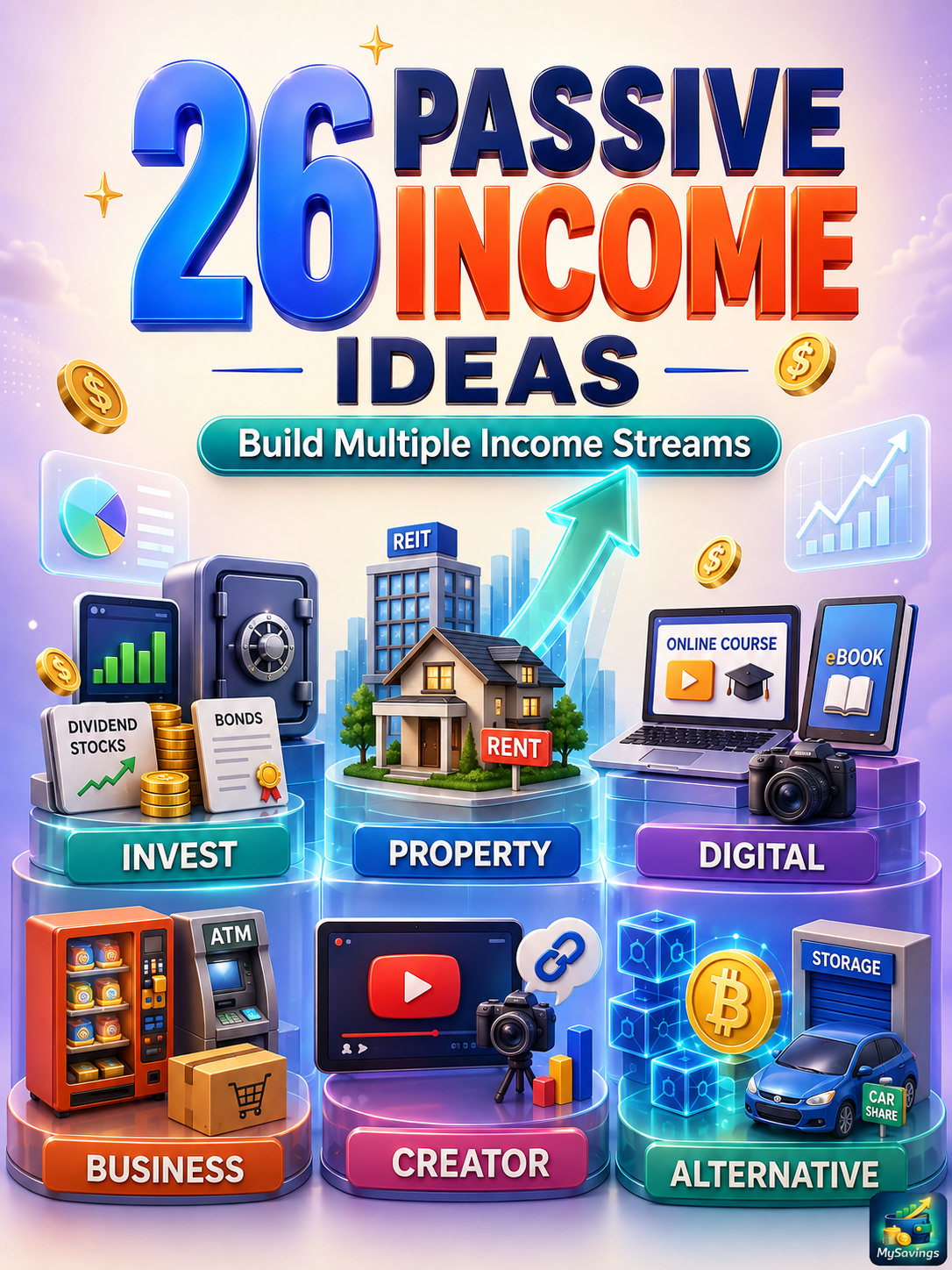
💰 Building passive income can create additional cash flow while reducing reliance on a single paycheck. This guide explores 26 passive income ideas, from dividend stocks, high-yield savings accounts, bonds, REITs, and rental property to digital products, affiliate marketing, blogging, YouTube, stock media, and creator-focused opportunities.
📈 The article explains how income streams work, what level of effort or capital they may require, and which options can be more scalable over time. It also covers alternative models such as P2P lending, vending machines, storage units, car sharing, house hacking, laundromats, dropshipping, Amazon FBA, and crypto mining.
🧭 Whether the goal is to generate supplemental income, diversify investments, or build long-term financial resilience, the key is understanding risk, liquidity, taxes, operating costs, and realistic returns before committing capital.
✨ Explore the 26 ideas and identify opportunities that fit your financial goals, resources, and level of involvement.
💡 What Is Passive Income?
Passive income refers to money generated from an asset, investment, business system, or intellectual property that does not require continuous active labor for every dollar earned.
The term can be misleading, however. Most passive income streams require some combination of initial capital, research, setup, maintenance, management, or ongoing optimization. The difference is that the income may continue without requiring the same amount of direct effort as a traditional hourly or salaried job.
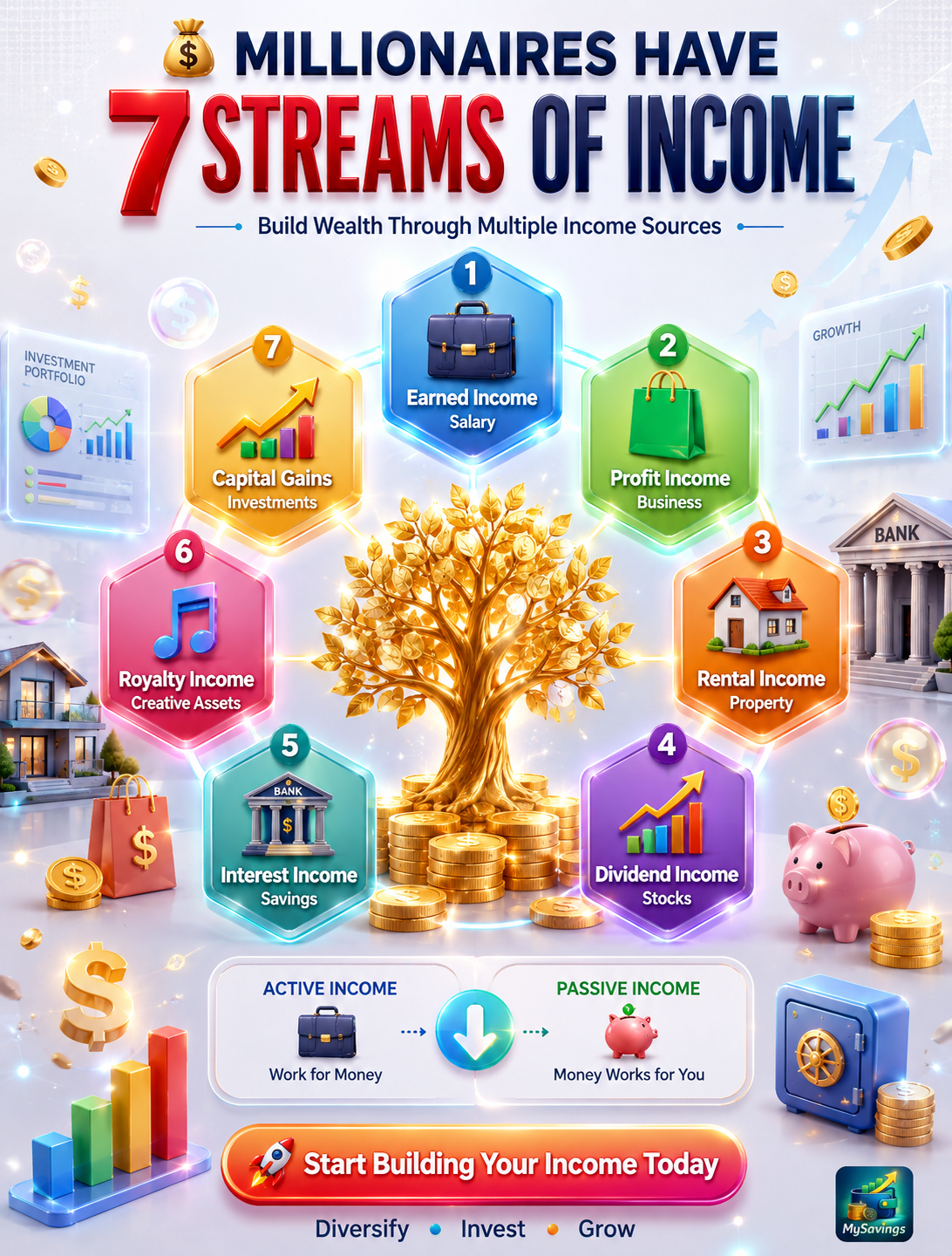
Building multiple income streams can potentially improve financial flexibility and diversify sources of cash flow. Instead of depending entirely on one salary or business, individuals can combine investments, property, digital assets, and automated business models.
The 26 ideas below cover a wide range of approaches, from relatively simple savings products to more complex businesses.
📈 Investment-Based Passive Income Ideas
Investment-based income streams can be attractive because they may require less day-to-day involvement once established. However, returns are never guaranteed, and risk varies significantly between assets.
💵 1. Dividend Stocks
Dividend stocks are shares of companies that distribute part of their profits to shareholders. Investors may benefit from both potential share-price appreciation and dividend payments.
Dividend investing is often associated with long-term wealth building because reinvested dividends can compound over time. Investors should consider company fundamentals, dividend sustainability, valuation, diversification, and market risk before investing.
🏦 2. High-Yield Savings Accounts
High-yield savings accounts can provide interest income while keeping money relatively accessible.
They may be useful for emergency funds, short-term savings, or cash that is waiting to be invested. The primary advantage is simplicity, although interest rates can change and inflation can reduce real purchasing power.
🏢 3. REITs
Real Estate Investment Trusts, or REITs, allow investors to gain exposure to income-producing real estate without directly purchasing and managing a property.
REITs can provide potential dividend income while offering access to areas such as commercial property, residential real estate, healthcare facilities, and infrastructure.
📜 4. Bonds
Bonds represent loans made to governments, municipalities, or companies. In return, investors generally receive interest according to the bond’s terms.
Bonds can play a role in income-focused portfolios, although they carry risks such as interest-rate changes, inflation, and issuer default.
🤝 5. P2P Lending
Peer-to-peer lending platforms connect borrowers with investors willing to provide loans.
Investors may receive interest payments in exchange for accepting credit risk. Diversification across multiple loans can be important, but P2P lending should not be treated as risk-free income.
⛏️ 6. Crypto Mining
Crypto mining involves using computing resources to help process and secure certain blockchain networks.
Potential income depends on cryptocurrency prices, mining difficulty, electricity costs, hardware efficiency, network conditions, and regulatory considerations. Because these variables can change significantly, crypto mining is generally more speculative than traditional savings or investment products.
🏠 Property-Based Passive Income Ideas
Real estate can generate income through rent, property appreciation, or specialized property models. It can also involve considerable costs and management requirements.
🏘️ 7. Rental Property
Rental properties can generate recurring rental income while potentially appreciating over the long term.
Investors need to account for mortgage payments, property taxes, insurance, maintenance, vacancies, repairs, property management, and local regulations when calculating potential returns.
🏡 8. House Hacking
House hacking involves using a primary residence to generate rental income, such as renting out rooms or separate living areas.
When structured appropriately, rental income may help offset housing expenses. Local zoning, financing rules, insurance, tenant laws, and privacy considerations should be evaluated beforehand.
🛏️ 9. Short-Term Rentals
Short-term rentals can generate income by renting furnished properties for shorter stays.
Revenue potential depends on location, seasonality, occupancy, pricing, property quality, and local tourism demand. Hosts must also consider cleaning, guest communication, platform fees, licensing, and local short-term rental restrictions.
📦 10. Storage Units
Self-storage facilities can generate recurring revenue from customers who need space for personal or business belongings.
Compared with traditional residential rentals, storage businesses may have different maintenance and management requirements. Location, occupancy, security, insurance, operating costs, and competition are important factors.
💻 Digital Income Opportunities
Digital products can be particularly scalable because the same product can potentially be sold repeatedly without manufacturing a new physical item for every customer.
📚 11. Selling eBooks
eBooks can turn knowledge, research, educational material, or creative content into a digital product.
Once published, an eBook can potentially continue generating sales with relatively low distribution costs. Success depends on topic selection, content quality, discoverability, pricing, and effective distribution.
🎓 12. Selling Online Courses
Online courses allow creators and businesses to package educational content into structured learning experiences.
A course may include videos, worksheets, presentations, quizzes, or downloadable resources. Although course sales can become scalable, creating quality material and keeping it updated requires ongoing work.
🌐 13. Blogging
A blog can generate income through advertising, affiliate partnerships, sponsored opportunities, digital products, or memberships.
A strong blog generally focuses on useful, searchable information that answers specific audience questions. Consistent publishing, topical authority, internal linking, and accurate information can improve long-term visibility.
📸 14. Selling Stock Photos
Photographers and visual creators can license photographs through stock media platforms.
Popular categories include business, lifestyle, technology, travel, finance, food, and everyday activities. A large, well-organized portfolio can create opportunities for repeated licensing revenue.
🎥 15. Selling Stock Videos
Video footage can also be licensed for use in advertisements, websites, presentations, social media, documentaries, and other productions.
High-quality footage with clear commercial applications can become a reusable digital asset. Demand varies by subject, technical quality, licensing terms, and market trends.
🛒 Online Business Models
Some online businesses can be systemized, outsourced, or automated to reduce daily involvement. They should still be considered active businesses during their setup and optimization stages.
📦 16. Amazon FBA
Amazon FBA, or Fulfillment by Amazon, allows sellers to send inventory to fulfillment centers where orders can be stored, packed, and shipped.
The model can simplify logistics, but sellers still need to manage product selection, inventory, advertising, pricing, fees, returns, and competition.
🛍️ 17. Electronic Commerce
An e-commerce business can sell physical or digital products through an online storefront.
Automation tools can help with payments, order processing, customer communication, and inventory management. However, profitability depends on margins, customer acquisition costs, product demand, fulfillment, and competition.
🚚 18. Dropshipping
Dropshipping allows an online seller to market products without necessarily holding inventory themselves. When a customer places an order, the supplier fulfills it.
The model can reduce upfront inventory requirements but may involve supplier risks, shipping delays, product-quality issues, refunds, and relatively competitive margins.
🤖 19. Vending Machines
Vending machines can generate recurring revenue from convenient, automated product sales.
The business becomes more attractive when machines are placed in locations with consistent foot traffic. Inventory replenishment, maintenance, payment processing, theft prevention, and location agreements remain important operational considerations.
🏧 20. ATM Business
An ATM business can potentially generate transaction-related revenue when machines are placed in suitable locations.
Profitability depends on transaction volume, surcharge structures, machine costs, cash management, maintenance, compliance requirements, and location agreements.
🚗 Asset-Sharing and Service-Based Models
Some income models involve turning existing assets or specialized infrastructure into revenue-generating resources.
🚙 21. Car Sharing
Car-sharing platforms can allow vehicle owners to rent their cars to other users.
This model may generate additional income from an underused vehicle, but owners should consider depreciation, insurance, maintenance, cleaning, mileage, platform fees, and potential damage.
🧺 22. Laundromats
Laundromats can provide recurring revenue from customers paying to use washing and drying equipment.
Modern payment systems, efficient machines, remote monitoring, and professional maintenance can reduce operational friction. Location and utility costs remain critical to the business model.
📣 Audience and Creator Income
An established audience can become a valuable digital asset when paired with useful content and relevant monetization channels.
🔗 23. Affiliate Marketing
Affiliate marketing involves recommending products or services and receiving a commission when qualifying purchases or actions occur through tracked referrals.
It can work through blogs, newsletters, social media, videos, or niche websites. The strongest approach is generally to promote products that genuinely match the audience’s needs and provide clear, useful information.
▶️ 24. YouTube Channel
A YouTube channel can potentially generate revenue through advertising, sponsorships, memberships, affiliate marketing, and digital products.
Older videos may continue attracting viewers after publication, creating a potentially durable content asset. Building that library generally requires consistent content production and audience development.
🎨 25. Creator Fund
Creator-focused monetization programs can reward eligible creators based on platform-specific performance or participation criteria.
Because program rules, eligibility, and compensation structures can change, creators should review current platform requirements and avoid relying on a single monetization source.
💰 26. Following Mastering Wealth
The final idea represented in the infographic is following Mastering Wealth, which reflects the broader concept of learning from established financial education resources and wealth-building frameworks.
Rather than treating any single strategy as a guaranteed income source, financial education can help individuals understand investing, diversification, budgeting, risk management, and long-term wealth creation.
The most useful financial knowledge is actionable: understanding how an income stream works, what can go wrong, how much capital it requires, and how its potential return compares with its risks.
🧭 How to Choose the Right Passive Income Idea
There is no universally best passive income strategy. The right option depends on available capital, skills, time, risk tolerance, financial goals, and access to suitable assets or markets.
🟢 Low-capital options: Blogging, affiliate marketing, digital products, stock photography, and content creation may require more time than money during the initial stage.
🔵 Investment-focused options: Dividend stocks, bonds, high-yield savings accounts, and REITs can provide exposure to financial assets with varying degrees of risk and liquidity.
🟣 Property-focused options: Rental property, house hacking, short-term rentals, and storage units may require substantial capital and ongoing management.
🟠 Business-focused options: Vending machines, laundromats, ATMs, e-commerce, Amazon FBA, and dropshipping require operational planning and business oversight.
📊 What Should You Consider Before Starting?
A passive income strategy should be evaluated using more than its advertised return.
🔍 Initial investment: Determine how much money is required to start and whether that capital can be comfortably committed.
🧮 Expected cash flow: Estimate realistic revenue after fees, taxes, maintenance, vacancies, platform charges, and other expenses.
⚠️ Risk: Consider market volatility, credit risk, business failure, regulatory changes, asset depreciation, and potential loss of capital.
💧 Liquidity: Some investments can be sold quickly, while real estate, businesses, and equipment may take considerably longer to convert into cash.
⏱️ Time commitment: A business described as passive may still require customer support, maintenance, marketing, accounting, or management.
🧾 Taxes: Different income sources can receive different tax treatment. Professional tax guidance may be appropriate when income becomes significant or complex.
🌱 Why Multiple Income Streams Matter
Multiple income streams can provide diversification. If one source declines, other sources may continue generating cash flow.
However, diversification does not mean adding as many income sources as possible. Managing too many unrelated ventures can increase complexity, costs, and risk.
A more practical approach is to build a small number of complementary income streams. For example, an investor might combine traditional investments with a digital asset such as a blog, online course, or stock-media portfolio.
The goal is not simply to collect income streams. The goal is to build sustainable cash flow supported by sensible risk management and long-term planning.
🚀 Building a Sustainable Passive Income Strategy
The 26 ideas in this guide range from traditional financial investments to digital products, real estate, automated businesses, and creator opportunities.
The strongest starting point is usually education and comparison. Evaluate each model according to its capital requirements, potential return, risk, liquidity, scalability, and workload.
A passive income strategy should also evolve over time. As capital grows, some people may move from low-risk cash products toward diversified investments or income-producing assets. Others may prioritize scalable digital businesses that require more effort initially but can become increasingly efficient.
Ultimately, passive income is less about finding one magical source of money and more about building assets and systems that can produce value repeatedly.
💎 Key Takeaway
There are many ways to pursue passive income, but every opportunity comes with trade-offs.
From dividend stocks and REITs to rental properties, eBooks, online courses, affiliate marketing, YouTube, e-commerce, vending machines, and other business models, the right choice depends on individual financial circumstances and objectives.
The most sustainable approach is to understand the economics first, manage risk carefully, diversify intelligently, and focus on income streams that can realistically be maintained over the long term.