📈 Maximizing profitability requires a clear understanding of corporate finance fundamentals, specifically the distinction between Capital Expenditures (CapEx) and Operational Expenditures (OpEx). For small business owners, corporate managers, and financial analysts alike, mastering how these two spending categories impact cash flow, tax liabilities, and long-term financial statements is critical. Strategic financial modeling depends entirely on correctly categorizing these costs to reflect a company’s true financial health.
Understanding CapEx vs OpEx ensures corporate investments align cleanly with overall financial objectives. Proper asset categorization prevents reporting errors, optimizes tax deductions, and presents a clear picture to stakeholders. This comprehensive guide breaks down the core definitions, pros and cons, real-world examples, and strategic considerations for managing both expenditure types.
🔍 Understanding Capital Expenditures (CapEx)
Capital Expenditures represent the funds a company invests to acquire, maintain, or upgrade physical and non-physical assets. These expenditures are designed to improve operational capacity over an extended period, spanning multiple tax years.
🏛️ Definition and Accounting Treatment
CapEx involves costs incurred to create future economic benefits. Instead of being fully expensed on the income statement in the year they are purchased, capital expenditures are capitalized. This means the asset is recorded on the balance sheet. Over time, the cost of the asset is systematically reduced through depreciation (for tangible assets like machinery) or amortization (for intangible assets like patents and multi-year software licenses).
🌟 The Advantages of CapEx
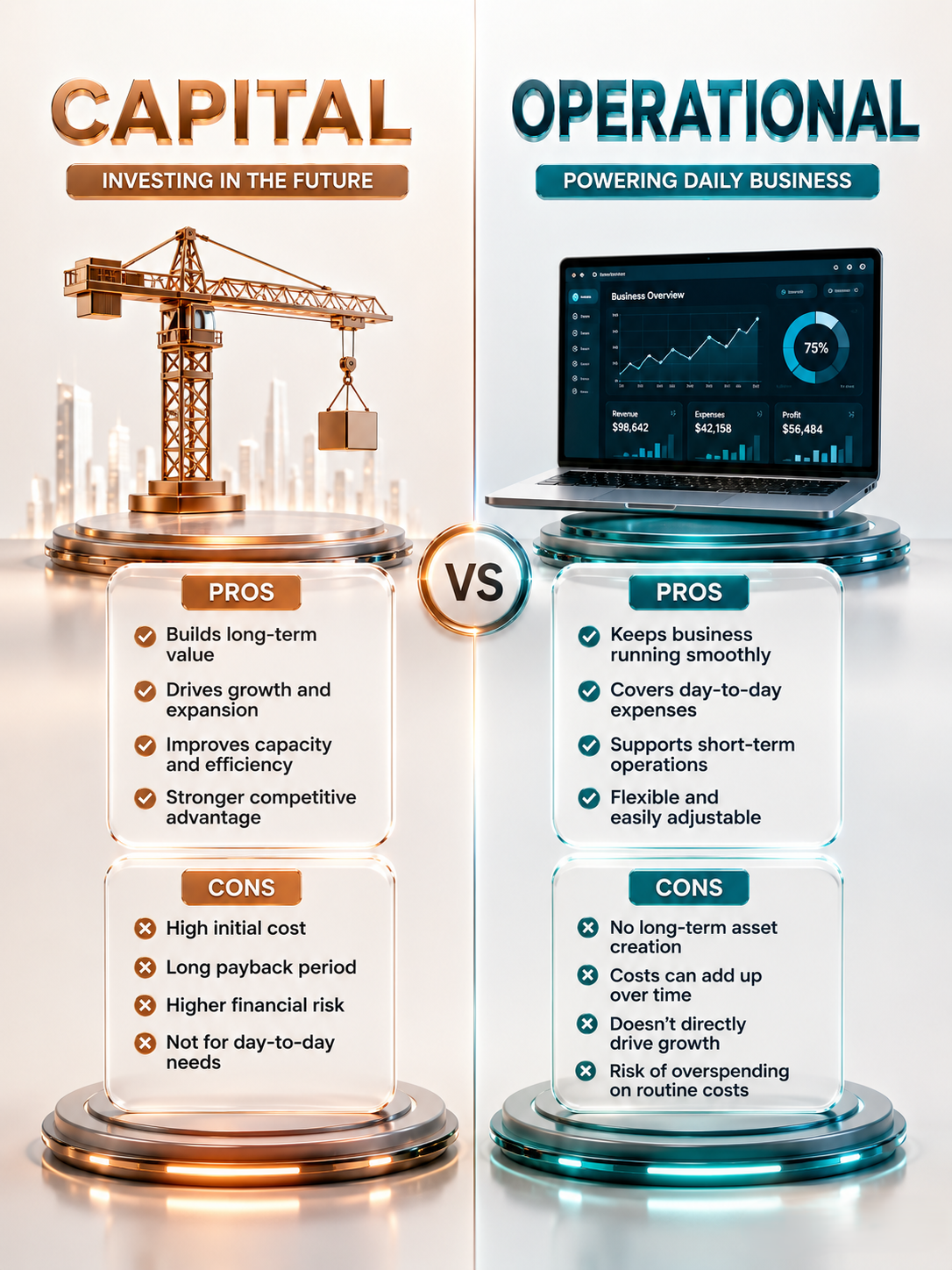
🛠️ Long-Term Asset Value Expansion: CapEx investments systematically build a company’s asset base. Increasing fixed assets enhances corporate net worth, strengthens the balance sheet, and provides collateral for securing future financing.
📈 Enhanced Efficiency and Competitive Advantage: Investing in advanced machinery, new factory buildings, or long-term software infrastructure directly leads to structural improvements. These upgrades boost long-term productivity, lower marginal production costs, and give enterprises a distinct competitive edge.
💰 Future Revenue Generation: Upgrading facilities or developing proprietary technology opens up new operational capabilities, paving the way for steady future income streams.
⚠️ The Drawbacks of CapEx
📉 Heavy Initial Cash Outflows: The primary disadvantage of CapEx is the substantial upfront cash requirement. Large capital outlays put significant pressure on immediate liquidity, which can strain working capital if not backed by robust financing.
🎲 Inherent Investment Risks: Capital investments carry long-term risks. There is no absolute guarantee that an expensive new facility or software deployment will yield the projected profits or efficiency gains, exposing the firm to potential asset impairment charges down the road.
⚙️ Deconstructing Operational Expenditures (OpEx)
Operational Expenditures are the ongoing, day-to-day costs required to keep a business running smoothly. Unlike capital investments, these expenses are fully consumed within the current accounting period.
📋 Definition and Financial Impact
OpEx covers the regular costs of business administration, sales, and core operations. On financial statements, operational expenditures are fully deducted from revenue in the same tax year they occur. Tracking OpEx is vital because it directly impacts net operating income and operating profit margins.
🌟 The Advantages of OpEx
⚡ Superior Cash Flow Flexibility: OpEx eliminates the need for massive upfront cash investments. Businesses can adopt a pay-as-you-go model, which preserves cash reserves and protects short-term liquidity.
🔄 High Agility and Market Scalability: Operational expenses provide businesses with the flexibility to quickly adjust spending levels based on fluctuating market demands, economic downturns, or changing consumer habits. For example, a business can easily scale its monthly software subscription seats up or down.
📉 Immediate Tax Relief: Because operational expenses are fully deducted in the year they are incurred, they immediately lower a company’s taxable income for that period, providing instant tax benefits.
⚠️ The Drawbacks of OpEx
💸 Susceptibility to Inflationary Pressure: OpEx costs, such as monthly rent, raw materials, utility bills, and labor salaries, tend to climb over time due to inflation. This can gradually erode operating margins if selling prices aren’t adjusted.
🏢 Absence of Long-Term Asset Equity: While OpEx keeps the business functional day to day, it does not build equity or long-term value. Once an operational expense is paid, that money is gone, leaving no tangible or intangible asset on the balance sheet to boost corporate value.
⚖️ Direct Comparison: CapEx vs OpEx
To optimize corporate financial strategies, decision-makers must compare how these two expenditure models operate side-by-side across core financial metrics.
| Financial Metric | Capital Expenditures (CapEx) | Operational Expenditures (OpEx) |
| Payment Timeline | Massive upfront investment | Regular, ongoing payments |
| Accounting Location | Balance Sheet (Asset) | Income Statement (Expense) |
| Tax Deductions | Spread over time via depreciation | Deducted completely in the current tax year |
| Value Horizon | Long-term future benefits | Short-term day-to-day utility |
| Risk Factor | High risk due to large cash lockup | Low risk with flexible commitment |
💡 Real-World Examples in Modern Business
Distinguishing between CapEx and OpEx becomes straightforward when looking at common corporate scenarios.
🏭 Typical CapEx Examples
🏢 Commercial Real Estate: Buying a new office building or constructing an industrial manufacturing plant.
🔧 Heavy Machinery: Purchasing production line equipment, specialized robotics, or delivery vehicle fleets.
💻 Core IT Infrastructure: Investing in dedicated physical servers or purchasing permanent enterprise software licenses used across multiple years.
📞 Typical OpEx Examples
💵 Employee Compensation: Monthly staff salaries, wages, sales commissions, and healthcare benefits.
🏠 Facility Overhead: Monthly office rent, property utilities, and routine equipment maintenance.
📣 Marketing and Growth: Ongoing digital advertising spend, public relations campaigns, and routine office supplies.
🛠️ Strategic Financial Management: Finding the Right Balance
Choosing between CapEx and OpEx is rarely a simple black-and-white decision. Modern corporate strategy often involves intentionally shifting costs between these two categories to optimize financial performance.
☁️ The Shift from CapEx to OpEx (The As-a-Service Model)
One of the most visible financial trends over the past decade is the transition from CapEx to OpEx, particularly within IT and technology infrastructure. Traditionally, setting up data operations required an enormous CapEx investment in physical servers, specialized cooling systems, and dedicated secure server rooms.
Today, companies largely bypass these upfront investments by using cloud computing services like AWS, Microsoft Azure, or Google Cloud. This shifts a massive initial capital outlay into a predictable, scalable monthly operational expense. This OpEx approach allows startups and scaling enterprises to access elite technology architecture without draining their initial cash reserves.
🎯 Key Decision Factors for Financial Leadership
When determining whether to allocate corporate funds via CapEx or OpEx, corporate financial officers assess several key variables:
🏢 Current Liquidity and Cash Reserves: Startups and capital-constrained small businesses typically lean toward OpEx models to protect their cash flow. Conversely, well-capitalized enterprises often prefer CapEx to secure lower long-term operating costs.
📊 Cost of Capital: If interest rates are high, borrowing capital to fund massive upfront investments becomes expensive. In these economic climates, OpEx strategies become highly attractive.
🔄 Technology Obsolescence Risk: In industries where technology evolves rapidly, buying equipment outright (CapEx) carries a high risk of obsolescence. Opting for operational leasing or subscription models (OpEx) ensures the company can easily upgrade to the latest tech without writing off depreciated assets.
📈 Driving Value Through Informed Spending
Successfully scaling an enterprise requires a balanced approach to both Capital and Operational Expenditures. CapEx builds the structural foundation and long-term asset value needed for future growth, while OpEx provides the day-to-day flexibility and operational agility required to navigate changing market landscapes. By accurately categorizing and balancing these expenses, financial leaders can optimize cash flow, maximize tax advantages, and build an agile, financially resilient business.