💡 Want to stop struggling with savings and finally see real results? This guide breaks down powerful, practical money-saving strategies that go beyond generic advice. 🚀 Learn how to control spending, avoid social pressure, track daily expenses, and build strong financial habits that actually stick. 📊 From smart budgeting techniques to the 24–48 hour rule for purchases, each step is designed to help you save more consistently and confidently. 💸 Discover how small behavioral changes can lead to long-term financial growth, improved money awareness, and better decision-making. 🌱 Whether you’re just starting your savings journey or looking to improve your current strategy, this article provides clear, actionable insights you can apply immediately. 🔑 Take control of your finances today and start building a future where your money works for you not the other way around.
💰 Why Saving Money Feels Hard (And How to Fix It)
Saving money is often presented as a simple concept spend less, save more. However, in reality, many people struggle to turn this idea into consistent action. The gap between knowing what to do and actually doing it comes down to behavior, habits, and environment.
Generic advice like “don’t go out” or “be mindful of spending” sounds helpful, but without clear, actionable steps, it rarely leads to real financial progress. To build sustainable savings, you need practical strategies that address everyday decisions.
This guide transforms common financial advice into real-world actions that can help improve financial stability, reduce unnecessary expenses, and build long-term wealth.
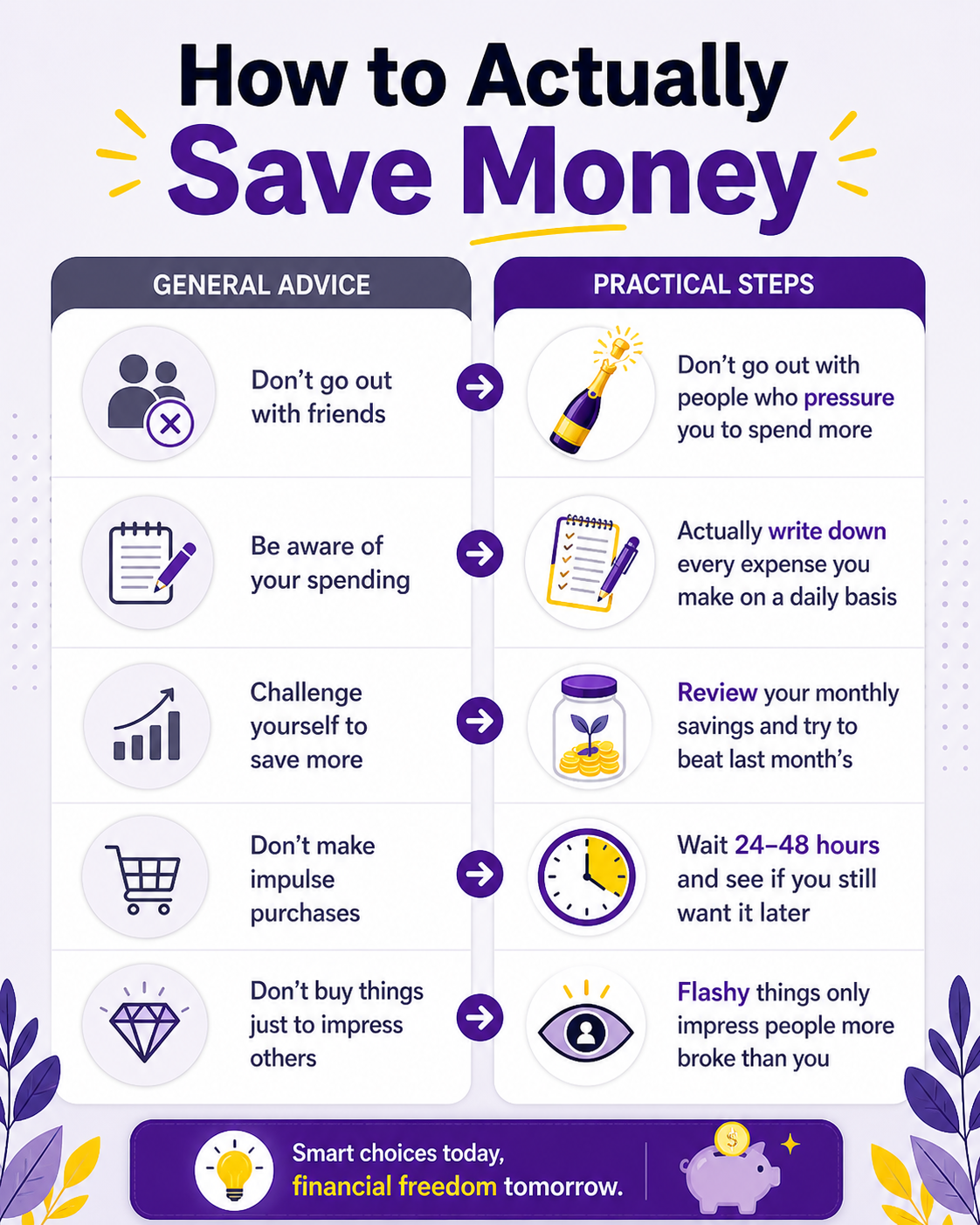
🧠 1. Control Social Spending Without Isolating Yourself
General Advice:
“Don’t go out with friends”
Practical Approach:
Avoid environments or people that pressure you to spend beyond your limits.
Social spending is one of the most common reasons people overspend. Dining out, entertainment, and group activities can quickly add up especially when influenced by peer pressure.
Instead of completely avoiding social interactions, focus on choosing financially aligned environments:
- Suggest budget-friendly activities
- Set spending limits before going out
- Be comfortable declining expensive plans
💡 Key Insight: Financial discipline doesn’t require isolation it requires intentional choices.
📊 2. Track Every Expense to Build Awareness
General Advice:
“Be aware of your spending”
Practical Approach:
Write down every expense you make on a daily basis.
Awareness is the foundation of financial control. Without tracking, it’s nearly impossible to identify where money is being lost.
Start with a simple system:
- Use a notebook, spreadsheet, or app
- Record every purchase, no matter how small
- Categorize expenses (food, transport, entertainment)
Over time, patterns will emerge. You’ll quickly identify:
- Unnecessary subscriptions
- Frequent small purchases
- Areas where spending can be reduced
💡 Key Insight: What gets tracked gets improved.
🎯 3. Turn Saving Into a Personal Challenge
General Advice:
“Challenge yourself to save more”
Practical Approach:
Review your monthly savings and aim to beat last month’s results.
Saving becomes more effective when it’s measurable and motivating. Treat it like a personal competition:
- Set monthly savings goals
- Track progress visually
- Reward consistency (without overspending)
This approach creates momentum. Even small improvements compound over time.
💡 Key Insight: Progress, not perfection, drives long-term savings success.
⏳ 4. Eliminate Impulse Purchases with the 24–48 Hour Rule
General Advice:
“Don’t make impulse purchases”
Practical Approach:
Wait 24–48 hours before buying anything non-essential.
Impulse spending is often emotional, not rational. Delaying purchases gives your brain time to evaluate:
- Do you really need it?
- Will it add long-term value?
- Can the money be better used elsewhere?
In many cases, the urge to buy fades within hours.
💡 Key Insight: Time is one of the most powerful tools for financial discipline.
👁️ 5. Stop Spending to Impress Others
General Advice:
“Don’t buy things just to impress others”
Practical Approach:
Understand that flashy purchases often impress people who are also financially struggling.
Spending to maintain an image is one of the fastest ways to drain your finances. Social media and cultural expectations can create pressure to appear successful.
Instead:
- Focus on financial security over appearance
- Prioritize value over brand names
- Define success based on your goals, not others’ opinions
💡 Key Insight: True financial strength is invisible it’s reflected in savings, not spending.
🔄 Building a Sustainable Saving System
Saving money is not about extreme restrictions it’s about building systems that support better decisions.
Combine These Strategies:
- Reduce social pressure spending
- Track daily expenses consistently
- Set measurable saving goals
- Delay non-essential purchases
- Avoid status-driven spending
When combined, these habits create a powerful financial framework that leads to long-term stability.
📈 The Psychology Behind Smart Saving
Understanding the psychology of spending helps reinforce these strategies:
- Emotional spending leads to regret
- Social influence increases unnecessary expenses
- Lack of awareness causes money leaks
- Delayed gratification improves financial outcomes
By addressing these factors, saving becomes easier and more natural.
💡 Advanced Tips to Maximize Savings
To further improve results, consider these additional methods:
1. Automate Savings
Set up automatic transfers to your savings account to remove the temptation to spend.
2. Use the “Pay Yourself First” Rule
Allocate a portion of your income to savings before covering expenses.
3. Set Clear Financial Goals
Whether it’s an emergency fund or a major purchase, goals provide direction and motivation.
4. Review Monthly Progress
Regular reviews help adjust strategies and maintain consistency.
🚀 Small Changes, Big Results
Saving money doesn’t require drastic lifestyle changes. Instead, it depends on small, consistent actions that build over time.
By transforming general advice into practical steps, you can:
- Reduce unnecessary expenses
- Improve financial awareness
- Build long-term savings habits
The key is not perfection it’s consistency.
Start with one strategy today, and gradually build a system that supports your financial growth.