What Are Personal Finance Slangs?
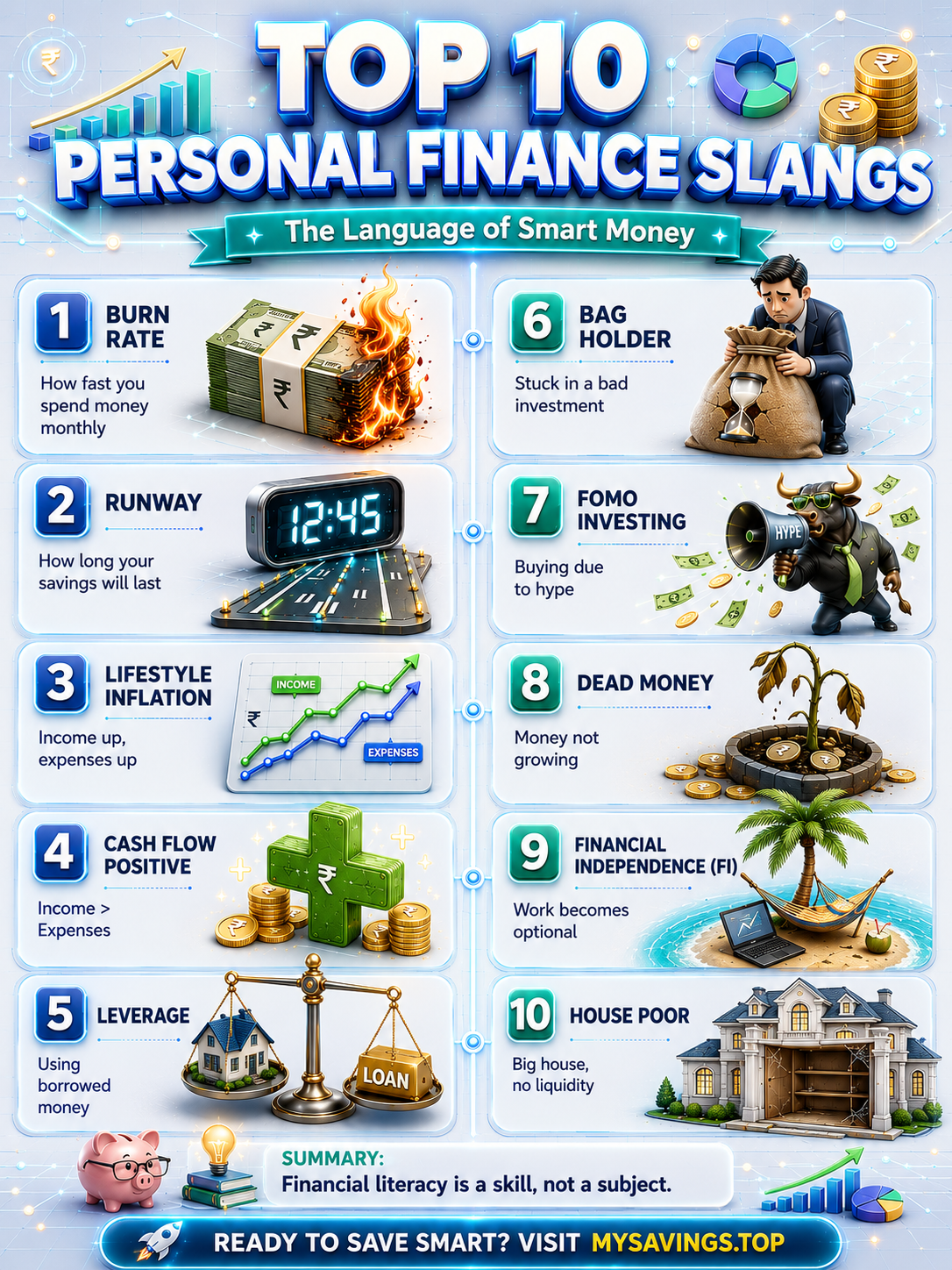
Personal finance slangs are informal terms and idioms used by investors and savvy savers to describe complex financial situations. Key terms include Burn Rate (monthly spending speed), Lifestyle Inflation (spending more as you earn more), and Financial Independence (when work becomes optional). Mastering these terms is the first step toward achieving professional financial literacy. 📈
Mastering the Language of Wealth: The Top 10 Personal Finance Slangs for Smart Money Management 💰
Ever felt like you were eavesdropping on a secret society when listening to finance experts? You hear terms like “burn rate” or “bag holder” and wonder if they’re talking about accounting or a high-stakes action movie. 🎬 Well, here is the truth: Financial literacy is a skill, not a subject. If you want to play the game of wealth, you have to speak the language.
At mysavings.top, we believe that understanding your money shouldn’t feel like deciphering ancient hieroglyphics. Whether you are just starting your savings journey or you are looking to optimize your portfolio, mastering these 10 slangs will help you make smarter decisions and sound like a pro in any boardroom. Let’s dive into the language of smart money! 🚀
1. Burn Rate: How Fast Are You Fueling Your Life? 🔥
In the world of startups, the Burn Rate is everything. In personal finance, it is equally vital. Simply put, your burn rate is how fast you spend money monthly.
If you earn $5,000 but your bills, groceries, and Netflix subscriptions total $4,500, your “fire” is burning hot. Monitoring this allows you to see if you are living sustainably or if you are one emergency away from financial trouble.
- Why it matters: Lowering your burn rate is the fastest way to increase your savings.
- Pro Tip: Track your “hidden” subscriptions; they often act as an invisible accelerant to your burn rate. 🕯️
2. Runway: Your Financial Safety Net Timeline ✈️
Once you know your burn rate, you can calculate your Runway. This term refers to how long your savings will last if your income suddenly stopped today.
Imagine you have $10,000 in the bank and your burn rate is $2,000 a month. You have a 5-month runway. In the finance world, having a long runway gives you the freedom to take risks, like starting a business or pivoting careers.
- Target: Aim for a runway of at least 3 to 6 months for ultimate peace of mind. 🧘♂️
3. Lifestyle Inflation: The Silent Wealth Killer 📈
This is perhaps the most dangerous slang on our list. Lifestyle Inflation occurs when your income goes up, and your expenses go up right along with it.
You get a 10% raise, so you move into a more expensive apartment and trade your reliable sedan for a luxury SUV. Suddenly, despite earning more, you aren’t actually any wealthier. Your “net” hasn’t grown because your spending expanded to meet your new salary. 🏎️💨
4. Cash Flow Positive: The Golden State of Finance ➕
Being Cash Flow Positive means your Income is greater than your Expenses. It sounds simple, but in a world driven by credit cards and “buy now, pay later” schemes, staying in the green is a massive win.
When you are cash flow positive, you have “extra” money at the end of the month to invest, save, or spend on experiences without guilt. This is the foundation of all wealth building. 🏗️
5. Leverage: Using Other People’s Money (OPM) ⚖️
Leverage is the act of using borrowed money to increase the potential return of an investment. The most common example is a mortgage. You use the bank’s money to buy an asset (a house) that you hope will increase in value.
- The Risk: Leverage is a double-edged sword. It can magnify your gains, but it can also magnify your losses if the investment goes south. Handle with care! ⚠️
6. Bag Holder: Avoiding the Investing Trap 🎒
Nobody wants to be a Bag Holder. This slang describes someone who is stuck in a bad investment that has plummeted in value.
Often, bag holders are people who bought into a “hype” stock at its peak and refused to sell as the price crashed, hoping it would “bounce back.” Eventually, they are left “holding the bag” of a worthless asset while everyone else has moved on. 📉
7. FOMO Investing: The Danger of Following the Crowd 📢
FOMO (Fear Of Missing Out) Investing is the act of buying due to hype. Whether it’s a new cryptocurrency or a trending tech stock, FOMO causes people to ignore fundamentals and throw money at things just because “everyone else is doing it.”
- The Moral: Decisions made in a panic are rarely profitable. Always do your own research (DYOR) before jumping in. 🕵️♀️
8. Dead Money: When Your Cash Goes to Sleep 😴
Dead Money refers to money that is not growing. If you have a large sum of cash sitting in a standard checking account with 0.01% interest, that is dead money.
While the money is safe, its purchasing power is actually shrinking due to inflation. To avoid dead money, you need to put your capital into assets—like high-yield savings accounts, stocks, or real estate—where it can work for you. 🪴
9. Financial Independence (FI): The Ultimate Goal 🏝️
Financial Independence is the point where work becomes optional. It means your investments and passive income generate enough cash to cover your burn rate indefinitely.
Achieving FI doesn’t mean you stop working; it means you have the freedom to choose what you do with your time without worrying about a paycheck. This is the “North Star” of the mysavings.top community. 🌟
10. House Poor: When Your Home Owns You 🏠
Being House Poor means you have a big house but no liquidity. Your home might be beautiful and worth a lot on paper, but because your mortgage, taxes, and maintenance take up such a huge chunk of your income, you have no cash left for travel, emergencies, or fun.
- Lesson: Just because a bank will lend you a certain amount doesn’t mean you should spend it all on a house. Keep your cash flowing! 💧
Building Your Financial Vocabulary for a Better Future 🏆
Understanding these 10 personal finance slangs is about more than just sounding smart at a dinner party. It is about identifying the patterns in your own life that are either building your wealth or draining it.
Financial literacy is the ultimate superpower. By managing your Burn Rate, avoiding Lifestyle Inflation, and striving for Cash Flow Positive status, you move closer to the ultimate prize: Financial Independence.
Don’t be a Bag Holder of bad habits! Start putting your Dead Money to work today.
Ready to grow your savings? Explore more guides at mysavings.top and take control of your financial destiny today! 🚀💸