🛍️ The Phantom Savings Trap: Why Sale Discounts Aren’t Saving You Cash 💸
We have all experienced that sudden rush of excitement when walking past a store banner announcing a massive 50% discount. 🏷️ Snagging a shiny new gadget or designer jacket marked down from $1,000 to $700 feels like winning a prize. 🛒
That psychological high tricks us into believing we just made $300 out of thin air. 🧠 In reality, your bank account did not gain three hundred dollars—it lost seven hundred dollars of actual liquid cash. 📉
Does buying items on sale actually save you money or increase spending?
Buying items on sale only saves money if you genuinely planned to purchase the product at full price beforehand. Discount marketing creates phantom savings by using high original anchor prices, encouraging consumers to spend out-of-pocket cash on unneeded items rather than growing their actual net worth.
Uncovering how retail marketing influences our brains changes how we shop forever. Let us explore how “phantom savings” work, and see how MySavings empowers you to build true wealth instead. 🚀
⚓ 1. The Psychology of Anchor Pricing and Retail Tricks 🧠
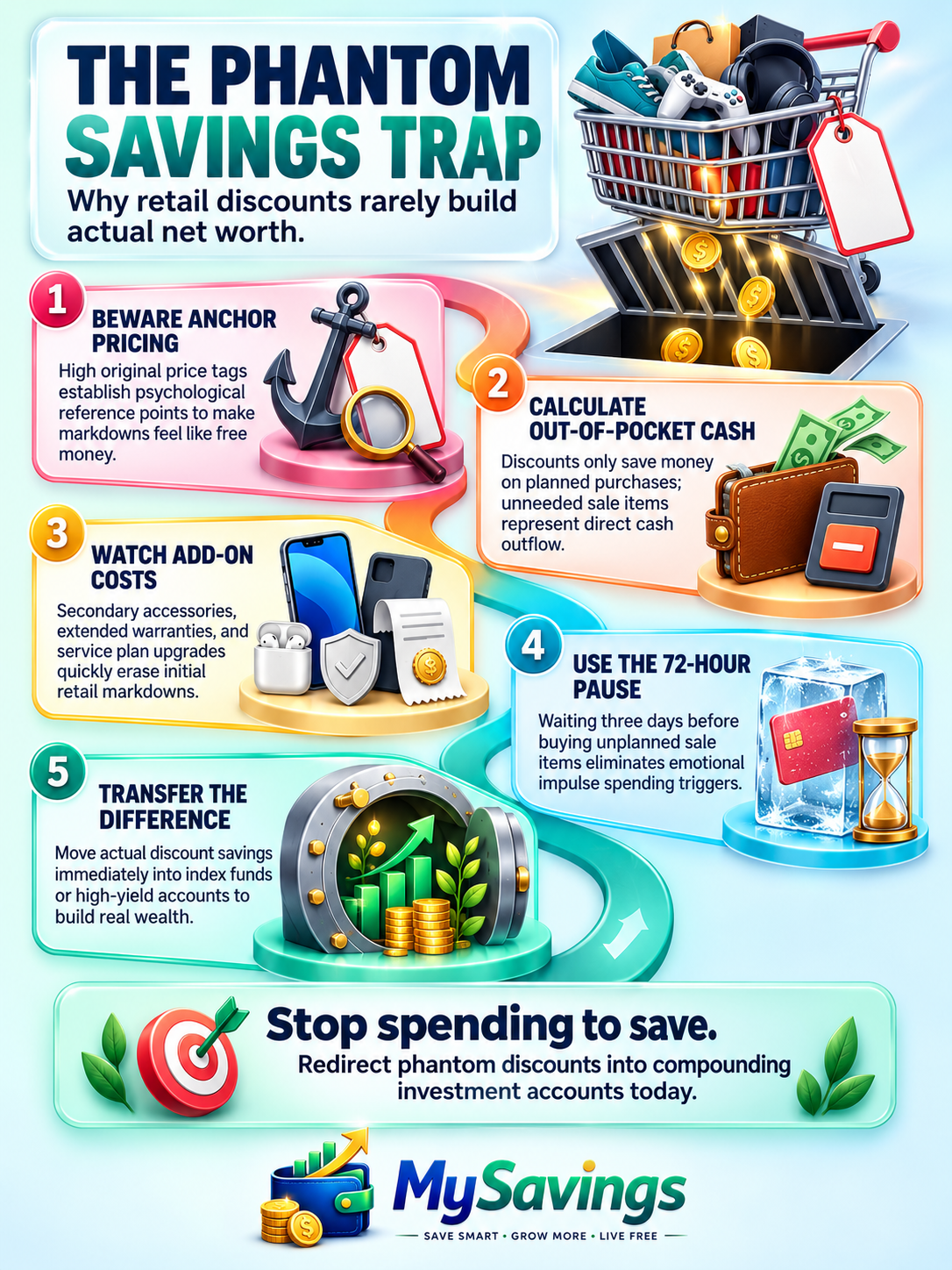
Stores rarely set original price tags by accident. 🏬 Marketing teams use a powerful cognitive bias known as anchor pricing to establish an artificially high reference point in your mind. 🎯
When you see an original price of $1,050 slashed down to $850, your brain focuses entirely on the $200 price drop. 🧮 That visual gap makes the purchase feel like an urgent bargain rather than a significant cash outflow. 💸
💡 The Anchor Effect: The first price you see establishes your perception of value, making discounted prices feel like free money.
🏷️ Urgency Badges: Countdown timers and “limited stock” warnings panic your brain into making fast impulse buys.
Recognizing these pricing tricks allows you to step back and evaluate purchases based on actual utility rather than marketing hype. 🛡️
You cannot spend your way to wealth! Unless you transfer the “discounted” difference directly into an investment account, you haven’t saved a single dime. 💎
📱 2. The Hidden Add-On Cascade and True Cost of Ownership 🛒
Buying a discounted high-ticket item is rarely the end of the transaction. 📱 Purchasing a smartphone on sale often triggers a cascade of secondary purchases that eat away your remaining budget. 📦
From protective cases and screen protectors to upgraded monthly service plans and extended warranties, add-on accessories quickly erase initial markdowns. 🎧 Knowing the total cost of ownership keeps your spending transparent. 🧭
📊 Phantom Discount vs. Real Cash Impact
| Purchase Scenario 🛒 | Perceived Outcome 🎁 | Actual Cash Flow 💵 | Net Worth Impact 📈 |
|---|---|---|---|
| Bought Unneeded $850 Phone on Sale 📱 | “Saved $200!” 🎉 | -$850 spent out-of-pocket 💸 | Net worth decreased 📉 |
| Skipped Sale & Kept Current Phone 📱 | “Missed the discount” 😅 | $0 spent out-of-pocket 🟢 | $850 preserved 🛡️ |
| Invested $850 in Index Funds 📈 | “No instant retail high” 🧘♂️ | $850 earning compound returns 🚀 | Net worth growing 🌲 |
Before hitting checkout, calculate the full bundle price including taxes, shipping, accessories, and maintenance! 🧮
💡 3. Turning “Phantom Savings” Into Real Compound Wealth 💰
Does this mean you should never buy items on sale? Absolutely not! 🛑 If an item was already on your written shopping list, securing a lower price is a legitimate win for your personal budget. 📝
The key to turning a retail discount into genuine wealth is making the “saved” money tangible. 🏦 If you budgeted $500 for a laptop and bought it for $400, immediately transfer that $100 difference into your high-yield savings account. 💸
📱 Execute Instant Transfers: Move the discounted difference into savings right at the checkout counter.
🚀 Fund Investment Pools: Let those redirected discount dollars compound steadily in index funds.
Automating this single habit bridges the gap between feeling like you saved and actually building wealth. 🏆
Leaving the “saved” money in your checking account! Unchecked funds quickly dissolve into minor daily spending leaks. 🕳️
⏳ 4. The 72-Hour Cooling Off Rule for Impulse Purchases 🧊
Retail sales are specifically designed to trigger emotional urgency, overriding our logical financial thinking. 🌊 Implementing a mandatory cooling-off period restores objective control over your wallet. 🛑
Whenever you encounter an unplanned item on sale, force yourself to wait 72 hours before buying. ⏳ In most cases, the temporary excitement fades, and you realize you never needed the product in the first place. 🧘♂️
Calculate purchases in hours worked! If a discounted $300 tablet represents 15 hours of hard labor, ask yourself if the device is worth almost two full days at your desk. ⏱️
Evaluating expenses through the lens of time worked puts every retail markdown into proper perspective. 🌲
🧘♂️ 5. Shifting Mindsets From Bargain Hunting to Value Asset Building 🏛️
Bargain hunting often becomes a hobby that fills spare time, training us to seek dopamine hits through spending. 🛍️ Shifting your focus toward accumulating assets transforms your long-term financial trajectory. 📈
True financial freedom isn’t about collecting discounted consumer goods that depreciate over time. 📉 It comes from stacking liquid cash reserves, acquiring dividend assets, and growing your net worth intentionally. 💎
Anchor pricing tricks buyers into spending real cash on phantom discounts. Real wealth comes from skipping unneeded sales and transferring savings into liquid investments.
📝 Key Takeaways for Smart Shoppers 📝
🧠 Recognize Anchor Pricing: Ignore “original” price tags and evaluate items based solely on out-of-pocket cost.
📦 Calculate Total Cost: Factor in accessories, warranties, and maintenance before buying.
💸 Transfer the Difference: Move discount savings immediately into a high-yield account or index fund.
⏳ Use the 72-Hour Rule: Pause on unplanned sale items to eliminate emotional impulse buying.
🚀 Focus on Net Worth: Prioritize acquiring compounding assets over accumulating depreciating goods.
🏁 Final Thoughts: Take Control of Your Financial Choices 🏁
Marketing campaigns are brilliant at making us feel like smart shoppers while quietly draining our bank balances. 💎 Once you see past the illusion of phantom savings, you regain total control over your financial destiny. 🌲
Spend intentionally on things that bring genuine value to your life, skip the rest, and let your preserved capital compound over time. Your future self will thank you for choosing wealth over temporary retail bargains. 🚀
Take charge of your personal finance strategy right now. Explore our practical budgeting frameworks, savings calculators, and wealth-building guides on MySavings to grow your net worth today! 🚀👇