💡 Investing can feel complicated when terms, platforms, and asset choices compete for attention. This beginner-friendly guide explains how to start investing with a clear, practical framework. It covers why starting early matters, how compound growth can build wealth over time, how much beginners may consider investing, and the main investment options available, including ETFs, index funds, bonds, mutual funds, and REITs. You’ll also learn what to look for when choosing an investment platform, from fees and fractional shares to automated tools and educational resources. A simple five-step process shows how to define financial goals, build an emergency fund, choose suitable investments, automate contributions, and review a portfolio. Finally, the guide highlights common first-time investor mistakes, such as market timing, speculative buying, and panic selling. The goal is to make investing more understandable, disciplined, diversified, and aligned with long-term financial objectives, without relying on short-term predictions.
💰 What Is Investing and Why Should Beginners Start?
Investing means putting money into assets with the expectation that they may increase in value or generate income over time. Unlike simply keeping money in a savings account, investing gives your money the potential to participate in the growth of businesses, financial markets, property, and other assets.
For beginners, the biggest challenge is often not finding an investment. It is understanding how to begin without taking unnecessary risks.
🧭 A sensible investing strategy starts with clear financial goals, an appropriate time horizon, an emergency fund, and an understanding of risk.
🌱 You Do Not Need to Be Rich to Start
One of the most common misconceptions about investing is that it requires a large amount of money. Many modern investment platforms allow people to begin with relatively small contributions.
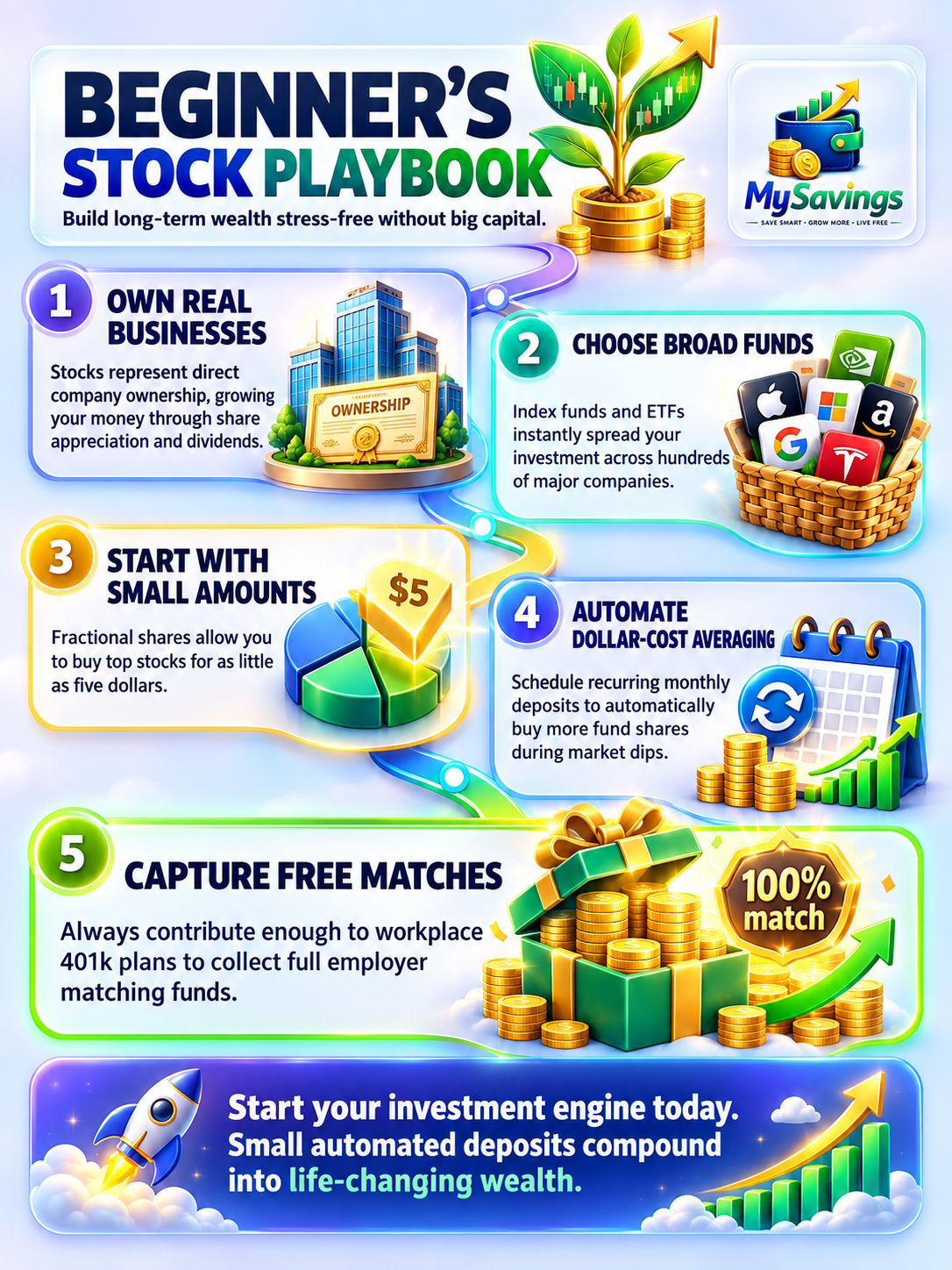
Some platforms also offer fractional shares, allowing investors to purchase a portion of an individual stock or other eligible investment instead of buying a complete share.
The important principle is consistency rather than trying to make a large investment immediately.
📈 The Power of Compound Growth
Compound growth occurs when investment earnings generate additional earnings over time. Instead of only earning returns on the original amount invested, future growth can also occur on previously accumulated returns.
⏳ This makes time an important part of long-term investing.
For example, regularly investing a modest amount for many years can potentially produce a significantly larger portfolio than investing the same total amount much later. Actual results depend on investment performance, fees, taxes, inflation, and market conditions, but the underlying principle remains important: time and consistency can support long-term wealth building.
Before investing, however, financial safety should come first.
🛡️ How Much Should a Beginner Invest?
There is no universal investment amount that works for everyone. The appropriate contribution depends on income, expenses, financial obligations, emergency savings, debt, goals, and risk tolerance.
💵 A practical starting point is to invest an amount that can be maintained consistently without interfering with essential expenses.
🏦 Build Financial Stability First
An emergency fund can help cover unexpected expenses without forcing an investor to sell investments during an unfavorable market period.
A beginner may therefore consider this order:
🔹 Establish an emergency fund.
🔹 Manage high-interest debt.
🔹 Determine short-term and long-term financial goals.
🔹 Decide how much disposable income can be invested regularly.
🔹 Increase contributions as income and financial stability improve.
The goal is not simply to invest as much as possible. The goal is to create a sustainable investing habit.
📊 What Are the Best Investments for Beginners?
Beginners have several investment options, each with different levels of risk, return potential, diversification, liquidity, and complexity.
1️⃣ ETFs and Index Funds
Exchange-traded funds, commonly called ETFs, and index funds can provide exposure to a diversified basket of assets through a single investment.
For example, an index fund may track a market index containing numerous companies rather than depending on the performance of one company.
📌 Many index funds are designed to track indexes such as the S&P 500 or other broad market benchmarks.
ETFs trade on exchanges during market hours, while traditional index mutual funds are generally bought and sold based on their end-of-day net asset value.
For beginners, diversified funds can be easier to manage than selecting numerous individual stocks.
2️⃣ Bonds
Bonds represent debt issued by governments, corporations, or other entities. Investors generally receive interest payments according to the terms of the bond.
🏛️ Bonds can play an important role in a diversified portfolio because their behavior can differ from stocks.
However, bonds are not completely risk-free. Credit risk, interest-rate risk, inflation, and changes in market value can affect investment outcomes.
Generally, bonds offer lower growth potential than stocks over long periods, but their role can be valuable for investors seeking income and diversification.
3️⃣ Mutual Funds
Mutual funds pool money from multiple investors and use that capital to purchase a collection of investments.
🧺 A single mutual fund can provide exposure to multiple stocks, bonds, or other assets.
Some mutual funds are actively managed, meaning professional managers select investments according to a defined strategy. Others are designed to track a particular index.
Beginners should pay attention to expenses, investment objectives, historical performance, and risk rather than choosing a fund based solely on recent returns.
4️⃣ REITs
Real estate investment trusts, or REITs, allow investors to gain exposure to income-producing real estate without directly purchasing a property.
🏢 REITs may own or finance properties such as apartments, offices, shopping centers, warehouses, or other real-estate assets.
Depending on the structure, REITs can provide potential income distributions and may offer greater liquidity than owning physical property directly.
However, REITs still carry market and property-related risks and should generally be considered as part of a diversified strategy rather than a complete portfolio.
📱 How to Choose an Investment Platform
The investment platform you choose can influence costs, convenience, available investments, and the overall investing experience.
💳 1. Compare Fees
Fees can reduce investment returns over time. Look for trading commissions, account fees, fund expenses, currency-conversion costs, withdrawal charges, and other applicable costs.
Even seemingly small recurring expenses can have a meaningful effect over a long investment period.
🧩 2. Look for Fractional Shares
Fractional investing allows investors to purchase portions of eligible investments.
This can make it easier to diversify when the price of a full share is relatively high.
🤖 3. Consider Automated Investing Tools
Some platforms provide automated investing or robo-advisor services that can build and manage diversified portfolios according to selected objectives and risk preferences.
Automation can also help maintain consistent contributions and reduce the temptation to make frequent emotional decisions.
🎓 4. Check Educational Resources
A beginner-friendly platform may provide tutorials, market explainers, calculators, research tools, and other educational resources.
Understanding what you are buying is more important than simply having access to a large number of investments.
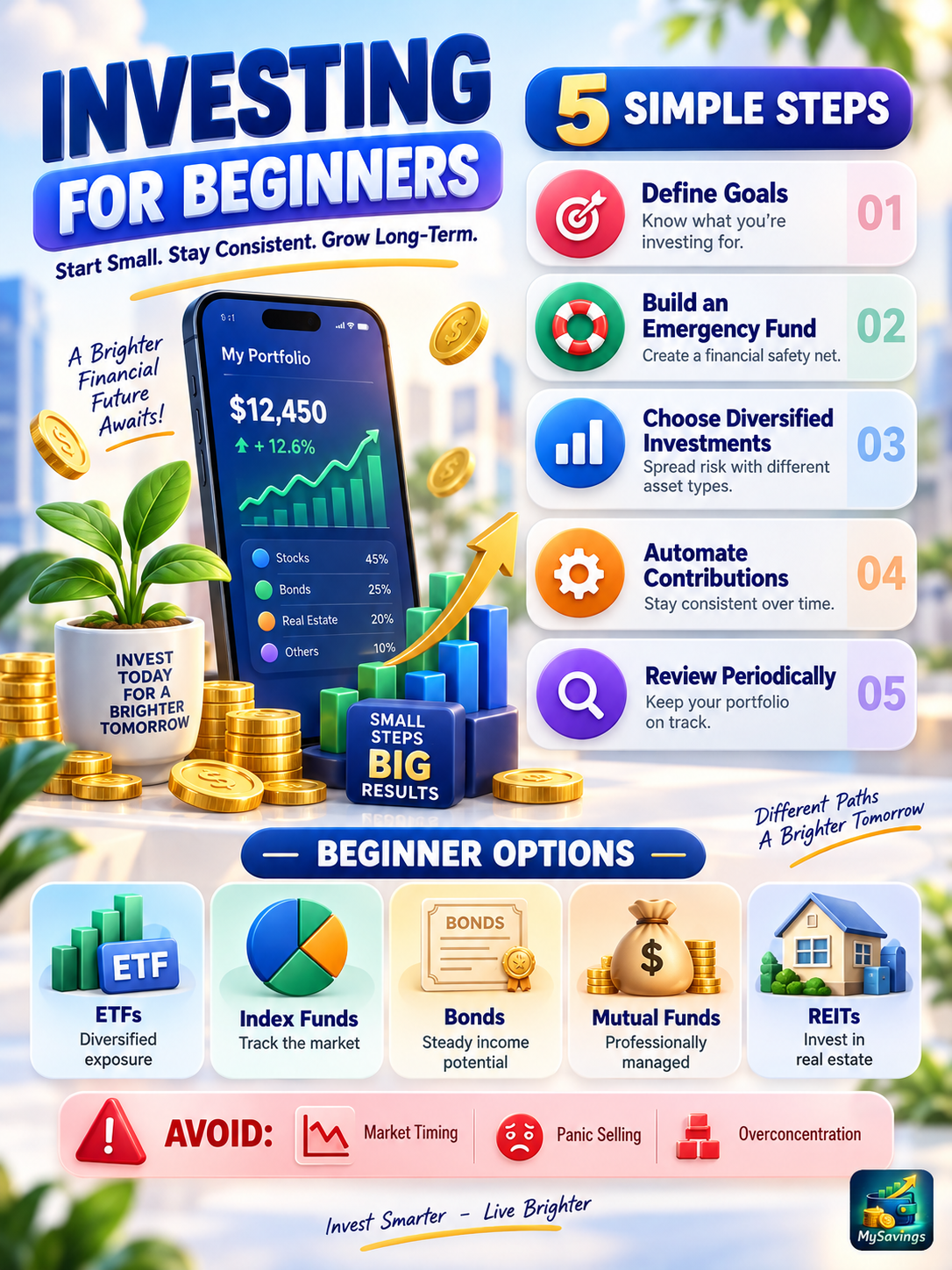
🚀 A Simple 5-Step Investing Process
Getting started becomes easier when investing is treated as a process rather than a single decision.
1. 🎯 Define Your Financial Goals
Determine what the money is intended for.
Possible objectives include retirement, purchasing a home, building long-term wealth, education, or another financial goal.
Your goal determines your investment time horizon and can influence how much risk may be appropriate.
2. 🛟 Build Your Safety Net
Before putting significant amounts into investments, establish an emergency fund suitable for your circumstances.
This provides a financial buffer for unexpected expenses.
3. 🧠 Choose Investments Based on Goals and Risk
Consider your time horizon and ability to tolerate market fluctuations.
A long-term investor may have a different asset allocation from someone who expects to need the money soon.
Diversification can help reduce dependence on the performance of a single asset, company, sector, or market.
4. ⚙️ Automate Contributions
Setting up automatic contributions can make investing more consistent.
Instead of deciding manually whether to invest every month, an automated contribution can transfer a predetermined amount according to the selected schedule.
Consistency can be particularly useful for long-term investing.
5. 🔎 Review Your Portfolio Periodically
Investing does not require constant monitoring.
Review your portfolio periodically to determine whether your investments still match your goals, risk tolerance, and desired asset allocation.
An annual or occasional review may be more useful than reacting to every daily market movement.
⚠️ Common Mistakes First-Time Investors Make
Understanding what not to do can be just as important as understanding what to buy.
📉 Trying to Time the Market
Attempting to consistently sell before market declines and buy before market increases is extremely difficult.
Short-term market movements are unpredictable, and frequent trading can increase costs and emotional decision-making.
A long-term investment strategy can help investors avoid making decisions based entirely on short-term market movements.
🎲 Buying Speculative Investments Without Research
A rapidly rising stock can attract attention, but price increases do not automatically mean an investment is suitable.
Before investing in an individual company, understand its business model, financial position, valuation, competitive environment, and associated risks.
😰 Panic Selling During Market Declines
Market downturns are part of investing.
Selling solely because prices have fallen can turn a temporary decline into a permanent loss.
However, staying invested does not mean ignoring risk. If an investment no longer matches the original financial objective or risk profile, reassessment may be appropriate.
🧱 Putting Everything Into One Investment
Concentrating an entire portfolio in one stock, industry, property type, or asset class creates concentration risk.
🌐 Diversification spreads exposure across multiple assets and can reduce the impact of poor performance from any single investment.
🕰️ Expecting Immediate Results
Investing is generally more effective when approached with a long-term perspective.
Beginners should avoid expecting every investment to rise quickly. Depending on the strategy, market conditions can produce periods of growth, decline, or limited movement.
🌟 How Beginners Can Build a Better Long-Term Strategy
A strong investing approach does not have to be complicated.
🧭 Keep the strategy simple: Understand each investment before adding it to your portfolio.
🛡️ Manage risk: Maintain an emergency fund and avoid investing money that may be needed immediately.
🌐 Diversify: Consider spreading investments across suitable asset classes rather than relying on one investment.
📅 Invest consistently: Regular contributions can help create a disciplined long-term habit.
🔍 Review periodically: Check whether your portfolio continues to match your goals and risk tolerance.
👨💼 Consider professional guidance: A qualified financial adviser may provide personalized guidance when financial circumstances or investment decisions become more complex.
💡 Final Takeaway
Starting to invest does not require predicting the next market winner or having a large amount of money.
The fundamentals are straightforward: define your goals, establish financial stability, choose suitable diversified investments, contribute consistently, control costs, and avoid emotional decisions.
For many beginners, ETFs, index funds, bonds, mutual funds, and REITs can provide different ways to build a diversified portfolio, depending on individual circumstances and risk tolerance.
The most important distinction is between investing with a plan and investing based on impulse. A disciplined approach gives your money more opportunity to work toward long-term financial objectives while keeping risk management at the center of the process.