💰 Family budgeting is not simply about cutting costs it is about building a spending system that works for changing household needs. This guide explains why family budgets differ from individual budgets, how to set practical spending benchmarks, and how to adapt categories for household size. It includes sample allocations for a family of four at $70,000, $100,000, and $150,000 annual income, showing how housing, groceries, transportation, childcare, healthcare, clothing, entertainment, savings, and buffers can shift as income rises. 🏡 You will also learn a seven-step budgeting process, from calculating true combined take-home pay to reviewing the plan each month. 🎯 Special attention is given to childcare costs, children’s activities, two-income households, college savings, and emergency funds. Finally, the guide explains how budgeting apps can support shared finances, goal tracking, custom categories, and cost comparisons while keeping the monthly plan realistic, adaptable, and effective over time.
Why Family Budgeting Is Different
Creating a household budget is more complicated than managing the finances of one person. A family budget has to account for multiple people, different financial priorities, changing expenses, and future goals.
An individual may be able to estimate monthly expenses with relatively little difficulty. A household, however, may have two incomes, children, childcare costs, school expenses, medical bills, transportation needs, and several competing savings goals.
A successful family budget therefore needs to be structured enough to provide financial control while remaining flexible enough to handle real-life changes.
🧩 Multiple decision-makers: Financial decisions may involve two partners or several adults, making communication and shared priorities essential.
🎈 Unpredictable child-related expenses: Children can create expenses that change throughout the year, from school requirements and activities to clothing and healthcare.
💵 Income complexity: Some households rely on two salaries, variable income, bonuses, freelance earnings, or seasonal work.
🔄 Life-stage transitions: Marriage, having children, changing jobs, moving homes, education, and retirement planning can all require a different household budget.
The goal is not to create a perfect budget that never changes. The goal is to establish a financial framework that can be reviewed and adjusted as circumstances evolve.
Family Budgeting Benchmarks: Where Should Household Income Go?
A useful starting point is to establish a monthly spending reference. Instead of assigning every dollar immediately, divide household take-home income among major categories.
Common family budget categories include:
🏠 Housing: Rent or mortgage, property-related costs, maintenance, and essential household expenses.
🛒 Food: Groceries, household food supplies, and dining expenses.
🚗 Transportation: Fuel, public transportation, insurance, maintenance, parking, and vehicle payments.
🎒 Childcare and school: Daycare, school fees, supplies, uniforms, educational activities, and related costs.
🩺 Healthcare: Insurance, prescriptions, appointments, dental care, and other medical expenses.
👕 Clothing: Clothing, footwear, seasonal purchases, and children’s replacement needs.
🎮 Entertainment: Recreation, subscriptions, outings, hobbies, and family activities.
🌱 Savings: Emergency savings, retirement contributions, education savings, and other financial goals.
The appropriate percentage for each category depends on household size, location, income, debt obligations, and family priorities. Percentages should therefore be treated as planning benchmarks rather than rigid rules.
Sample Family Budget for a Family of Four
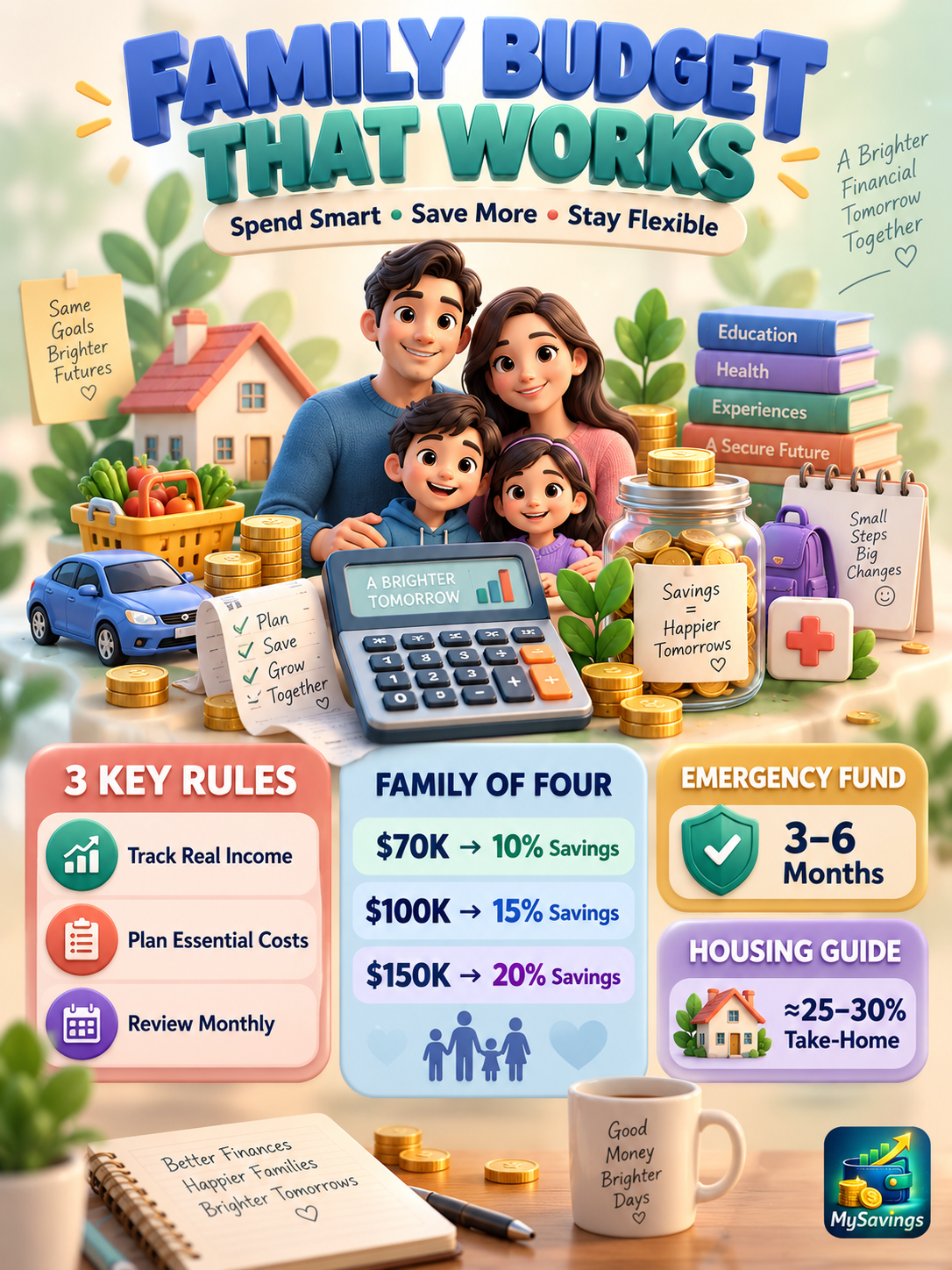
The mind map provides three illustrative household-income scenarios: $70,000, $100,000, and $150,000 in annual income. These examples demonstrate an important budgeting principle: higher income does not necessarily mean every category should increase at the same rate.
$70,000 Annual Income
The example assumes approximately $4,600 in monthly take-home income.
🏠 Housing — 26%
🛒 Groceries — 13%
🚗 Transportation — 14%
🎒 Childcare/school — 17%
💡 Utilities — 4%
🩺 Healthcare — 7%
👕 Clothing — 3%
🎬 Entertainment — 3%
🌱 Savings — 10%
🛟 Buffer — 2%
Here, housing and childcare represent significant portions of the household budget. Savings remain important, but the available flexibility is relatively limited.
$100,000 Annual Income
The example uses approximately $6,800 in monthly take-home income.
🏠 Housing — 25%
🛒 Groceries — 11%
🚗 Transportation — 12%
🎒 Childcare/school — 15%
💡 Utilities — 4%
🩺 Healthcare — 6%
👕 Clothing — 3%
🎬 Entertainment/dining — 4%
🌱 Savings — 15%
🛟 Buffer — 5%
The increased income allows the household to dedicate a larger percentage to savings and financial flexibility while keeping essential spending relatively controlled.
$150,000 Annual Income
The example assumes approximately $9,400 in monthly take-home income.
🏠 Housing — 23%
🛒 Groceries — 10%
🚗 Transportation — 10%
🎒 Childcare/school — 14%
💡 Utilities — 3%
🩺 Healthcare — 5%
👕 Clothing/kids — 3%
🎬 Entertainment/dining — 5%
🌱 Savings — 20%
🛟 Buffer — 7%
At this income level, the example allocates a much larger share toward savings and a financial buffer. This illustrates how income growth can be used to strengthen financial resilience rather than simply increasing lifestyle spending.
A Seven-Step Family Budgeting System
A reliable household budget becomes easier to manage when the process is consistent every month.
1. Calculate True Combined Take-Home Pay
Start with the amount actually available after taxes, insurance, retirement deductions, and other payroll deductions.
For households with variable income, use a conservative estimate rather than assuming the highest possible monthly earnings.
2. List Fixed Expenses
Separate predictable expenses from costs that fluctuate.
🏠 Rent or mortgage
📱 Utilities and recurring bills
🚘 Vehicle payments or transportation commitments
🎓 School or childcare payments
💳 Minimum debt payments
Fixed expenses establish the foundation of the household budget.
3. Estimate Variable Expenses
Review at least three months of spending when possible.
🛒 Grocery costs
⛽ Transportation
🩺 Medical spending
👕 Clothing
🍽️ Dining
🎯 Entertainment
Using historical averages can make estimates more realistic than relying on assumptions.
4. Identify Discretionary Spending
Not every expense has the same priority. Separate essential household costs from spending that can be reduced when necessary.
This distinction becomes particularly useful when income falls or an unexpected expense appears.
5. Set Savings Goals
Savings should be treated as a planned financial category rather than whatever remains at the end of the month.
🌱 Emergency savings
🏦 Retirement
🎓 College or education savings
✈️ Planned major purchases
🏠 Future housing goals
Assigning savings targets at the beginning of the month makes long-term financial goals easier to track.
6. Close the Budget Gap
If expenses exceed income, something needs to change.
✂️ Reduce discretionary categories.
🔎 Review recurring subscriptions and services.
📉 Renegotiate or eliminate unnecessary costs where possible.
💰 Increase savings gradually if income allows.
📈 Consider ways to increase household income when expense reductions are insufficient.
A balanced budget should reach zero without requiring every available dollar to be spent.
7. Review and Adjust Monthly
A family budget should be recalibrated regularly.
Compare planned spending with actual spending, identify unexpected categories, and update the next month’s allocation.
This monthly review transforms budgeting from a one-time exercise into an ongoing household financial system.
Family-Specific Challenges Generic Budgets Often Miss
Standard budgeting templates can overlook costs that become significant when children are involved.
The Childcare Cliff
Childcare can consume a substantial portion of household income, particularly during the early years. A budget should account for childcare changes rather than assuming the same cost indefinitely.
The Kids’ Activities Creep
Sports, music lessons, clubs, camps, school events, equipment, and extracurricular activities can gradually create a large annual expense.
Creating a dedicated children’s activities category can make these costs easier to control.
The Two-Income Trap
Two incomes can increase household financial capacity, but they can also encourage lifestyle inflation.
A stronger approach is to determine essential household spending first and then deliberately allocate additional income toward savings, debt reduction, investments, or defined goals.
College Savings
Education savings should be considered alongside other long-term financial priorities. The appropriate amount depends on household income, available resources, expected education costs, and existing savings.
Building a Family Emergency Fund
An emergency fund protects a household when unexpected expenses or income disruptions occur.
A useful long-term target is approximately three to six months of total family expenses, although the appropriate amount varies depending on income stability, debt, employment, insurance coverage, and household responsibilities.
Rather than trying to build the entire fund immediately, families can create it in stages.
🪙 Stage 1: Build a small initial emergency reserve.
📦 Stage 2: Work toward approximately one month of essential expenses.
🛡️ Stage 3: Continue building toward three months.
🏦 Stage 4: Consider extending the reserve toward six months when household circumstances justify a larger safety margin.
The emergency fund should be separate from money intended for predictable annual expenses.
For example, school fees, insurance premiums, holidays, property taxes, or annual memberships are predictable costs. These are better handled through sinking funds, where money is saved gradually before the bill arrives.
What Can Budgeting Apps Do for Families?
Technology can make shared household budgeting considerably easier.
👨👩👧👦 Multi-user sharing: Partners can access and update the same financial plan.
🗂️ Custom categories: Families can create categories specifically for childcare, school, children’s activities, or other household priorities.
🎯 Goal tracking: Progress toward emergency savings, education, travel, or major purchases can be monitored.
🏦 Bank synchronization: Some tools can automatically import transactions, reducing manual entry.
📊 Cost comparisons: Certain budgeting platforms can help compare expenses or identify opportunities to reduce recurring costs.
The most effective tool is not necessarily the one with the most features. It is the one that makes it easier for everyone responsible for household finances to understand spending and follow the plan consistently.
Practical Rules of Thumb for Family Budgeting
A few broad guidelines can help families establish an initial framework.
🏡 Housing: A household may consider targeting roughly 25–30% of take-home income for housing, depending on local costs and other obligations.
⚖️ 50/30/20: The traditional framework can provide a starting point, but families with children may need to adjust the percentages because childcare, education, healthcare, and other essential costs can be higher.
🔄 Adapt regularly: A budget should change when income, childcare, housing, debt, or family circumstances change.
💬 Budget together: Household budgeting works better when major financial priorities are discussed collectively rather than managed separately.
The Most Important Family Budgeting Principle
There is no universal percentage that works perfectly for every household.
A family earning $70,000 may need to devote considerably more of its available income to essential expenses than a family earning $150,000. Likewise, a household with young children may have very different priorities from one with teenagers or adult children.
The strongest family budget is therefore realistic, measurable, flexible, and connected to specific financial goals.
Start with actual take-home income. Track real spending. Separate fixed and variable costs. Give savings a defined place in the plan. Prepare for predictable annual expenses. Build an emergency fund. Then review the numbers every month.
A family budget does not need to eliminate every enjoyable expense. Its purpose is to ensure that everyday spending, family responsibilities, and long-term financial goals can work together within the household’s available resources.