💡 Tired of tracking every coffee, bill, and impulse purchase? The anti-budget method offers a simpler approach to saving money by prioritizing savings before discretionary spending. Instead of assigning every dollar to a category, you decide how much to save and invest on payday, automate transfers, cover fixed bills, and freely spend what remains. This guide explains how the anti-budget method works, how much to save, which accounts to use, and when the strategy may or may not fit your finances. You’ll also see a practical monthly-income example, key advantages and drawbacks, and comparisons with traditional, 50/30/20, zero-based, and “pay yourself first” budgeting. Whether you want less money-management friction or a more automatic savings plan, this framework can help create consistent habits while keeping the process straightforward, flexible, and easier to maintain over time. It also highlights safeguards for debt, emergencies, and irregular income, too.
What Is the Anti-Budget Method?
💡 The anti-budget method is a personal finance strategy designed for people who want to save and invest consistently without tracking every individual expense.
Instead of creating detailed spending categories for groceries, entertainment, clothing, dining, subscriptions, and other purchases, the method reverses the traditional budgeting process.
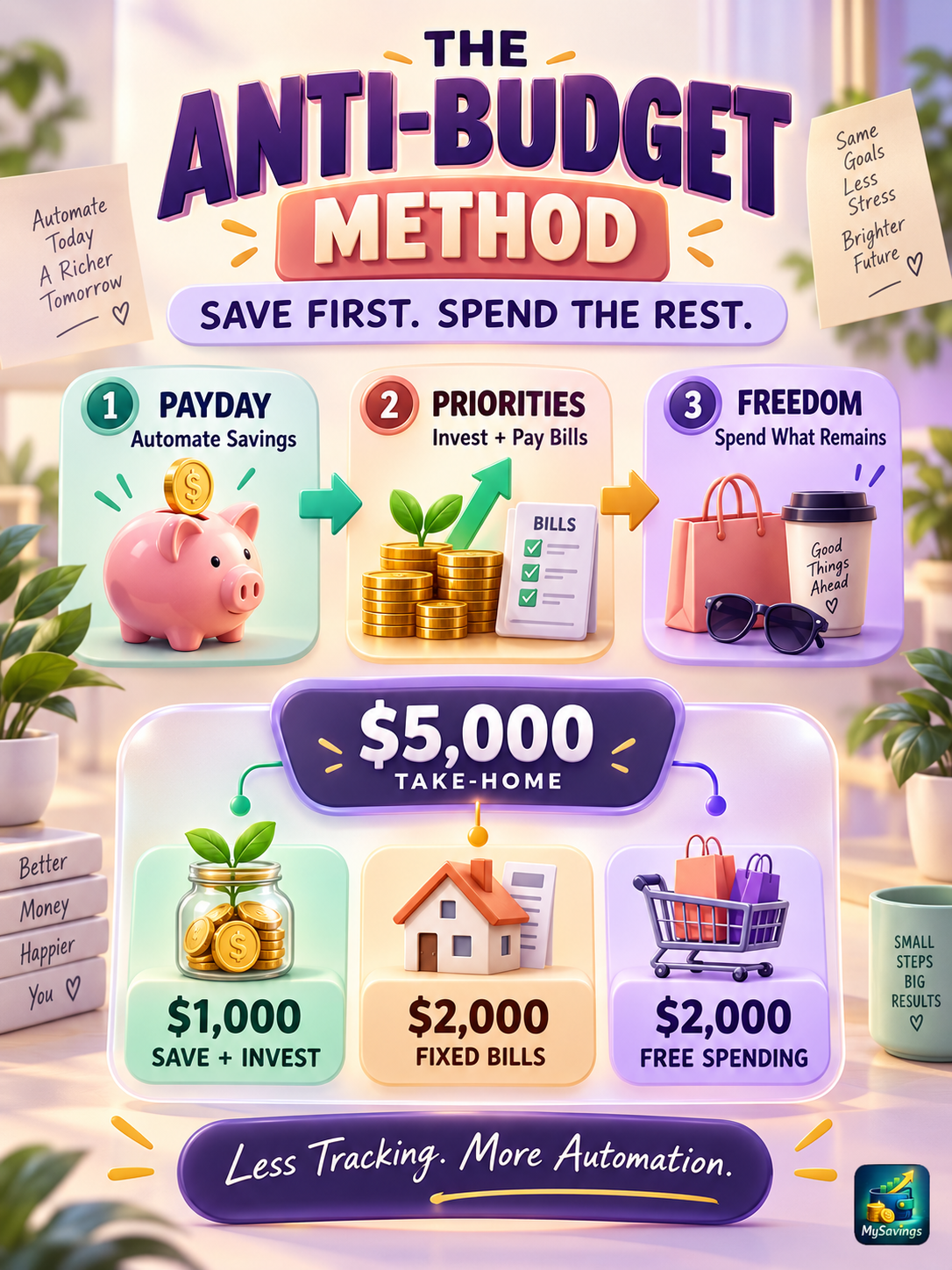
On payday, money is allocated to the most important financial priorities first. Savings and investments are automated, essential bills are covered, and the remaining money becomes available for everyday spending.
The basic principle is simple:
💰 Save first. Pay fixed expenses. Spend what remains.
This approach can make money management less dependent on daily decision-making. Once the automated transfers and essential payments are established, there is less need to record every purchase or constantly adjust spending categories.
However, the anti-budget is not a justification for unlimited spending. It works only when the amount saved, invested, and reserved for bills is realistic for the income available.
How Does the Anti-Budget Work on Payday?
The anti-budget method is primarily built around automation.
📌 1. Decide your savings rate
Choose a percentage or fixed amount of take-home pay to save. A common starting point is around 20%, although the appropriate amount depends on income, financial obligations, debt, emergency savings, and long-term goals.
📈 2. Automate savings
Move the selected amount into a dedicated savings account, such as a high-yield savings account where appropriate.
🌱 3. Automate investing
If your financial foundation is established, a separate amount can be directed toward an investment or retirement account, such as a workplace retirement plan or an individual investment account.
🧾 4. Pay fixed bills
Essential recurring expenses come next. These may include rent or mortgage payments, utilities, insurance, subscriptions, loan payments, and other predictable obligations.
🛍️ 5. Spend the remainder
After savings, investments, and fixed bills are accounted for, the remaining money can be used for flexible spending.
⏳ 6. Stop spending when the account reaches zero
If the designated spending balance runs out before the next payday, discretionary spending should pause rather than pulling money from savings or increasing debt.
This creates a natural spending boundary without requiring every transaction to be assigned to a category.
How to Set Up an Anti-Budget
Creating an anti-budget system requires more preparation than daily maintenance.
Choose the Right Accounts
🏦 A practical setup can include a dedicated savings account, an investment or retirement account, and a checking account for bills and discretionary spending.
Separating these purposes makes the system easier to understand. Savings intended for emergencies or short-term goals should not be confused with money available for everyday purchases.
Automate as Much as Possible
⚙️ Automation is the central feature of the anti-budget method.
Set recurring transfers for savings and investing around payday. Fixed bills can also be placed on automatic payment when appropriate, provided sufficient funds are maintained and payment dates are monitored.
The objective is to move important financial decisions from the end of the month to the beginning of the pay cycle.
Keep a Financial Buffer
🛟 Automation should not leave a checking account so tight that an unexpected bill immediately creates an overdraft or credit-card balance.
A cash buffer can provide additional flexibility for irregular expenses and timing differences between income and payments.
How Much Should You Save With the Anti-Budget Method?
There is no universal savings percentage that works for every household.
🎯 20% can be a useful starting point for someone building a savings habit.
📊 30% or more may be possible for households with strong cash flow and relatively low fixed expenses.
🏡 A lower percentage may be more realistic when housing, childcare, debt payments, or other essential expenses consume a large share of income.
The right savings rate should support financial progress without creating a system that repeatedly fails.
Questions to Consider Before Choosing a Rate
🔹 Are high-interest debts being addressed?
🔹 Is there an adequate emergency fund?
🔹 Are retirement contributions on track?
🔹 Are there short-term financial goals that require additional cash?
🔹 Can the chosen rate be maintained after unexpected expenses?
A sustainable savings rate is generally more useful than an aggressive target that cannot be maintained.
A Simple Monthly Example
Consider a household with $5,000 in monthly take-home pay.
💵 If 20% is allocated to savings and investing, that equals $1,000 per month.
🏦 The $1,000 could be divided between a savings account and long-term investing according to the household’s financial priorities.
🧾 If fixed bills total $2,000, those obligations are covered separately.
🛒 The remaining $2,000 becomes the flexible spending amount.
The structure therefore looks like this:
💰 Take-home pay: $5,000
🌱 Savings and investing: $1,000
🏠 Fixed bills: $2,000
🛍️ Flexible spending: $2,000
The exact percentages and dollar amounts should be adjusted to reflect individual circumstances rather than treated as universal rules.
Benefits of the Anti-Budget Method
Less Day-to-Day Tracking
✨ One of the biggest advantages is reduced administrative work. Instead of recording every purchase, the system focuses on whether the major financial priorities were funded.
Fewer Spending Decisions
🧠 Automation can reduce the number of decisions required throughout the month. Savings happen before discretionary spending becomes available.
Consistent Saving
📈 Regular automated transfers can help turn saving into a recurring financial behavior rather than something dependent on leftover money.
Easy to Automate
⚙️ Once the accounts and transfers are established, the system can require relatively little ongoing maintenance.
Greater Spending Flexibility
🎈 Unlike highly restrictive budgets, the anti-budget generally does not require every discretionary dollar to have a predetermined category.
Drawbacks and Limitations
The method is not appropriate for every financial situation.
⚠️ Limited visibility: People who need detailed spending information may find the lack of category tracking problematic.
💳 Debt concerns: Someone carrying substantial high-interest debt may need a more structured strategy that prioritizes debt repayment.
💵 Insufficient income: If income barely covers essential expenses, automatically transferring a large percentage to savings may create cash-flow problems.
🔍 Hidden spending patterns: Without transaction tracking, recurring overspending can be harder to identify.
🌦️ Variable income: Freelancers, commission-based workers, and others with irregular income may need a larger cash buffer and more active financial planning.
The anti-budget works best when there is enough predictable cash flow to fund savings, essential expenses, and discretionary spending simultaneously.
Who Is the Anti-Budget Best For?
👔 People with consistent salaries or predictable income may find the method particularly straightforward.
💪 Individuals who already have reasonable spending discipline can benefit from the flexibility without needing detailed categories.
📱 People who dislike maintaining spreadsheets or tracking individual transactions may prefer automated money management.
🛟 Households with an established emergency fund and manageable debt may also have greater flexibility to use this approach.
The method is less suitable for someone who frequently overspends when excess money is visible, has unstable income without an adequate cash reserve, or needs detailed visibility into where money is going.
Anti-Budget vs. Other Budgeting Methods
Anti-Budget vs. Pay Yourself First
Both methods prioritize saving before discretionary spending.
The difference is that the anti-budget emphasizes avoiding detailed expense tracking after savings and fixed bills are covered. It is essentially a streamlined version of prioritizing financial goals first.
Anti-Budget vs. Traditional Budgeting
📋 Traditional budgeting usually assigns spending limits to specific categories.
The anti-budget focuses more heavily on the amount saved and the obligations covered, leaving the remainder available for flexible spending.
Anti-Budget vs. 50/30/20
⚖️ The 50/30/20 framework generally divides after-tax income among needs, wants, and savings or debt repayment.
The anti-budget does not require every remaining dollar to follow those predefined categories. Its central focus is automating financial priorities before discretionary spending.
Anti-Budget vs. Zero-Based Budgeting
🧮 Zero-based budgeting assigns every dollar a specific purpose before the spending period begins.
The anti-budget is simpler: savings and essential obligations receive priority, while the remaining money can be spent without assigning each dollar a category.
How to Make the Anti-Budget More Effective
Review Your Savings Rate Regularly
📅 A savings rate should not remain unchanged forever. Review it periodically as income, expenses, debt, and financial goals change.
Separate Short-Term and Long-Term Money
🏦 Emergency savings and near-term goals generally require different planning from retirement or long-term investing.
Protect Against Lifestyle Creep
🚦 When income increases, automatically increasing savings or investing can prevent every raise from being absorbed by higher discretionary spending.
Monitor the Big Picture
🔎 The anti-budget reduces tracking; it does not eliminate financial awareness.
Review account balances, debt, savings progress, recurring subscriptions, and major expenses periodically to make sure the system remains sustainable.
When Should You Avoid an Anti-Budget?
🚨 A highly automated system may not be ideal when finances are already under significant pressure.
If high-interest debt is growing, bills are frequently missed, income fluctuates dramatically, or discretionary spending regularly exceeds available cash, a more detailed budgeting approach may provide better control.
Likewise, anyone who wants to understand exactly where money goes may benefit from traditional expense tracking alongside automated saving.
The Bottom Line
💡 The anti-budget method replaces detailed daily budgeting with a simple financial sequence: save and invest first, cover fixed bills, then spend the remainder.
Its biggest strength is simplicity. By automating savings and investing on payday, the method can make consistent financial progress less dependent on willpower or daily tracking.
However, simplicity should not come at the expense of financial visibility. Emergency savings, debt repayment, irregular expenses, and cash-flow needs still require attention.
For people with stable income, manageable obligations, and reasonable spending discipline, the anti-budget can be an effective way to automate saving while maintaining everyday spending flexibility.
Frequently Asked Questions
What is the anti-budget method?
💡 The anti-budget method is a budgeting strategy where savings and investments are funded first, fixed bills are paid, and the remaining money is available for discretionary spending.
Is the anti-budget better than traditional budgeting?
⚖️ Neither method is universally better. The anti-budget prioritizes simplicity and automation, while traditional budgeting provides greater visibility into individual spending categories.
How much should you save with an anti-budget?
🎯 Around 20% can be a starting point, but the appropriate savings rate depends on income, expenses, debt, emergency savings, and financial goals.
Can the anti-budget include investing?
📈 Yes. Automated investing can be included alongside automated savings, provided essential expenses and appropriate cash reserves are adequately funded.
Does the anti-budget require tracking expenses?
🧾 Detailed transaction-by-transaction tracking is not central to the method, although periodic reviews remain useful for identifying major changes or unwanted spending patterns.
Who should avoid the anti-budget?
🚨 People with significant high-interest debt, unstable income without sufficient reserves, recurring cash-flow problems, or poor spending control may need a more structured budgeting system.