💡 Investing does not have to be complicated, expensive, or reserved for financial experts. A simple, disciplined strategy can help beginners build wealth over time through consistent saving, diversified investments, and tax-efficient accounts. 📈 This guide explains the core principles of beginner investing from a financial independence perspective, including compound growth, low-cost index funds, asset allocation, dollar-cost averaging, and tax-advantaged accounts. 🏦 It also explores practical portfolio choices, including a simple one-fund approach and a flexible three-fund portfolio covering U.S. stocks, international stocks, and bonds. 🎯 Readers will learn how to avoid common investing mistakes, determine an FI target, automate contributions, and stay invested through market volatility. Whether starting with a modest monthly amount or building a larger portfolio, the focus is on creating sustainable investing habits rather than trying to predict the market or chase short-term returns.
How Can Beginners Start Investing and Build Long-Term Wealth?
Investing can appear intimidating when financial terminology, market fluctuations, investment accounts, and hundreds of fund choices enter the picture. But the fundamental principles are surprisingly straightforward.
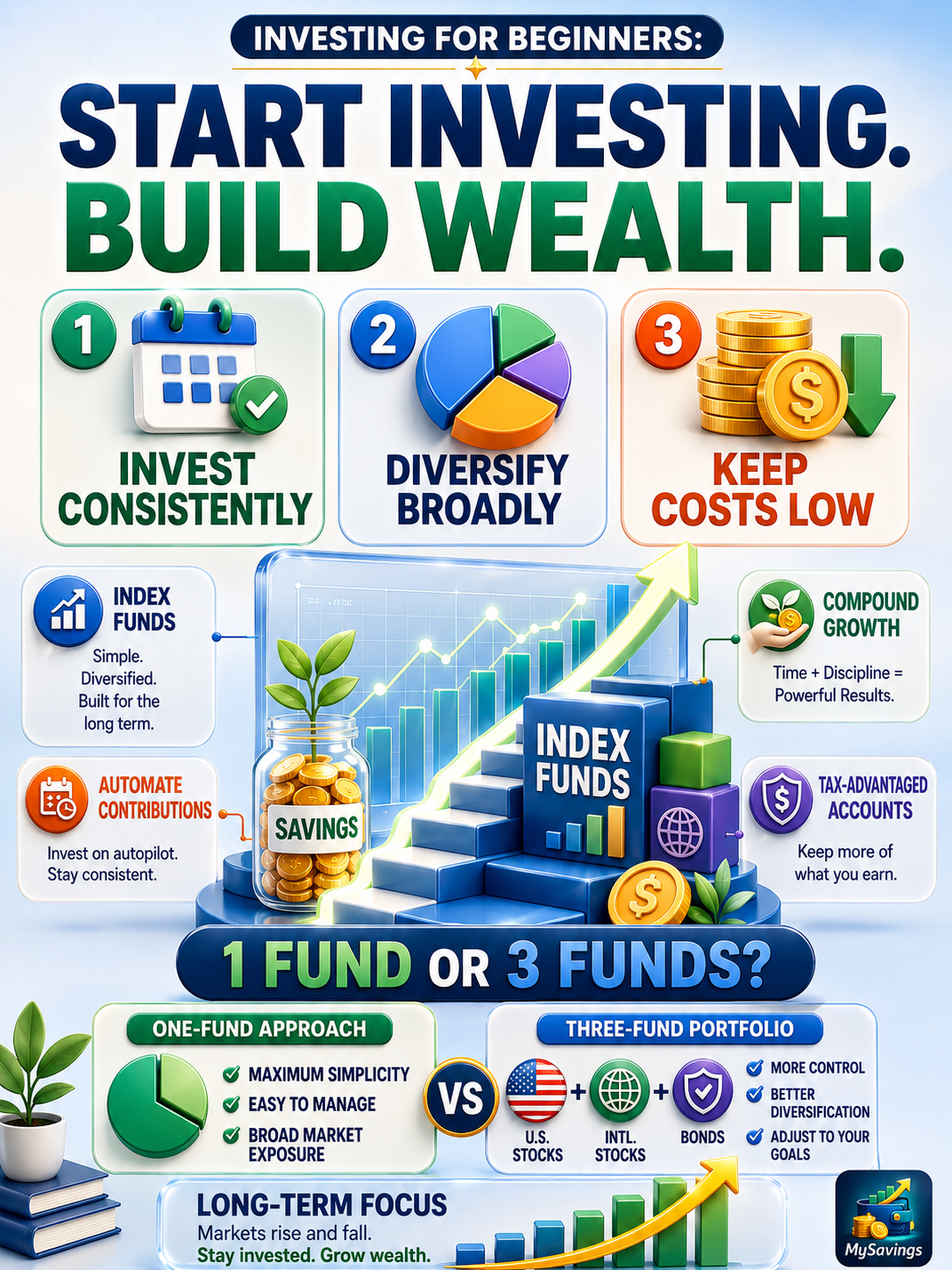
From a financial independence perspective, investing is less about finding the perfect stock and more about putting money to work consistently, keeping costs low, diversifying broadly, and allowing time to do the heavy lifting.
For beginners, the goal is not to become an expert overnight. The goal is to create a repeatable financial system that makes sensible investing easier.
This guide breaks down the essential concepts, investment choices, account types, common mistakes, and practical steps beginners can use to build long-term wealth.
🌱 The Core Idea Behind Beginner Investing
At its foundation, investing is about exchanging money today for the potential to have more financial resources in the future.
💡 The objective: Build assets that can grow and potentially generate income over many years.
You do not necessarily need to be exceptionally wealthy, highly skilled at analyzing companies, or capable of predicting the next market move.
Instead, successful long-term investing generally relies on several repeatable principles:
🔹 Start as early as practical.
🔹 Invest consistently.
🔹 Diversify across many assets.
🔹 Keep investment costs low.
🔹 Use tax-advantaged accounts when appropriate.
🔹 Avoid emotional decisions during market volatility.
🔹 Stay invested for the long term.
The financial independence approach emphasizes simplicity because an investment strategy that is easy to understand and maintain is often easier to follow consistently.
📈 Five Investing Concepts That Matter Most
1. Compound Growth
Compound growth is one of the most important concepts for long-term investors.
When an investment earns a return, those earnings can remain invested and potentially generate additional returns. Over long periods, this creates a compounding effect.
⏳ Time is the key ingredient.
For example, investing a fixed amount every month for several decades can produce a dramatically different result than waiting until later and attempting to invest a much larger amount.
The exact outcome depends on contributions, investment returns, fees, taxes, and market conditions. There are no guaranteed investment returns, but time gives compounding more opportunity to work.
2. Low-Cost Index Funds
Instead of attempting to identify individual stocks that will outperform the market, beginners can consider broadly diversified index funds.
An index fund generally seeks to track a market index rather than actively select investments in an attempt to beat it.
🌎 A total-market index fund can provide exposure to a large number of companies through a single investment.
💰 Lower fund expenses can also help preserve more of an investor’s return over time.
Examples of well-known total-market funds include VTSAX, FSKAX, and SWTSX, although investors should compare expense ratios, availability, tax considerations, and account compatibility before selecting any fund.
The central concept is more important than the ticker: broad diversification plus low costs can create a simple foundation for long-term investing.
3. Asset Allocation
Asset allocation describes how an investment portfolio is divided among different asset categories, such as stocks and bonds.
📊 Stocks generally provide greater long-term growth potential but can experience significant short-term declines.
🛡️ Bonds can provide diversification and may reduce portfolio volatility, although they also carry risks and can lose value.
A common rule of thumb sometimes uses 110 minus your age to estimate a potential stock allocation. However, this is only a starting framework, not a universal formula.
Your time horizon, financial goals, risk tolerance, income stability, and ability to withstand market declines should all be considered.
4. Tax-Advantaged Accounts
Taxes can significantly affect long-term investment results, making account selection an important part of financial planning.
🏦 A workplace 401(k) may offer tax advantages and, when available, an employer match.
🩺 An HSA can provide significant tax advantages for eligible individuals when used according to applicable rules.
🌱 A Roth IRA allows eligible contributions to potentially grow tax-free, with qualified withdrawals generally receiving favorable tax treatment.
The exact contribution limits, eligibility requirements, and tax rules can change. Investors should check current rules and consider professional tax advice when necessary.
5. Dollar-Cost Averaging
Dollar-cost averaging involves investing a predetermined amount at regular intervals rather than trying to identify the perfect moment to invest.
📅 For example, an investor could automatically contribute a fixed amount every month.
This approach can reduce the temptation to constantly predict market highs and lows.
It also creates a routine: earn → save → invest → repeat.
Dollar-cost averaging does not eliminate investment risk or guarantee a profit. Its primary advantage for many beginners is behavioral consistency.
🛒 What Should Beginners Actually Buy?
Once the basic principles are understood, the next question is often: What investments should I purchase?
For a long-term investor, a diversified index-fund strategy can be considerably simpler than selecting individual stocks.
One-Fund Approach
🟢 One broad-market fund can provide an extremely simple portfolio structure.
A total U.S. stock market index fund, for example, can provide exposure to companies across different industries and company sizes.
However, a single U.S. stock fund does not provide complete global diversification or necessarily match every investor’s risk profile.
Three-Fund Portfolio
🔵 U.S. stocks provide exposure to American companies.
🟣 International stocks provide exposure to companies outside the United States.
🟠 Bonds can provide additional diversification and may help manage portfolio volatility.
A traditional three-fund structure can therefore provide broader diversification while allowing investors to control the relative allocation between stocks and bonds.
The exact percentages should reflect the investor’s circumstances rather than following a rigid formula. A portfolio might use a higher stock allocation for a long time horizon or a greater bond allocation when stability becomes more important.
⚖️ One Fund vs. Three Funds
Both approaches can work within a disciplined long-term investing strategy.
One-Fund Strategy
🟢 Maximum simplicity
🟢 Easier portfolio maintenance
🟢 Less need for rebalancing
Three-Fund Strategy
🔵 Greater control over U.S., international, and bond exposure
🔵 More flexibility in adjusting asset allocation
🔵 Slightly more portfolio management
The better approach is often the one an investor understands and can maintain consistently.
Complexity does not automatically produce better investment results.
🚫 Biggest Mistakes Beginners Make
Many investing problems are behavioral rather than technical.
Chasing Individual Stocks
🎯 Buying individual companies can create concentration risk and requires substantially more research than owning a diversified index fund.
Paying Excessive Fees
💸 A seemingly small annual fee can reduce long-term wealth because the cost compounds over time.
For example, a fund charging 1% annually costs substantially more than one charging 0.03%, assuming comparable investment exposure. The actual impact depends on investment performance, account size, and time.
Waiting for the “Perfect” Time
⏰ Markets are unpredictable. Waiting indefinitely for the ideal entry point can prevent investors from participating in long-term market growth.
Panic Selling
📉 Market declines are a normal feature of investing. Selling solely because prices have fallen can turn temporary market declines into permanent losses.
Overcomplicating the Portfolio
🧩 Owning numerous accounts, funds, strategies, and financial products does not necessarily improve diversification.
A smaller number of well-understood investments may be easier to manage.
🧭 The Financial Independence Framework
Financial independence, often abbreviated as FI, focuses on accumulating enough assets to support future living expenses without relying entirely on employment income.
One commonly used framework begins with annual spending.
Estimating an FI Number
🎯 A simplified calculation is:
FI Number = Annual Spending ÷ Target Withdrawal Rate
For example, someone spending $50,000 per year and using a 4% withdrawal-rate assumption would arrive at a theoretical target of approximately $1.25 million.
This is a planning framework, not a guarantee.
Withdrawal strategies should consider portfolio composition, taxes, inflation, market conditions, longevity, and spending flexibility.
The broader lesson is important: reducing unnecessary spending and increasing the amount available for investment can accelerate progress toward financial independence.
💵 Why Savings Rate Matters
Investment returns receive considerable attention, but the amount saved and invested can be equally important, especially during the early stages of wealth building.
📌 Earning more can increase the amount available to invest.
📌 Spending less can increase the savings rate.
📌 Investing the difference gives those savings an opportunity to compound.
This creates a powerful cycle:
Income → Savings → Investments → Growth → Greater Financial Flexibility
The focus should be on controlling the factors that can reasonably be controlled rather than attempting to predict every market movement.
🚀 Practical Steps to Start Investing
Getting started does not require a complicated financial system.
Step 1: Choose a Broad, Low-Cost Investment
🔎 Research diversified index funds and compare costs, diversification, tax considerations, and investment objectives.
Step 2: Open the Appropriate Account
🏦 Depending on eligibility and circumstances, this could include a workplace 401(k), IRA, Roth IRA, HSA, or taxable brokerage account.
Step 3: Automate Contributions
⚙️ Set up recurring contributions so investing happens automatically rather than depending on monthly motivation.
Step 4: Build the Habit
📆 Even a modest recurring contribution can establish the behavior of investing consistently.
Starting with $50 per month is not about the size of the first contribution. It is about creating a system that can potentially increase as income grows.
Step 5: Stay Invested Through Volatility
🌊 Markets will rise and fall. A long-term plan should account for periods of uncertainty rather than assuming prices will continuously increase.
🏆 Pros and Cons of a Simple Index-Investing Approach
Pros
🟢 Broad diversification
🟢 Low ongoing costs
🟢 Simple portfolio management
🟢 Easy automation
🟢 Reduced dependence on individual stock selection
🟢 Potential tax efficiency depending on account and fund structure
Cons
🟠 Market values can decline substantially.
🟠 Withdrawals from certain accounts may be restricted or taxable.
🟠 Investors generally accept market-average performance rather than attempting to outperform the market.
🟠 Diversification does not eliminate investment risk.
The objective is not to remove risk completely. Instead, it is to take an appropriate level of risk for a specific long-term financial goal.
❓ Frequently Asked Questions About Beginner Investing
Is investing safe for beginners?
Investing always involves risk. Diversified funds can spread risk across many securities, but investment values can still decline. Beginners should understand their time horizon and risk tolerance before investing.
How much money should a beginner start investing with?
There is no universal minimum amount. A modest recurring contribution can be a practical starting point, provided essential expenses and high-priority financial obligations are addressed.
Should beginners buy individual stocks?
Individual stocks can carry higher concentration risk. Broadly diversified index funds can offer a simpler starting point for investors seeking long-term market exposure.
Is a stock index fund better than individual stocks?
Neither is automatically better for every investor, but an index fund can provide diversification across many companies while reducing reliance on the performance of a single business.
Should I pay off debt before investing?
The answer depends on the interest rate, debt type, employer retirement match, emergency savings, and overall financial situation. High-interest debt often deserves significant priority.
Is a Roth IRA better than a brokerage account?
They serve different purposes. A Roth IRA offers specific tax advantages but has eligibility and contribution rules, while a taxable brokerage account generally provides greater flexibility but does not receive the same tax treatment.
Can investors lose money in index funds?
Yes. Index funds fluctuate with the markets they track and can lose value, particularly over shorter periods.
What is the simplest portfolio for a beginner?
A diversified one-fund portfolio can be one of the simplest approaches. A three-fund portfolio can provide greater control over U.S. stocks, international stocks, and bonds.
How often should an investment portfolio be checked?
Long-term investors generally do not need to monitor market prices constantly. Reviewing the portfolio periodically and rebalancing when appropriate can be more useful than reacting to daily market movements.
What is dollar-cost averaging?
Dollar-cost averaging means investing a predetermined amount at regular intervals regardless of short-term market movements.
How does compound growth build wealth?
Investment earnings can remain invested and potentially generate additional earnings. Over long periods, this compounding effect can significantly increase the value of consistent contributions.
What is an FI number?
An FI number is an estimated portfolio value intended to support financial independence. A simplified calculation divides annual spending by a chosen withdrawal-rate assumption.
🌟 The Bottom Line
Beginner investing does not require constant market predictions, complicated strategies, or an extensive collection of financial products.
The essential framework is relatively simple: save consistently, invest broadly, keep costs low, use appropriate tax-advantaged accounts, diversify, automate contributions, and maintain a long-term perspective.
Financial independence is also less about discovering one perfect investment and more about building a sustainable relationship between income, spending, saving, and investing.
For many beginners, the most valuable first step is not finding a winning stock. It is creating an investment system that can continue working through market highs, market declines, changing headlines, and different stages of life.