In the fast-paced world of modern commerce, many entrepreneurs and business owners fall into the “Top-Line Trap”—equating rising revenue with genuine financial success. However, as this comprehensive guide explores, high sales figures can often mask a deteriorating business model. This article breaks down the fundamental distinctions between revenue and earnings, illustrating why market share and customer demand are only half of the equation. We delve into the dangers of “busy work” fueled by heavy discounting and inefficient operations, contrasting it with the wealth-generating power of healthy profit margins. By prioritizing earnings, businesses can fund their own growth, survive economic downturns, and build long-term value. Whether you are analyzing a local startup in Trincomalee or a global enterprise, understanding these core financial metrics is essential for moving beyond the “treadmill” of high-volume, low-reward activity and toward a future of compounding, sustainable profitability and true institutional wealth.
The Great Financial Illusion: Why Growth Isn’t Always Progress
In the landscape of personal and corporate finance, there is a seductive metric that often leads even seasoned professionals astray: Revenue. It is the “top line,” the grand total, and the number most frequently celebrated in quarterly meetings. Yet, a fundamental truth remains: it is entirely possible to grow your revenue while simultaneously getting poorer.
Understanding the nuance between Revenue and Earnings is not merely an accounting exercise; it is a survival skill. Many businesses chase the wrong figures, celebrating the achievement of massive sales targets while the underlying structural integrity of the business weakens. To build lasting wealth, one must look past the surface-level activity and evaluate the efficiency of the wealth-creation engine itself.
Deconstructing Revenue: The Pulse of Market Demand
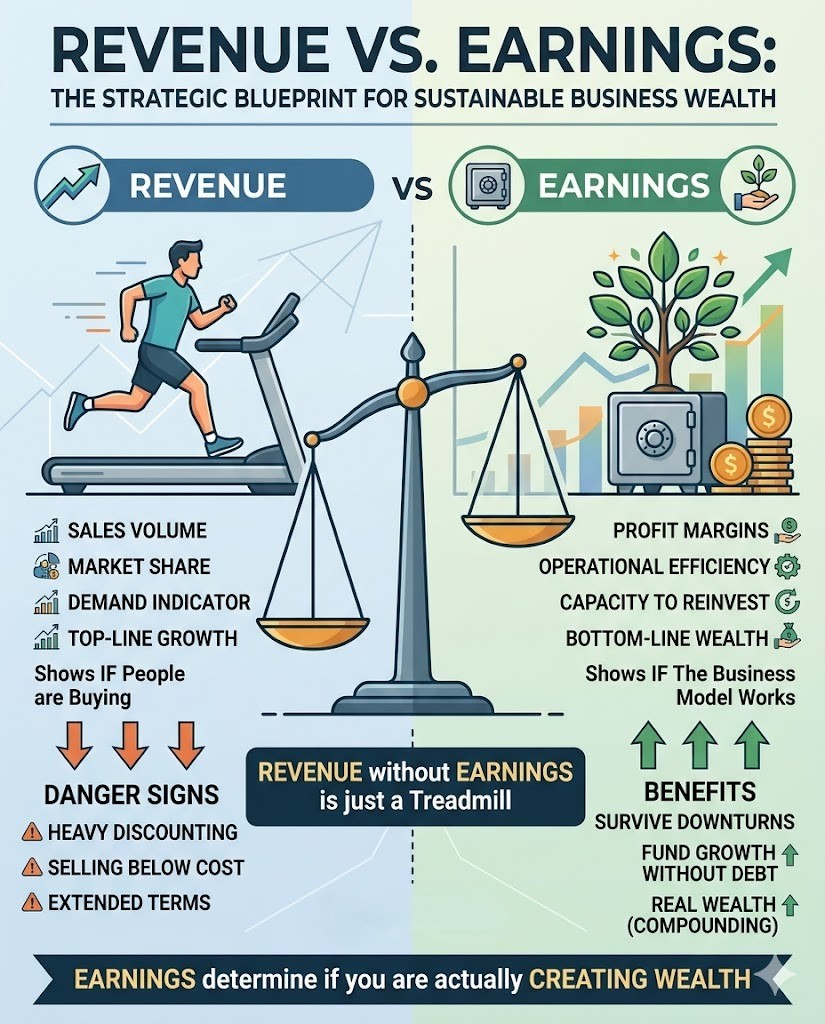
Revenue serves as the primary indicator of a business’s “velocity.” It tells a specific story about how the market perceives a product or service. When revenue is climbing, it provides several key insights:
- Market Share and Reach: High revenue suggests a dominant position within a sector or a successful expansion into new geographic or digital territories.
- Customer Validation: It proves that there is an active demand for what is being sold. People are opening their wallets, which confirms a “product-market fit.”
- Sales Effectiveness: It acts as a report card for the sales and marketing teams, indicating their ability to convert interest into transactions.
However, revenue is a “vanity metric” when viewed in isolation. It can be dangerously inflated by short-term tactics that compromise long-term health. For instance, heavy discounting to hit monthly targets might spike revenue, but if the product is sold below cost, every sale actually drains the company’s reserves. Similarly, extended payment terms might show high sales on paper, but if the cash isn’t in the bank to pay suppliers, the business remains at risk.
The Power of Earnings: The Metric of True Worth
If revenue is the pulse, Earnings (or Net Income) is the health of the vital organs. Earnings represent what is left after every expense—materials, labor, taxes, and overhead—has been deducted. This is the “bottom line,” and it is the only number that determines if a business model actually works.
Earnings provide the clarity required to answer the most important question in finance: Is this sustainable? Profitability shows:
- Pricing Integrity: Whether the price point accurately reflects the value provided while covering the real costs of production.
- Operational Efficiency: How well a company manages its resources. High earnings relative to revenue suggest a streamlined, well-oiled machine.
- Reinvestment Capacity: The ability to fund research, development, and expansion without relying on high-interest external debt.
The Revenue Treadmill vs. The Wealth Engine
A business with high revenue but zero earnings is effectively on a treadmill. The owner and employees are moving at a frantic pace, managing high volumes of customers and logistics, yet they are going nowhere. They are “working for free” because the top-line numbers cannot be used to pay for the future; only retained profits can do that.
Conversely, focusing solely on earnings while revenue shrinks is equally hazardous. A highly profitable but shrinking company is a “harvest” play—it is efficient but lacks a future. The goal of any robust financial strategy, particularly within the MySavings philosophy, is to achieve a balance: using revenue to capture the market and earnings to capture wealth.
Strategic Valuation and Long-Term Stability
When investors or professional buyers evaluate a company, they use revenue to understand its market position, but they value the acquisition based on earnings. A business is worth a multiple of its profit, not its sales. This is because real wealth comes from the compounding of retained profits over time.
Furthermore, profitable businesses are naturally resilient. During economic downturns or shifts in local market conditions—whether in the Eastern Province or a global financial hub—companies with healthy earnings buffers can survive price wars and supply chain disruptions that would bankrupt a low-margin, high-revenue competitor.
Moving Toward Sound Financial Models
To transition from “keeping busy” to “building wealth,” leadership must pivot focus toward the bottom line. This requires the discipline to walk away from low-margin contracts and the insight to optimize internal costs. In the end, revenue without earnings is just noise. Earnings are the signal that you are creating a legacy of value.